
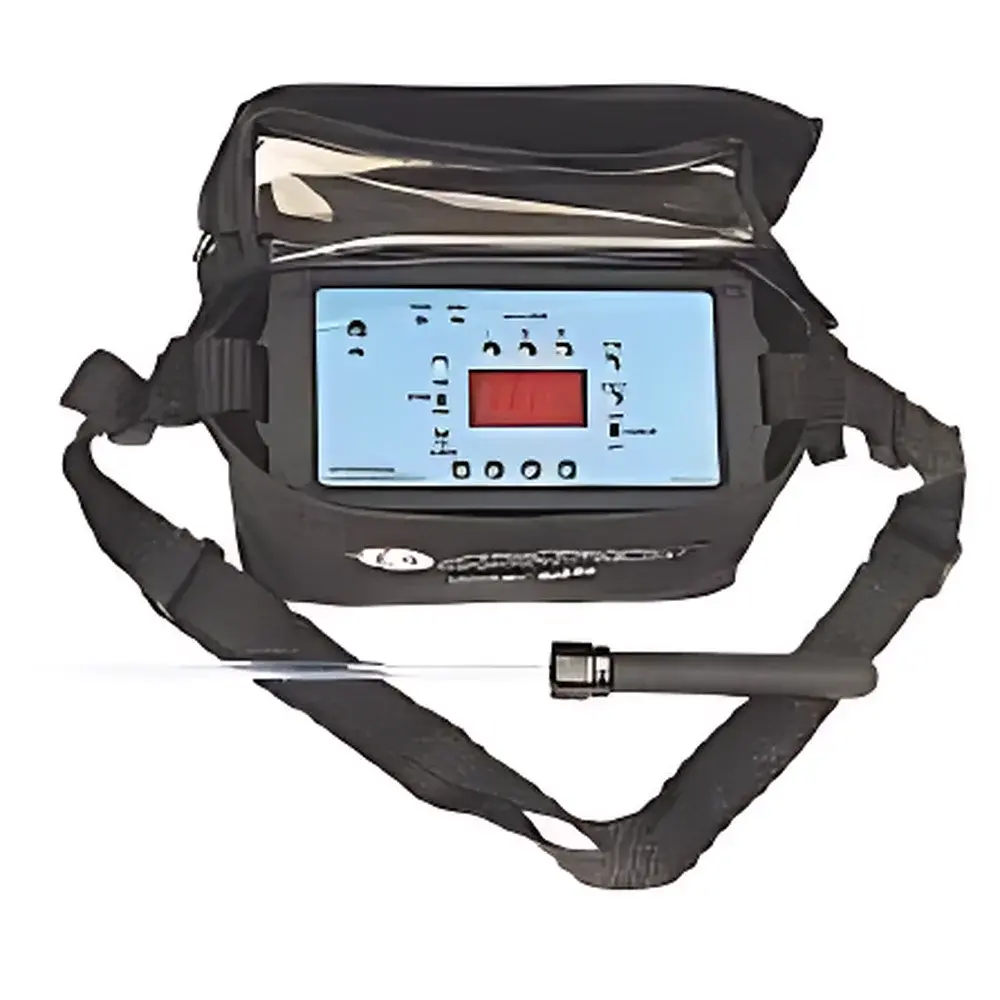
IQ-350 Portable Single-Gas Detector
| Origin | USA |
|---|---|
| Manufacturer Type | Authorized Distributor |
| Origin Category | Imported |
| Model | IQ-350 |
| Pricing | Available Upon Request |
| Power Supply | 4×C alkaline batteries, optional NiCd rechargeable battery or AC adapter/charger |
| Battery Life | 20 hrs (alkaline), 12 hrs (NiCd) |
| Sensor Options | Solid-state, electrochemical, IR, PID |
| Gas Selection | User-configurable from >150 toxic, combustible, or volatile organic compounds |
| Resolution | 0.01 ppm (0–10 ppm), 0.1 ppm (10–100 ppm), 1 ppm (100–1000 ppm) |
| Accuracy | ±5% of reading |
| Sampling Method | Integrated diaphragm pump with 1.2 m sampling tube |
| Display | 3-digit LED |
| Alarm | Dual adjustable threshold (low/high), visual & audible |
| Operating Temperature | –20 °C to +50 °C |
| Storage Temperature | –20 °C to +60 °C |
| Humidity Range | 0–99% RH (non-condensing) |
| Enclosure | Anodized aluminum housing |
| Dimensions | 181.1 × 85.9 × 101.6 mm |
| Weight | 1.14 kg (incl. batteries) |
| Standard Accessories | Host unit, sampling probe, alkaline batteries, 110 VAC adapter/charger, operator manual, calibration certificate, washable carry case |
| Optional Accessories | NiCd rechargeable battery pack, 110/220 VAC universal converter |
Overview
The IQ-350 Portable Single-Gas Detector is an engineered field instrument designed for rapid, reliable, and repeatable detection of a single target gas from a library of over 150 analytes—including formaldehyde, carbon monoxide, hydrogen sulfide, chlorine, ammonia, methane, and volatile organic compounds (VOCs). Built on modular sensor architecture, the device supports interchangeable detection technologies: electrochemical (EC) for low-concentration toxic gases (e.g., HCN, Cl₂, SO₂), non-dispersive infrared (NDIR) for CO₂, hydrocarbons, and refrigerants, photoionization detection (PID) for broad-spectrum VOCs (e.g., benzene, toluene, xylene), and solid-state metal-oxide semiconductor (MOS) sensors for combustible gases and reducing agents. Its core measurement principle varies by sensor type—electrochemical cells generate current proportional to gas concentration via redox reactions; NDIR sensors quantify absorption at characteristic wavelengths; PID detectors ionize molecules using 10.6 eV UV light and measure resulting photocurrent. This flexibility enables precise application alignment across industrial hygiene, confined space entry, hazardous materials response, environmental remediation, and laboratory safety protocols.
Key Features
- Modular sensor platform supporting user-selectable electrochemical, IR, PID, or solid-state detection modules—each factory-calibrated and pre-installed for immediate deployment.
- Integrated diaphragm sampling pump with 1.2-meter reinforced PTFE sampling tube, enabling remote monitoring in ducts, manholes, tanks, or behind walls without physical instrument exposure.
- Dual independent alarm thresholds (low and high), fully programmable via front-panel controls to meet OSHA, ACGIH TLV®, or site-specific exposure limits (e.g., formaldehyde STEL = 0.1 ppm).
- Rugged anodized aluminum enclosure rated IP65 for dust and water resistance, compliant with MIL-STD-810G for shock, vibration, and thermal cycling durability.
- Three-digit LED display with automatic range scaling and real-time concentration readout in ppm, %LEL, or % by volume—contextually optimized per selected gas and sensor type.
- Low-voltage and sensor-fault diagnostics: continuous audible/visual alerts accompany battery depletion or sensor degradation, while “ACTIVE” LED extinction signals end-of-life or calibration drift.
- Washable, chemical-resistant carrying case facilitates decontamination after exposure to corrosive or particulate-laden environments—critical for emergency response and cleanroom applications.
Sample Compatibility & Compliance
The IQ-350 accommodates gas-specific configurations validated against international reference standards. Electrochemical sensors conform to EN 45544-1 for personal gas monitors; NDIR modules comply with ISO 8573-1 for compressed air purity verification; PID units meet IEC 60079-29-1 for intrinsic safety in explosive atmospheres (Class I, Division 1, Groups B–D). All factory calibrations are traceable to NIST-certified standards, and full calibration certificates include uncertainty budgets per ISO/IEC 17025 requirements. The instrument supports GLP-compliant operation through documented calibration intervals, user-accessible zero/span logs, and tamper-evident calibration seals. While not FDA 21 CFR Part 11–certified as a standalone system, its audit trail functionality—including timestamped alarm events, battery status history, and sensor activation records—supports GMP-aligned data integrity frameworks when integrated into validated workflows.
Software & Data Management
Data logging is performed internally with non-volatile memory retaining up to 1,000 time-stamped readings (date/time, concentration, alarm status, battery level). Readouts export via RS-232 serial interface to third-party software (e.g., Excel, LabVIEW, or enterprise EHS platforms) using ASCII protocol. No proprietary cloud service or mobile app is embedded—ensuring data sovereignty and compatibility with air-gapped or classified networks. Firmware updates are delivered via secure USB-to-serial adapter and require physical access, aligning with ITAR and NIST SP 800-171 cybersecurity guidelines for defense-related environmental monitoring. Calibration adjustments are password-protected and logged with operator ID and timestamp, satisfying internal QA/QC documentation requirements for ISO 9001-certified laboratories.
Applications
- Occupational health monitoring: Real-time assessment of worker exposure to formaldehyde in pathology labs, H₂S in wastewater treatment plants, or CO in boiler rooms—supporting compliance with OSHA 29 CFR 1910.1200 (HazCom) and 1910.134 (respiratory protection).
- Hazardous materials incident response: Rapid identification of chlorine leaks in chemical storage facilities, ammonia releases in refrigeration systems, or VOC plumes during spill containment—enabling dynamic risk zone demarcation.
- Indoor air quality (IAQ) surveys: Quantification of formaldehyde emissions from composite wood products (per ASTM D6007), benzene from attached garages, or CO from malfunctioning HVAC combustion appliances.
- Process safety management (PSM): Pre-entry verification of inert atmospheres in reactors, residual solvent detection in pharmaceutical cleanrooms (per USP ), and leak screening in semiconductor fab tool cabinets.
- Environmental site assessment: Screening for chlorinated solvents (e.g., TCE, PCE) in soil vapor probes, landfill gas composition (CH₄/C₂H₆), or fenceline monitoring of refinery emissions.
FAQ
What sensor technologies are supported, and how do I select the appropriate one for my target gas?
Electrochemical sensors are optimal for sub-ppm detection of toxic gases (e.g., H₂S, CO, Cl₂); NDIR excels for CO₂, CH₄, and saturated hydrocarbons; PID provides broad VOC sensitivity (e.g., benzene, acetone) but lacks compound specificity; solid-state sensors suit combustible gas screening where cost and longevity outweigh precision.
Is the IQ-350 intrinsically safe for use in Class I, Division 1 environments?
When equipped with certified EC or IR sensors and operated with approved NiCd batteries or isolated AC power, the IQ-350 meets UL 913 and CSA C22.2 No. 152 for Class I, Division 1, Groups B–D. PID configurations require additional barrier certification and are not inherently rated for such zones without external isolation.
How often must the instrument be calibrated, and what documentation accompanies calibration?
Initial calibration is performed pre-shipment with NIST-traceable gas standards. Field calibration is recommended before each day’s use (bump test) and full span calibration every 30 days or after exposure to sensor-poisoning compounds (e.g., silicones, H₂S for EC cells). Each calibration certificate includes gas lot number, cylinder pressure, flow rate, ambient conditions, and expanded uncertainty at k=2.
Can the IQ-350 detect formaldehyde specifically—and what is its lowest measurable concentration?
Yes. With a dedicated electrochemical formaldehyde sensor, the IQ-350 achieves a resolution of 0.01 ppm in the 0–10 ppm range and is validated per ISO 16000-3 for indoor air sampling. Detection limit is 0.03 ppm (3σ), suitable for verifying compliance with WHO IAQ guidelines (0.1 ppm 30-min average) and California Air Resources Board (CARB) ATCM standards.
Does the device support multi-gas capability or firmware upgrades for new gases?
No. The IQ-350 is strictly a single-gas platform. Adding a new gas requires hardware-level sensor replacement—not firmware update—due to fundamental differences in detection chemistry, electronics, and signal processing. Multi-gas functionality is available only in the IQ-500 series.







