
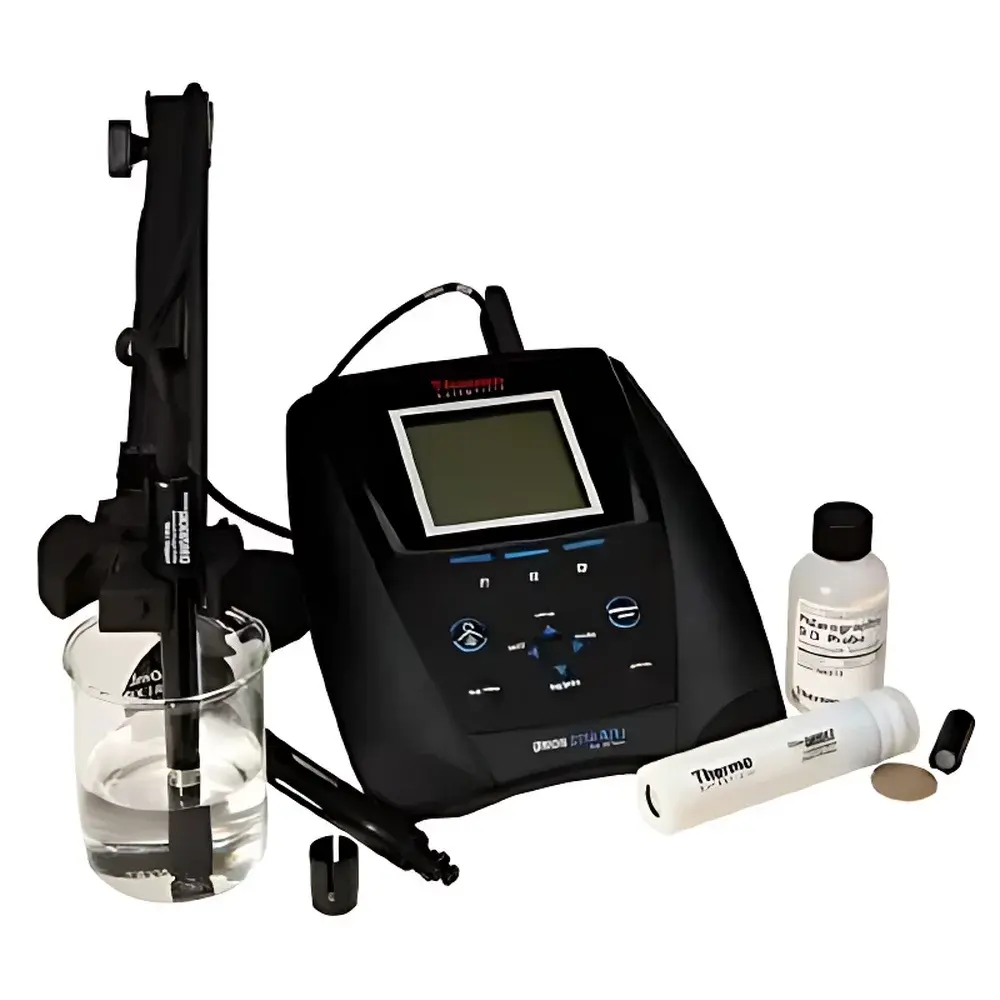
Orion Star A Benchtop/Portable pH and Conductivity Meter
| Origin | USA |
|---|---|
| Manufacturer Type | Authorized Distributor |
| Origin Category | Imported |
| Model | Orion Star A |
| Pricing | Available Upon Request |
Overview
The Orion Star A Benchtop/Portable pH and Conductivity Meter is a dual-channel, laboratory-grade electrochemical instrument engineered for precision, flexibility, and regulatory compliance in diverse analytical environments—from quality control labs and environmental monitoring stations to field-based water testing and pharmaceutical process support. Built on Thermo Fisher Scientific’s legacy of electrode metrology, the Star A platform employs potentiometric measurement principles for pH/mV/ORP and four-electrode (or two-electrode) AC conductivity detection with temperature-compensated algorithms. Its dual-mode architecture supports both benchtop operation—optimized for stability and reproducibility—and rugged portable deployment—validated to IP67 ingress protection—enabling seamless transition between controlled lab settings and demanding outdoor or industrial sampling locations. The instrument adheres to fundamental electrochemical measurement standards including ASTM D1125 (Standard Test Methods for Electrical Conductivity and Resistivity of Water), ISO 7888 (Water Quality — Determination of Electrical Conductivity), and USP (Electrical Conductivity of Water for Pharmaceutical Use), making it suitable for GLP- and GMP-aligned workflows.
Key Features
- Dual-channel display: Simultaneously monitor pH/mV/RmV and conductivity/TDS/salinity/resistivity with real-time temperature overlay—no mode switching required.
- AUTO-READ™ intelligent stabilization detection: Automatically locks readings when signal drift falls below user-defined thresholds (±0.002 pH units or ±0.1 mS/cm over 3 sec), improving throughput and reducing operator bias.
- Multi-standard buffer recognition: Auto-detects and applies calibration parameters for USA (NIST-traceable), DIN, and technical buffer sets without manual selection.
- Editable calibration: Adjust individual pH calibration point offsets post-calibration to refine slope and asymmetry without full recalibration—critical for aging electrodes or non-ideal buffer handling.
- Regulatory-ready data integrity: Full GLP-compliant data logging with embedded metadata—including electrode ID (via optional RFID tag support), user ID, sample ID, timestamp, calibration history, and ATC probe serial number.
- Flexible power architecture: Operates on four AA alkaline batteries (up to 8,000 hours in low-power mode) or universal 100–240 V AC adapter; battery life is monitored and displayed in real time.
- Ruggedized enclosure: Benchtop version rated IP54 (dust-protected, splash-resistant); portable version certified IP67 (submersible up to 1 m for 30 min), meeting IEC 60529 specifications.
Sample Compatibility & Compliance
The Star A accommodates standard BNC pH electrodes, mini-DIN conductivity cells (including 0.01, 0.1, 1.0, and 10 cm⁻¹ cell constants), and integrated ATC temperature probes. It supports aqueous matrices across wide dynamic ranges—from ultrapure water (resistivity up to 100 MΩ·cm, using non-linear temperature compensation per ASTM D5127) to concentrated brines (salinity up to 80 ppt NaCl equivalent). For pharmaceutical applications, the built-in USP pure water resistivity limit check and ISO/EN 27888 TDS conversion curve ensure alignment with compendial requirements. All calibrations and measurements comply with FDA 21 CFR Part 11 when used with Thermo Fisher’s Traceable™ software suite, providing electronic signatures, audit trails, and secure user access controls.
Software & Data Management
Data export and firmware updates are supported via USB 2.0 (Type-A) or RS232 serial interface. The included Orion™ CombiStat Software enables full bidirectional communication: download measurement logs (up to 5,000 entries, with time-stamped metadata), generate calibration reports with residual error analysis, configure instrument parameters remotely, and perform batch editing of sample IDs or user profiles. Export formats include CSV, TXT, and Excel-compatible XLSX—structured to meet LIMS integration requirements. Audit trail records capture all configuration changes, calibration events, and data deletions with operator ID and timestamp, satisfying ALCOA+ (Attributable, Legible, Contemporaneous, Original, Accurate, Complete, Consistent, Enduring, Available) data governance criteria.
Applications
- Environmental water testing: Surface water, wastewater effluent, groundwater, and seawater salinity profiling per EPA Method 120.1 and APHA Standard Methods 2510B.
- Pharmaceutical water systems: Purified water (PW), water for injection (WFI), and clean steam condensate monitoring per USP , , and EU Ph. Eur. 2.2.38.
- Food & beverage QC: Brine concentration, fermentation broth pH stability, and rinse water conductivity validation.
- Academic research: Teaching electrochemistry fundamentals, sensor characterization, and multi-parameter environmental surveys.
- Industrial process control: Cooling tower water treatment, boiler feedwater purity, and desalination plant intake screening.
FAQ
Does the Orion Star A support FDA 21 CFR Part 11 compliance?
Yes—when paired with Orion CombiStat Software and configured with role-based user accounts, electronic signatures, and enabled audit trail logging, the system meets core Part 11 requirements for electronic records and signatures.
Can I use the same electrode for both pH and conductivity measurements?
No—pH and conductivity require physically separate sensors: pH is measured via glass/reference electrode assemblies (BNC interface), while conductivity requires dedicated conductivity cells with defined cell constants (8-pin mini-DIN interface).
What temperature compensation models are available for conductivity?
Linear (0–10.0%/°C), non-linear (based on polynomial fit for natural waters), ultra-pure water model (per ASTM D5127), and USP fixed-limit mode for pharmaceutical water qualification.
Is calibration verification traceable to NIST standards?
Yes—the instrument supports NIST-traceable pH buffer sets (e.g., 4.005, 7.000, 10.012 at 25°C) and conductivity standards (e.g., KCl solutions certified to ISO/IEC 17025-accredited reference materials).
How is data security maintained during USB transfer?
All exported files retain original timestamps and metadata; no encryption is applied by default, but files may be encrypted externally per organizational IT policy prior to LIMS upload or archival.
Related Products





