
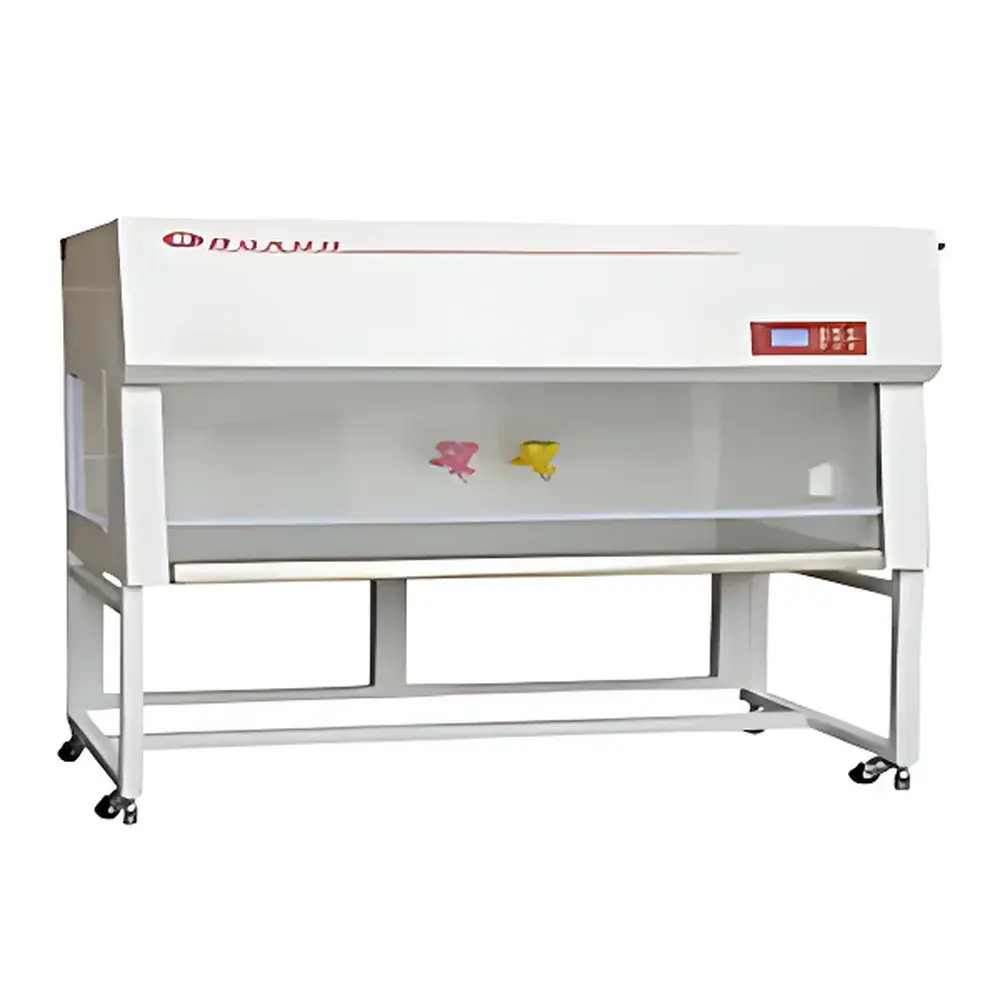
BOXUN BJ-3CD Vertical Laminar Flow Clean Bench
| Brand | BOXUN |
|---|---|
| Origin | Shanghai, China |
| Manufacturer Type | Direct Manufacturer |
| Product Category | Domestic |
| Model | BJ-3CD |
| Instrument Type | Vertical Laminar Flow Clean Bench |
| Cleanliness Class | ISO Class 5 (100-level, ≥99.99% filtration efficiency for particles ≥0.5 µm) |
| Noise Level | ≤67 dB(A) |
| User Capacity | Three-person single-sided operation |
| Airflow Pattern | Vertical unidirectional laminar flow |
| Working Surface Dimensions (W×D×H) | 1800 × 700 × 495 mm |
| Overall Dimensions (W×D×H) | 1960 × 744 × 1680 mm |
| HEPA Filter Specification | 1770 × 604 × 50 mm (1 unit) |
| Illumination | ≥300 lux (30 W fluorescent ×2) |
| UV Lamp | 30 W ×1 |
| Operating Wind Speed Range | 0.3–0.6 m/s (6-step adjustable, real-time digital display) |
| Vibration Amplitude | ≤5 µm (peak-to-peak, X/Y/Z axes) |
| Power Supply | AC 220 V ±10%, 50/60 Hz |
| Rated Power | 0.55 kW |
| Net Weight | 280 kg |
| Control Interface | LCD panel with multi-parameter real-time monitoring |
Overview
The BOXUN BJ-3CD Vertical Laminar Flow Clean Bench is an ISO Class 5-certified local environmental control system engineered for contamination-sensitive laboratory operations. It employs a vertical unidirectional airflow architecture—air drawn from the ambient environment passes sequentially through a pre-filter (medium-efficiency), then a certified HEPA filter (≥99.99% retention of ≥0.5 µm particles), and finally discharges uniformly downward across the work surface at a precisely regulated velocity (0.3–0.6 m/s). This laminar flow profile eliminates turbulent eddies and prevents cross-contamination between samples or personnel, making it suitable for aseptic handling in cell culture, microbiological isolation, reagent preparation, and sterile assembly of diagnostic components. The bench meets fundamental design requirements aligned with ISO 14644-1 for cleanroom performance verification and supports compliance with GLP and GMP operational frameworks where localized particle control is mandated.
Key Features
- Robust structural integrity: Cold-rolled steel outer casing with SUS304 brushed stainless steel work surface—resistant to corrosion, chemical splashes, and repeated disinfection cycles.
- Intelligent airflow management: Six-step digitally adjustable wind speed with real-time LCD display showing actual velocity, differential pressure across HEPA, cumulative operating hours, filter service life indicator, and clock synchronization.
- Integrated safety interlocks: UV lamp and main lighting operate under mechanical/electrical interlock—UV deactivation occurs automatically upon sash movement; illumination only activates when UV is off.
- Human-centered ergonomics: 5° forward-sloping front panel reduces operator fatigue during extended procedures; counterbalanced vertical sash allows smooth, position-locking adjustment within defined travel limits.
- Proactive maintenance alerts: Visual and audible alarms trigger upon HEPA filter degradation, physical damage, or pressure drop exceeding threshold—enabling timely replacement before integrity compromise.
- Utility-ready infrastructure: Built-in splash-proof power outlets (220 V), plus dedicated ports for compressed air and deionized water supply—eliminating external extension cords and reducing clutter-related contamination risks.
- Stable mechanical platform: Equipped with heavy-duty casters and leveling feet—ensuring mobility during facility reconfiguration while maintaining vibration isolation (<5 µm peak-to-peak) critical for sensitive instrumentation integration.
Sample Compatibility & Compliance
The BJ-3CD accommodates standard biosafety Level 1 (BSL-1) and select BSL-2 applications involving non-aerosol-generating procedures—such as plating, media pouring, pipetting, and sterile packaging. It is not designed for containment of hazardous biological agents or volatile chemicals. Its filtration performance conforms to EN 1822-1:2022 (HEPA classification H14) and JIS Z 8122:2016 standards. While not a biosafety cabinet (BSC), its ISO Class 5 airflow stability supports adherence to USP environmental monitoring expectations for low-risk compounding, as well as ASTM E2500-13 guidance on equipment qualification in pharmaceutical settings. Documentation packages include factory-verified airflow uniformity reports and filter integrity test certificates.
Software & Data Management
The embedded microcontroller operates without external PC dependency but logs time-stamped operational data—including total runtime, filter usage duration, alarm events (e.g., HEPA fault timestamp), and average daily wind speed profiles. All parameters are stored in non-volatile memory and exportable via optional RS-232 interface for integration into lab-wide asset tracking or preventive maintenance systems. Audit trail functionality satisfies basic FDA 21 CFR Part 11 requirements for electronic records when paired with institutional SOPs governing data review and signature protocols. No cloud connectivity or proprietary software installation is required; configuration remains accessible via intuitive menu navigation on the integrated LCD.
Applications
- Cell and tissue culture: Aseptic transfer of primary cells, passaging, and cryopreservation workflows requiring particulate-free environments.
- Molecular biology: Plasmid purification, PCR setup, and NGS library preparation where nuclease-free conditions mitigate false positives.
- Pharmaceutical QC: Sterile sampling of raw materials, excipient blending, and visual inspection of injectables per USP .
- Environmental microbiology: Isolation of airborne or surface-derived microbes using settle plate or membrane filtration methods.
- Electronics manufacturing support: Handling of optical sensors, MEMS devices, and calibration standards susceptible to sub-micron particulate adhesion.
- Educational laboratories: Teaching core aseptic technique principles with real-time parameter feedback reinforcing procedural discipline.
FAQ
Does the BJ-3CD meet ISO 14644-1 Class 5 certification requirements?
Yes—the unit achieves and maintains ≥99.99% particle removal efficiency for ≥0.5 µm particles under standardized testing per ISO 14644-3, validated at 0.45 m/s nominal face velocity.
Can this clean bench be used for handling pathogenic organisms?
No. It provides product protection only—not personnel or environmental protection—and must not be substituted for a Class II biological safety cabinet in BSL-2+ applications.
What is the expected service life of the HEPA filter under typical usage?
Filter longevity depends on ambient air quality and daily runtime; typical replacement intervals range from 12 to 24 months, monitored continuously via differential pressure and displayed on the LCD interface.
Is external validation support available for IQ/OQ protocols?
BOXUN provides factory-as-tested documentation (airflow mapping, filter integrity reports, electrical safety certificates); qualified third-party vendors may perform site-specific qualification per user-defined protocols.
How is UV lamp exposure safety ensured during operation?
Mechanical sash interlock cuts UV power immediately upon upward movement; LED status indicators confirm active/inactive states, and a 60-second delay prevents accidental reactivation after closure.



