
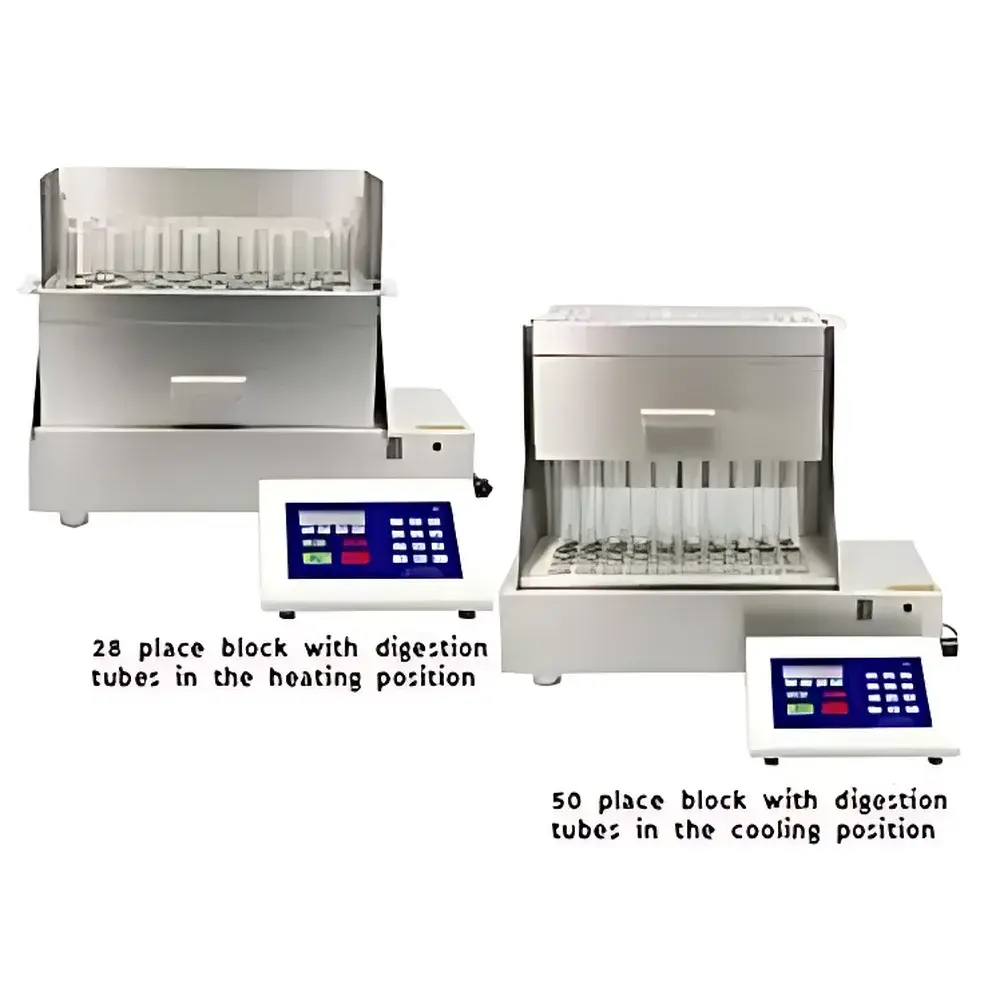
SEAL BD28 & BD50 Automated Block Digestion Systems
| Brand | SEAL |
|---|---|
| Origin | USA |
| Model | BD28 & BD50 |
| Digestion Capacity | 28 × 250 mL or 50 × 75/100 mL |
| Temperature Range | Ambient to 450 °C |
| Temperature Control Accuracy | ±2 °C |
| Heating Mechanism | Aluminum Block Heater |
| Automation Level | Semi-Automatic |
| Power Supply (Heater) | 220–260 VAC, 50/60 Hz |
| Power Supply (Controller) | 100–260 VAC, 50/60 Hz |
| Safety Features | Over-Temperature Cut-Off, Power-Fail Resume Logic, Acid-Vapor-Isolated Controller Housing |
| Compliance | Designed for ASTM D129, ISO 11908, USP <231>, EPA Method 3050B/3051A/3052, and GLP/GMP-aligned workflows |
| Software Capability | 20 User-Defined Methods, up to 30 Steps per Method, Ramp Rate Adjustable from 1 to 30 °C/min |
Overview
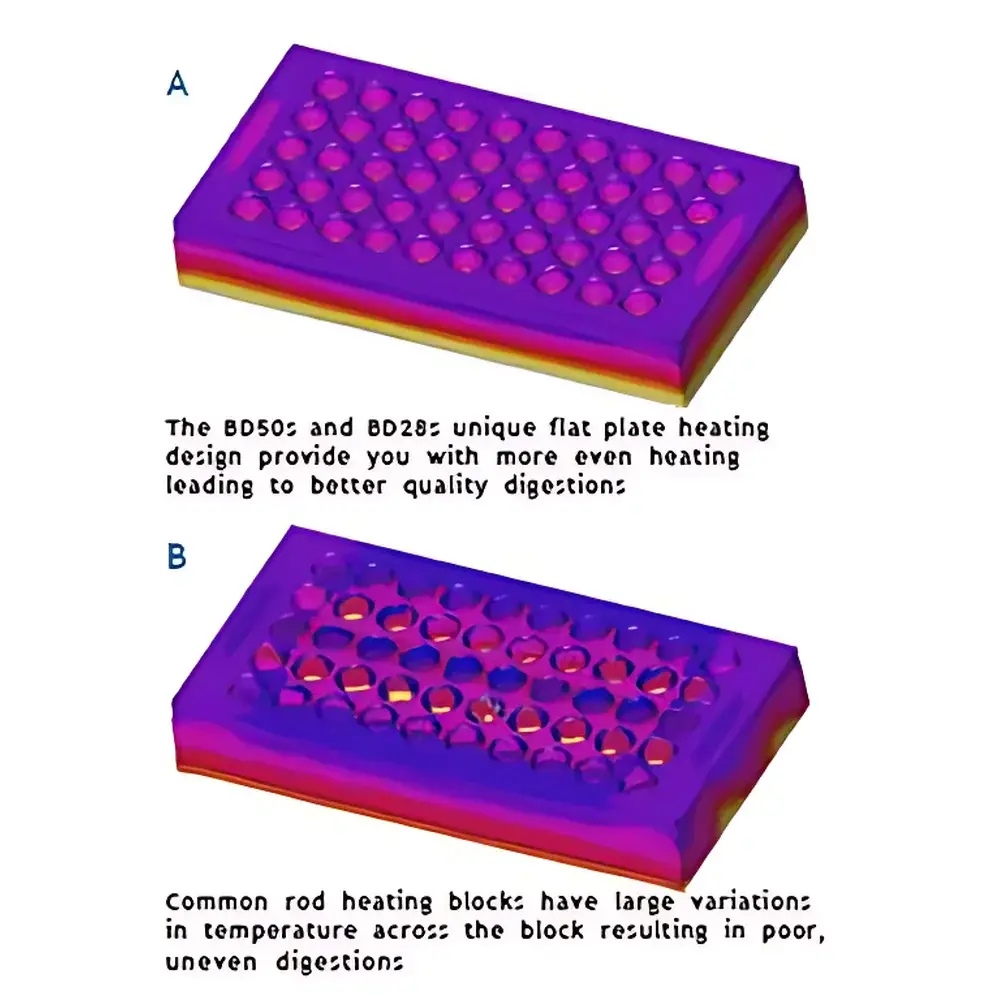
The SEAL BD28 and BD50 Automated Block Digestion Systems are precision-engineered semi-automatic hot block digesters designed for high-throughput, reproducible acid digestion of environmental, agricultural, food, pharmaceutical, and clinical samples. Based on the legacy AIM-600 platform acquired by SEAL Analytical in 2011, these systems employ a uniform aluminum heating block architecture—distinct from conventional rod-heated units—to deliver spatially consistent thermal profiles across all sample positions. This design eliminates radial and axial temperature gradients, ensuring identical thermal exposure for every tube within a batch. The systems operate under programmable ramp-and-hold temperature profiles, enabling controlled decomposition of organic matrices using strong mineral acids (e.g., HNO3, H2SO4, HClO4, HF) without splashing, bumping, or incomplete oxidation. Applications include total Kjeldahl nitrogen (TKN), total phosphorus, heavy metal extraction (e.g., Pb, Cd, As, Hg), COD digestion, and sample preparation for ICP-OES, ICP-MS, AAS, and colorimetric assays.
Key Features
- Uniform Aluminum Block Heating: Solid aluminum digestion blocks provide exceptional thermal mass and conductivity, achieving ±2 °C accuracy and minimizing positional variance (<0.5 °C across all wells).
- Programmable Thermal Profiles: Up to 20 user-stored methods, each supporting up to 30 discrete steps—including ramp rates as low as 1 °C/min and hold durations up to 999 minutes—enabling full method replication across shifts and operators.
- Fail-Safe Operational Integrity: Built-in power-fail recovery logs current digestion parameters and resumes operation upon power restoration; over-temperature cut-off halts heating at 470 °C to prevent thermal runaway.
- Operator & Instrument Protection: Controller unit is physically isolated from the digestion block and placed outside the fume hood, shielding electronics from corrosive vapors and reducing operator exposure to acid fumes.
- Space-Efficient Design: Compact footprint (60 × 28 cm) optimizes fume hood real estate—particularly critical in regulated laboratories where ventilation capacity is constrained.
- No Consumable Components: Beyond reagents and digestion tubes, the system requires zero recurring consumables—no pumps, valves, tubing, or disposable manifolds—reducing long-term TCO and maintenance complexity.
Sample Compatibility & Compliance
The BD28 and BD50 accommodate standard borosilicate or quartz digestion tubes (28 × 250 mL or 50 × 75/100 mL). Tube compatibility extends to EPA-certified vessels for Methods 3050B (soil/sediment), 3051A (microwave-assisted reference), and 3052 (high-pressure digestion validation). The systems support digestion protocols aligned with ASTM D129 (sulfur in petroleum), ISO 11908 (total mercury in water), USP (heavy metals), and AOAC 985.23 (crude protein). All thermal profiles are fully documentable and exportable—supporting audit readiness for GLP and GMP environments. While not inherently 21 CFR Part 11 compliant out-of-the-box, the controller’s event log (time-stamped start/stop, method ID, temperature setpoints, and fault codes) provides foundational traceability for validated workflows when integrated with LIMS or ELN platforms.
Software & Data Management
The microprocessor-based controller features an intuitive membrane keypad and LCD interface for real-time monitoring of setpoint, actual temperature, elapsed time, and active step. All method parameters—including ramp rate, target temperature, hold duration, and step sequence—are stored non-volatile memory with battery-backed retention. Event logs record power interruptions, over-temperature events, and manual overrides—each timestamped and labeled with method name and operator ID (via optional external barcode scanner integration). Raw data can be exported via RS-232 serial interface to laboratory information management systems (LIMS) or spreadsheet software for QA/QC review. No proprietary software installation is required; configuration remains accessible via front-panel navigation only—minimizing cybersecurity surface area and IT dependency.
Applications
- Environmental analysis: Total recoverable metals in soils, sludges, and wastewater per EPA SW-846 Methods.
- Nutrient determination: Total Kjeldahl nitrogen (TKN) and total phosphorus in biosolids and plant tissues.
- Pharmaceutical quality control: Heavy metal screening (Pb, Cd, As, Hg) in APIs and excipients per ICH Q3D and USP /.
- Food safety testing: Arsenic speciation prep, cadmium in rice flour, and lead in infant formula.
- Clinical and forensic toxicology: Mercury quantification in hair and blood samples prior to cold vapor AAS or ICP-MS.
- Research-grade sample prep: Carbonaceous matrix destruction for subsequent elemental fingerprinting or isotopic ratio analysis.
FAQ
What distinguishes the BD50/BD28 from microwave digestion systems?
Microwave systems offer faster ramp times but impose strict vessel pressure limits and require specialized consumables. The BD series prioritizes robustness, method transferability, and regulatory acceptance—especially where open-vessel digestion is mandated (e.g., EPA 3050B) or where sample heterogeneity demands visual monitoring.
Can the BD50 accommodate both 75 mL and 100 mL tubes simultaneously?
Yes—the BD50 block is configured with dual-diameter well inserts, allowing mixed loading of 75 mL and 100 mL tubes without adapter plates or performance compromise.
Is calibration verification required before each run?
While daily calibration is not mandatory, SEAL recommends quarterly NIST-traceable thermocouple verification using a calibrated reference thermometer inserted into a representative well—documented per internal SOPs.
How does the system handle volatile analytes like mercury during digestion?
The BD series supports reflux-capable digestion tubes and optional condenser attachments. For ultra-trace Hg work, pairing with a quartz reflux condenser and low-ramp protocols (≤5 °C/min to 120 °C, then 1 °C/min to final hold) minimizes volatilization loss.
Does the controller support network connectivity or remote monitoring?
No—network interfaces are intentionally omitted to maintain electromagnetic compatibility in analytical lab environments and simplify 21 CFR Part 11 validation. Data export remains serial-only, preserving data integrity and audit trail clarity.



