
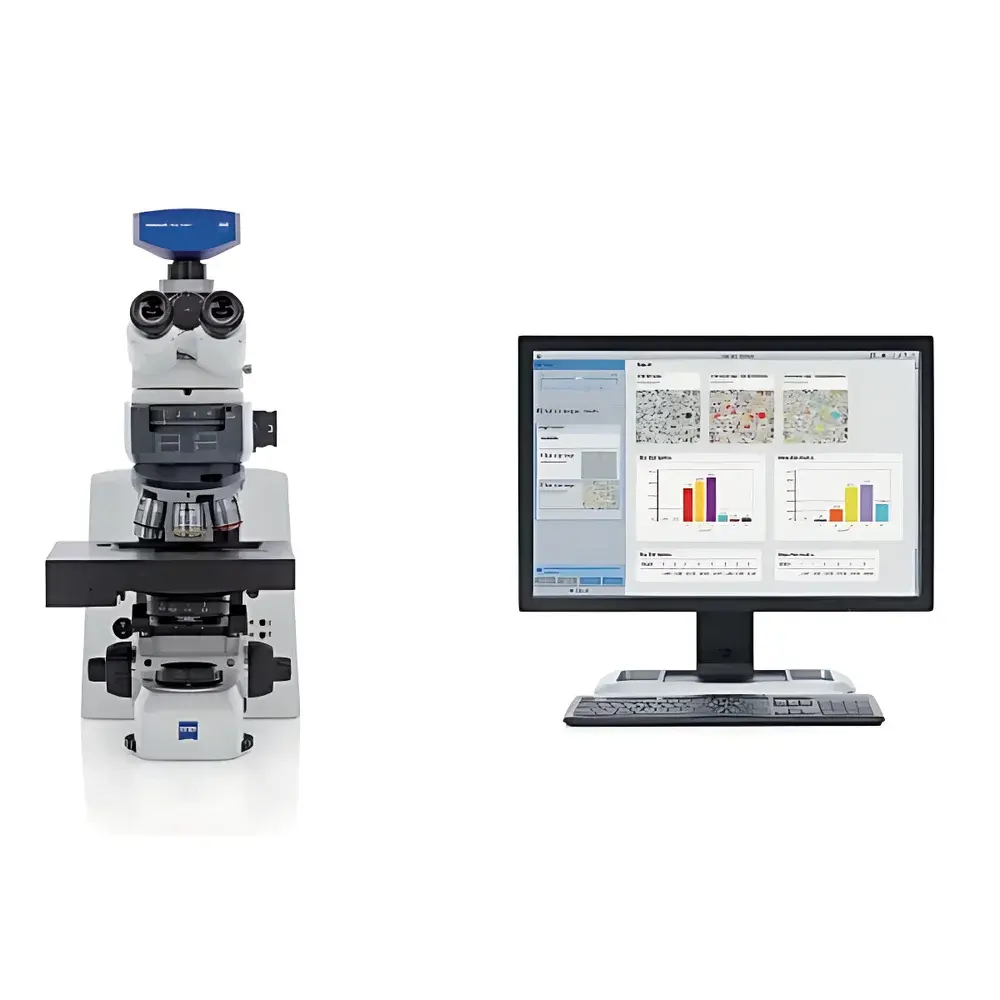
ZEISS Axioscope 7 Advanced Upright Metallurgical Microscope
| Brand | ZEISS |
|---|---|
| Origin | Shanghai, China |
| Manufacturer Type | Manufacturer |
| Product Origin | Domestic (China) |
| Model | Axioscope 7 |
| Configuration | Upright |
| Image Analysis System | Integrated ZEN Core Software |
| Illumination Management | Automated Brightfield/Darkfield/Polarized Light Intensity & Aperture Control |
| Motorized Axes | Fully Motorized X/Y/Z Stages |
| Observation Modes | Brightfield, Darkfield, Polarization, DIC, C-DIC, PlasDIC, Phase Contrast, Fluorescence |
| Software Platform | ZEN Core (Materials Science Edition) |
| Compliance | Designed for ISO 9001-certified manufacturing environments |
Overview
The ZEISS Axioscope 7 is an advanced upright metallurgical microscope engineered for high-precision optical imaging in industrial materials laboratories and academic research settings. Built upon ZEISS’s legacy of optical excellence, it employs Köhler illumination principles with motorized condenser and aperture control to ensure optimal contrast, resolution, and uniformity across all observation modes—including brightfield, darkfield, polarization, differential interference contrast (DIC), contrast-enhanced DIC (C-DIC), plasmonic DIC (PlasDIC), phase contrast, and fluorescence. Its rigid mechanical architecture minimizes vibration-induced drift, while the encoded optical train guarantees repeatable magnification, focus position, and illumination parameters—critical for standardized metallographic evaluation per ASTM E112 (grain size), ASTM E2109 (coating thickness), ASTM E1558 (graphite morphology), and ISO 16232 (particulate contamination analysis). The system is designed for integration into quality control workflows where traceability, inter-operator consistency, and regulatory compliance are non-negotiable.
Key Features
- Fully motorized XYZ stage with encoded positional feedback for automated multi-field stitching, z-stack acquisition, and reproducible coordinate recall
- Automated illumination management: real-time adjustment of LED intensity, field diaphragm, and aperture diaphragm synchronized with objective selection and observation mode
- Encoded optics: objectives, nosepiece, filter cubes, and condenser positions are digitally registered—enabling method-driven acquisition and full parameter logging
- Ergonomic control interface: integrated joystick and function keys on the microscope body eliminate reliance on external controllers or keyboard/mouse during routine operation
- Modular optical design supporting interchangeable contrast modules (e.g., DIC sliders, polarizer/analyzer assemblies, fluorescence filter sets) without realignment
- Thermally stable aluminum alloy frame with precision-ground optical rails to maintain alignment under extended usage and ambient temperature fluctuations
Sample Compatibility & Compliance
The Axioscope 7 accommodates standard metallurgical specimens up to 76 mm × 52 mm (3″ × 2″) with optional large-stage configurations for oversized castings or cross-sectioned components. It supports both polished and uncoated metallic samples, ceramic composites, additive-manufactured alloys, and coated substrates—including those requiring conductive carbon or gold sputtering for SEM correlation. All illumination and contrast modalities comply with ISO/IEC 17025 requirements for test method validation when used in accredited laboratories. The system meets CE marking directives (2014/30/EU EMC, 2014/35/EU LVD) and is compatible with cleanroom Class ISO 5–8 environments when equipped with optional anti-static accessories. Data acquisition adheres to ALCOA+ principles (Attributable, Legible, Contemporaneous, Original, Accurate, Complete, Consistent, Enduring, Available) through ZEN Core’s embedded metadata tagging and electronic signature support.
Software & Data Management
ZEN Core (Materials Science Edition) serves as the unified acquisition, analysis, and reporting platform. It provides calibrated measurement tools for grain size distribution (ASTM E112, ISO 643), phase fraction quantification (using thresholding, color deconvolution, and machine-learning-assisted segmentation), coating thickness profiling (line-scan intensity gradient analysis), graphite nodule classification (ISO 945-1), and particulate cleanliness assessment (ISO 16232-CDS). All image metadata—including objective ID, exposure time, illumination settings, stage coordinates, and user credentials—are embedded in TIFF and OME-TIFF files. Audit trails record every acquisition, annotation, and export action with timestamp, operator ID, and IP address. Export options include PDF reports compliant with internal QA templates, CSV tables for statistical process control (SPC), and structured XML for LIMS integration.
Applications
- Quantitative metallography: grain boundary detection, precipitate sizing, inclusion rating (ASTM E45, ISO 4967)
- Failure analysis: crack propagation mapping, fatigue striation measurement, corrosion pit depth profiling
- Coating & surface engineering: PVD/CVD layer thickness verification, adhesion interface characterization, thermal spray porosity analysis
- Advanced manufacturing: AM powder morphology screening, build layer fidelity assessment, residual stress-induced birefringence visualization
- Quality assurance: incoming material inspection, in-process verification, final product release testing per customer-specific specifications
FAQ
Does the Axioscope 7 support automated grain size analysis per ASTM E112?
Yes—ZEN Core includes a certified grain size module that implements the planimetric and intercept methods defined in ASTM E112, with calibration traceable to NIST-traceable stage micrometers.
Can the system be integrated into a laboratory information management system (LIMS)?
Yes—ZEN Core supports HL7 and ASTM E1384-compliant data export protocols, enabling direct transfer of images, measurements, and metadata to validated LIMS platforms.
Is fluorescence capability available as a factory-installed option?
Yes—fluorescence observation is supported via optional LED-based epi-illumination modules with excitation/emission filter sets optimized for common metallurgical dyes (e.g., picric acid derivatives, fluorescent etchants) and semiconductor defect labeling.
What level of service and calibration support does ZEISS provide for industrial users?
ZEISS offers annual preventive maintenance contracts including optical alignment verification, stage calibration, illumination uniformity mapping, and software update deployment—all documented in ISO 9001-aligned service reports.




