
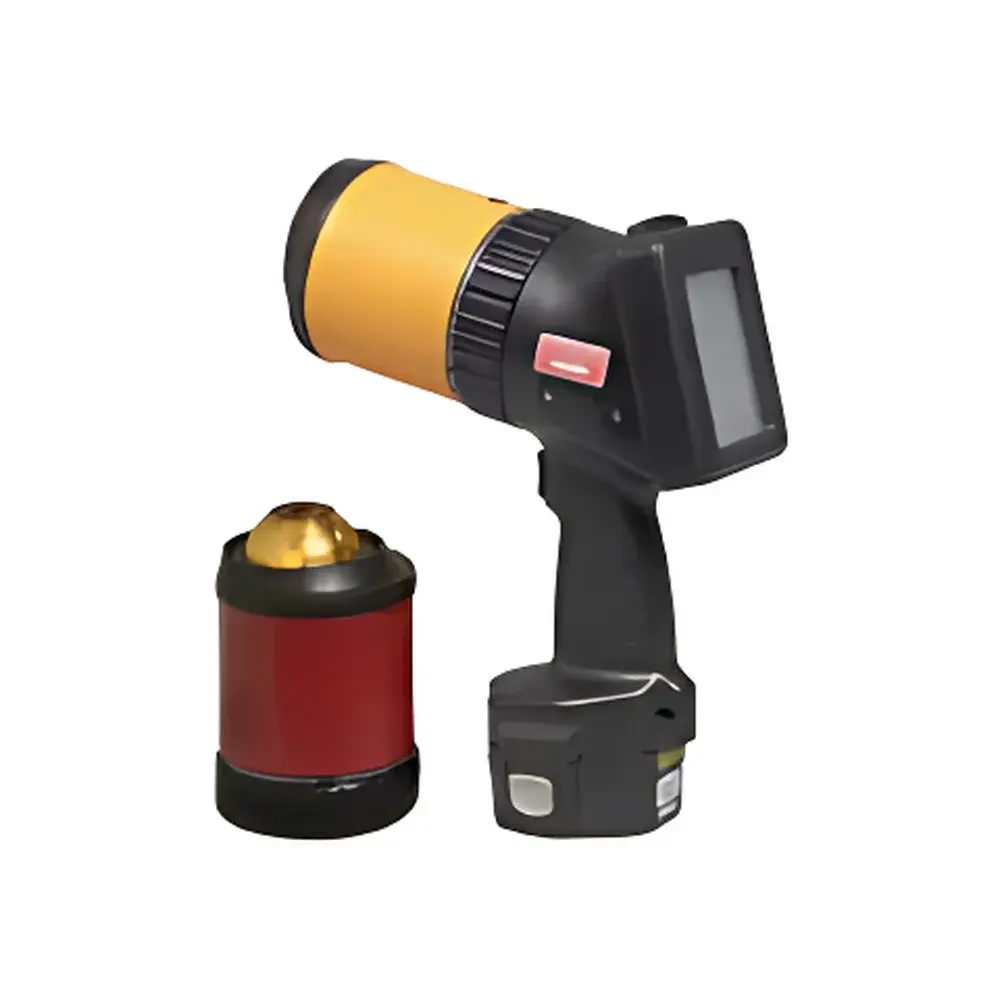
SurfaceOptics SOC 410 Vis-IR Portable Spectral Reflectance and Emissivity Meter
| Brand | SurfaceOptics (SOC) |
|---|---|
| Origin | USA |
| Model | 410 Vis-IR |
| Spectral Range (VIS) | 335–2500 nm (7 bands) |
| Spectral Range (IR) | 1.5–21 µm (6 bands) |
| Incident Angles | 20° & 60° from normal |
| Measurement Time | ~10 s per acquisition |
| Warm-up Time | 90 s |
| Sample Geometry Support | Flat, convex (≥6" radius), concave (≥12" radius) |
| Compliance | ASTM E903, ASTM C1549, ASTM E408 |
| Weight | 2.1 kg (with batteries) |
| Power | Rechargeable NiMH dual battery pack |
| Operating Temp | 0–40 °C (non-condensing) |
| Storage Temp | −25–70 °C |
Overview
The SurfaceOptics SOC 410 Vis-IR is a field-deployable, modular spectral reflectance and directional-hemispherical emissivity meter engineered for quantitative optical property characterization across the solar and thermal infrared spectrum. It replaces legacy instruments such as the Gier-Dunkle DB100 while extending spectral coverage, measurement flexibility, and operational robustness. The system operates on the principle of directional-hemispherical reflectance (DHR) measurement using calibrated broadband illumination and synchronized spectral detection. By acquiring reflectance at two discrete incidence angles—20° and 60° relative to surface normal—it enables calculation of solar absorptance (αsolar) via integration against the AM1.5G solar irradiance spectrum, and thermal emittance (ε) via integration against Planckian blackbody functions at user-defined temperatures (e.g., 300 K or 500 K). Directional emissivity values are then used to estimate hemispherical total emissivity using established empirical correlations validated for non-diffuse surfaces. This dual-angle, multi-band methodology satisfies the physical basis required by ASTM E903 (solar absorptance), ASTM C1549 (cool roof reflectance), and ASTM E408 (total normal emittance), making the 410 Vis-IR suitable for regulatory reporting and material qualification in energy-critical applications.
Key Features
- Modular dual-head architecture: Interchangeable visible-near-infrared (335–2500 nm) and mid-to-far-infrared (1.5–21 µm) measurement heads, each optimized for spectral responsivity and signal-to-noise ratio.
- Simultaneous spectral band integration: Seven defined VIS-NIR bands (e.g., 335–380 nm, 400–540 nm, 700–1100 nm, etc.) and six IR bands (e.g., 1.5–2 µm, 5–10.5 µm, 10.5–21 µm) aligned with atmospheric transmission windows and standard reference spectra.
- Field-portable operation: Integrated PDA-style touchscreen interface, onboard SD card data logging, and lightweight design (2.1 kg with batteries) support handheld or tripod-mounted measurements without external computing.
- Traceable metrology: Supplied with a certified gold mirror reference standard; optional NIST-traceable calibration certificates available for both VIS and IR channels, including uncertainty budgets per ISO/IEC 17025 requirements.
- Angle-resolved capability: Precise mechanical alignment fixtures ensure repeatable 20° and 60° incidence geometries—critical for distinguishing specular vs. diffuse contributions in anisotropic or textured surfaces.
- Ruggedized environmental tolerance: Rated for operation between 0–40 °C (non-condensing) and storage from −25–70 °C; sealed optical path minimizes drift during ambient temperature fluctuations.
Sample Compatibility & Compliance
The 410 Vis-IR accommodates flat, curved, and textured samples without requiring vacuum or controlled atmosphere. Its optical geometry supports surfaces with curvature radii ≥6 inches (convex) or ≥12 inches (concave), enabling direct measurement on aircraft skins, telescope mirrors, building façades, and coated solar absorbers. All reported reflectance and emittance values comply with the definitions and procedural constraints outlined in ASTM E903 (for solar-weighted reflectance), ASTM C1549 (for cool roofing materials), and ASTM E408 (for total normal emittance of opaque surfaces). The instrument’s spectral band definitions and integration algorithms are consistent with ISO 9050 (glass optical properties) and EN 410 (solar heat gain coefficient derivation). Data outputs meet GLP documentation requirements when paired with optional audit-trail-enabled software modules.
Software & Data Management
Embedded firmware provides real-time spectral visualization, auto-zero referencing, and on-device calculation of derived parameters—including solar absorptance (αsolar), thermal emittance (ε), and bidirectional reflectance distribution function (BRDF)-informed directional emissivity. Raw spectral data and metadata (time stamp, GPS coordinates if enabled, operator ID, sample ID) are stored in CSV and XML formats on the internal SD card. Optional PC-based analysis software supports batch processing, spectral interpolation, comparison against reference libraries (e.g., ASTM G173, CIE Standard Illuminants), and generation of compliance-ready reports compliant with FDA 21 CFR Part 11 when configured with electronic signatures and audit trails.
Applications
- Aerospace: In-situ verification of thermal control coatings (TCCs) on satellite bus surfaces and re-entry vehicle heat shields.
- Optical astronomy: Quantitative assessment of mirror coating degradation, contamination-induced reflectance loss, and emissivity drift in segmented primary mirrors.
- Building envelope science: Field validation of low-emissivity (low-e) glazing, cool roof membranes, and radiant barrier systems per ASHRAE 90.1 and LEED v4.1 credit requirements.
- Solar energy: Performance screening of selective solar absorber coatings, anti-reflective films, and spectrally tuned photothermal surfaces.
- Defense & camouflage: Evaluation of multispectral signature suppression across visible, NIR, and MWIR/LWIR bands under standardized illumination conditions.
- Materials R&D: High-throughput screening of novel nanocomposite coatings, metamaterials, and adaptive optical surfaces where spectral selectivity governs functional performance.
FAQ
Does the 410 Vis-IR require external power or laptop connectivity to operate?
No. It operates autonomously using its internal rechargeable NiMH battery pack, with full functionality—including spectral acquisition, calculation, and data storage—accessible via the integrated touchscreen interface.
Can it measure curved or non-planar surfaces?
Yes. The optical design accommodates convex surfaces with radius ≥6 inches and concave surfaces with radius ≥12 inches, maintaining measurement validity within ASTM-defined angular tolerances.
Is NIST traceability included with the base system?
A certified gold mirror reference standard is supplied with every unit. NIST-traceable calibration for VIS and IR channels is available as an optional service, delivered with full uncertainty analysis and certificate of calibration.
How is thermal emittance calculated from reflectance data?
Using the principle of thermodynamic reciprocity (Kirchhoff’s law), directional-hemispherical reflectance measured at 20° and 60° is converted to directional emissivity. Hemispherical total emissivity is then estimated using empirically validated models that account for surface roughness and scattering behavior, consistent with ASTM E408 Annex A2.
What spectral resolution does the instrument provide?
The 410 Vis-IR is a band-integrating radiometer—not a scanning spectrometer—and reports integrated power over predefined wavelength intervals. Bandwidths are selected to align with international standards and minimize atmospheric interference effects during field use.



