
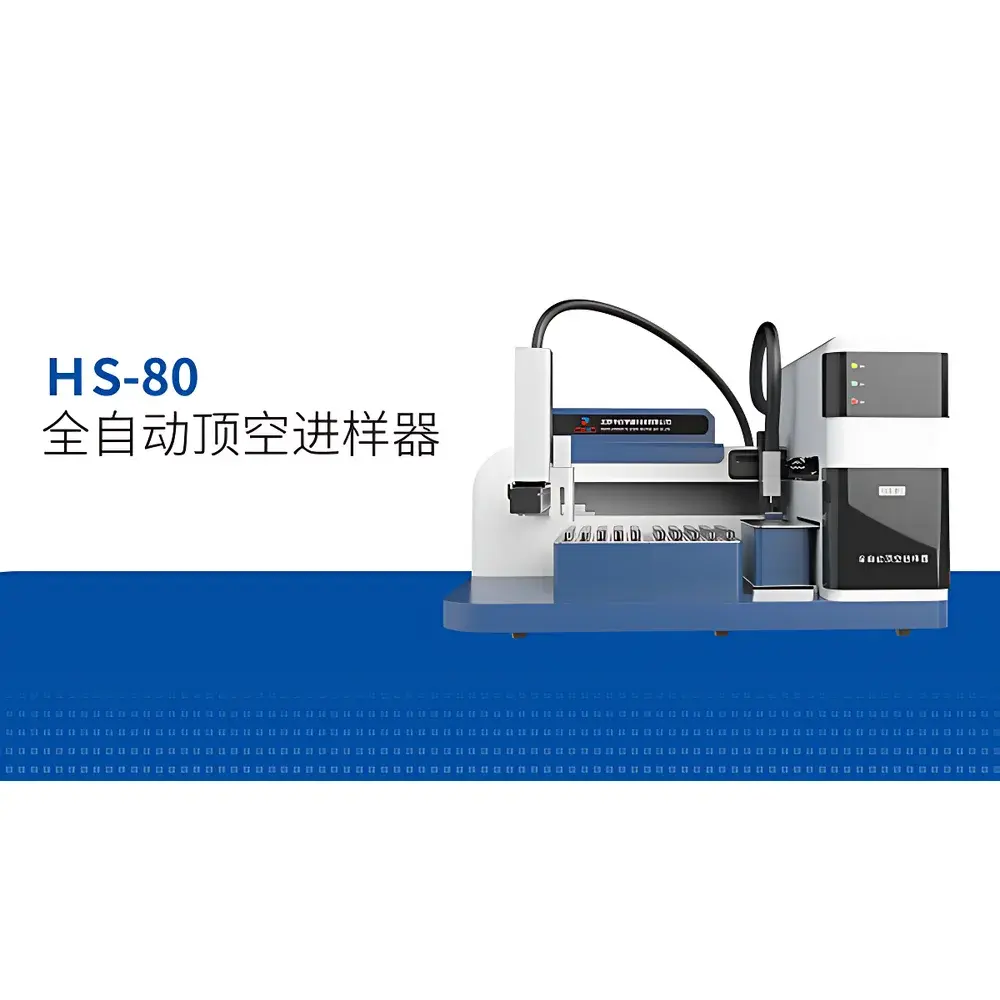
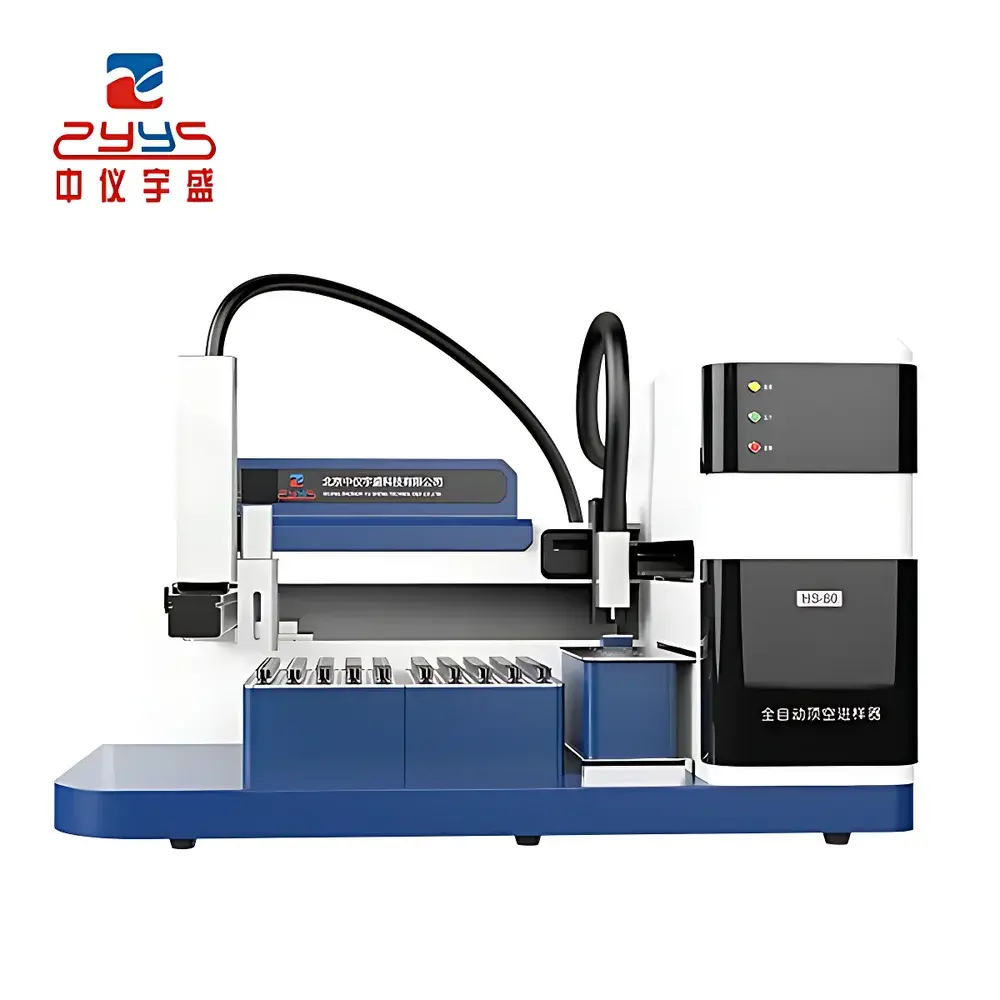
Zhongyi Yusheng HS-80 Fully Automated Static Headspace Sampler
| [Brand | Zhongyi Yusheng |
|---|---|
| Origin | Beijing, China |
| Manufacturer Type | Direct Manufacturer |
| Instrument Type | Static Headspace Sampler |
| Automation Level | Fully Automated |
| Sample Tray Capacity | 80 positions |
| Vial Specification | 20 mL crimp-top headspace vials |
| Heating Zones | 10 independent temperature-controlled ovens |
| Optional Features | Vial agitation, needle heating, leak detection, PC-based control with real-time status monitoring, GC/GC-MS synchronization and bidirectional communication, audit-trail-enabled method logging] |
Overview
The Zhongyi Yusheng HS-80 Fully Automated Static Headspace Sampler is an engineered solution for high-throughput, reproducible analysis of volatile and semi-volatile organic compounds (VOCs, SVOCs) in solid, liquid, and semi-solid matrices. Based on the static headspace principle—where analytes partition between a sealed sample phase and its equilibrium vapor phase—the HS-80 enables quantitative transfer of headspace gas into a coupled gas chromatograph (GC) or GC-mass spectrometer (GC-MS) without liquid-phase injection. Its design emphasizes analytical robustness, regulatory readiness, and seamless integration within modern analytical laboratories performing environmental, pharmaceutical, forensic, clinical, and materials testing.
Key Features
- 80-position automated sample carousel — Standard configuration supports unattended batch processing of up to 80 samples; optional 40-position tray available for space-constrained environments.
- Dual three-axis robotic motion system — Ensures precise, repeatable positioning of the sampling needle across vials and GC inlet, minimizing carryover and positional error.
- 10 independently controlled heating ovens — Enables staggered or overlapping thermal equilibration cycles, significantly reducing overall analysis cycle time compared to single-oven systems.
- Programmable vial agitation (optional) — Enhances mass transfer kinetics and shortens time-to-equilibrium for viscous or heterogeneous samples such as soils, sediments, or polymer extracts.
- Heated transfer lines and sampling needle (up to 220 °C) — Prevents condensation of high-boiling-point analytes and maintains vapor-phase integrity during transfer.
- Inert fluidic pathway — All wetted components—including sample loop, needle, and transfer tubing—are constructed from silanized stainless steel or fused silica with deactivated surfaces to minimize adsorption and memory effects.
- Integrated leak and pressure integrity diagnostics — Real-time monitoring of vial seal integrity and carrier gas line pressure ensures data validity and alerts operators to potential system faults prior to injection.
- Comprehensive safety architecture — Includes automatic self-test at power-on, overtemperature cutoff, ground-fault circuit interruption (GFCI), and hardware-enforced thermal limits across all heated zones.
Sample Compatibility & Compliance
The HS-80 accommodates standard 20 mL crimp-top headspace vials compliant with ASTM D6866, ISO 17025, and USP . It supports a broad range of sample types: aqueous solutions (e.g., drinking water per GB/T 5750.8–2023), soil and sediment slurries (per HJ 642–2013, HJ 643–2013), solid waste homogenates (HJ 736–2015, HJ 741–2015), biological fluids (GA/T 842–2019), medical device extracts (GB/T 16886.7–2015), and packaging materials (SN/T 4148–2015). Its firmware implements full audit trail functionality—including user login, method parameter changes, run timestamps, and instrument state logs—in alignment with FDA 21 CFR Part 11 requirements for electronic records and signatures. The system supports GLP/GMP-compliant workflows through configurable electronic signatures and role-based access control when operated via validated LIMS or CDS platforms.
Software & Data Management
Controlled via Windows-based software with intuitive graphical interface, the HS-80 provides real-time visualization of instrument status—including vial position, oven temperature, needle movement, and GC handshake signals. Users define multi-step methods with independent parameters per vial: equilibration time/temperature, agitator speed (if equipped), pressurization duration, loop fill volume, and injection dwell time. The software supports dynamic queue reordering—allowing urgent samples to be inserted mid-batch without interrupting ongoing runs. It offers native bidirectional communication protocols compatible with major GC and GC-MS platforms (Agilent, Thermo Fisher, Shimadzu, PerkinElmer), enabling synchronized start/stop commands and remote status feedback. All method configurations and raw run metadata are stored in encrypted SQLite databases with versioned backups, supporting retrospective review and regulatory inspection.
Applications
- Environmental monitoring: VOCs in groundwater (HJ 620–2011), halogenated hydrocarbons in soil (HJ 742–2015), ketones and ethers in sediment (HJ 1289–2023).
- Clinical toxicology: Ethanol quantification in whole blood (GA/T 842–2019), tetraethyllead detection in serum (HJ 959–2018).
- Pharmaceutical quality control: Residual solvents in APIs (ICH Q3C), ethylene oxide residuals in sterilized devices (GB/T 16886.7–2015).
- Food and packaging safety: Migration testing of VOCs from plastic containers (SN/T 4148–2015), flavor compound profiling in beverages.
- Materials science: Outgassing analysis of adhesives, coatings, and composites under regulated thermal conditions.
FAQ
Is the HS-80 compatible with third-party GC and GC-MS systems?
Yes—it features universal TTL and RS-232 interfaces, along with vendor-specific driver modules for Agilent, Thermo Fisher, Shimadzu, and PerkinElmer instruments, supporting both forward triggering and reverse status polling.
Does the system support method validation per ICH or ISO guidelines?
The HS-80’s deterministic motion control, temperature uniformity across ovens (±0.5 °C), inert flow path, and audit-trail logging meet core requirements for method validation under ISO/IEC 17025 and ICH Q2(R2). Full qualification documentation (IQ/OQ/PQ templates) is available upon request.
Can multiple equilibration temperatures be programmed within a single sequence?
Yes—each vial position accepts independent temperature, time, and agitation settings, enabling matrix-matched calibration or multi-analyte optimization within one batch.
What maintenance intervals are recommended for long-term reliability?
Routine maintenance includes quarterly verification of oven temperature accuracy, semiannual replacement of septa and vial caps, and annual calibration of pressure sensors and motion encoders—all tracked automatically in the system log.
Is remote monitoring supported over LAN or VPN?
The control software operates natively on Windows networks; remote desktop or secure VNC access is supported for off-site supervision, provided local IT policies permit encrypted session initiation.




