
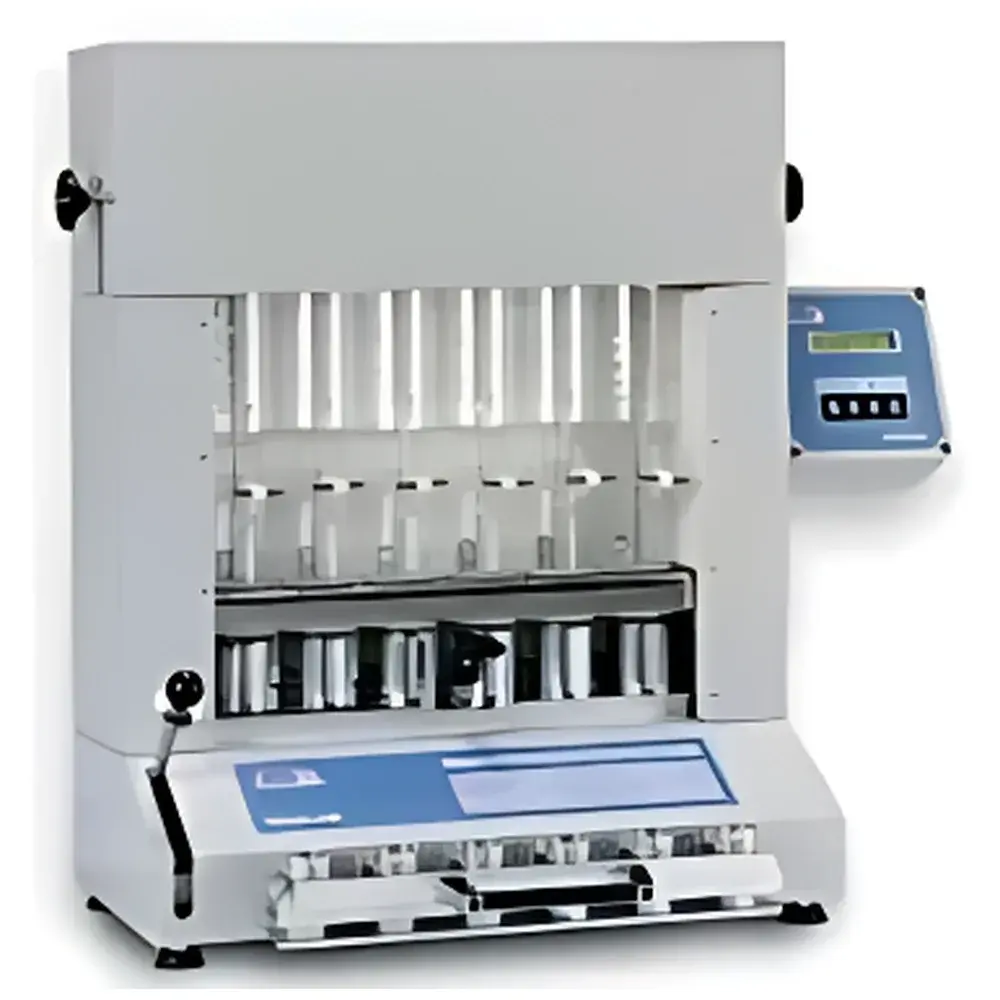
JP Det-gras N Series Soxhlet Fat Extractor
| Brand | JP |
|---|---|
| Origin | Spain |
| Model | Det-gras N |
| Extraction Chamber Volume | 40 mL |
| Receiver Flask Volume | 50 mL |
| Temperature Range | 90–240 °C |
| Temperature Control Accuracy | ±1 °C |
| Number of Channels | 6 |
| Solvent Recovery Rate | 60–80% |
| Maximum Solvent Volume | 50 mL |
| Programmable Methods | 16 |
| Extraction Time Range | 0–99 min |
| Display | Dual-line LCD |
| Control Interface | 4-button membrane keypad |
| Construction | Steel frame with epoxy resin chemical-resistant coating |
| Compatible Solvents | Petroleum ether, diethyl ether, n-hexane, acetone, acetonitrile |
| Extraction Vessels | Glass thimbles or cellulose filter cartridges |
| Safety Features | Over-temperature cutoff protection |
Overview
The JP Det-gras N Series Soxhlet Fat Extractor is a fully automated, six-channel benchtop instrument engineered for precise and reproducible fat determination in accordance with standardized gravimetric methods based on the classical Soxhlet extraction principle. It operates on continuous solvent reflux—where condensed solvent percolates through a solid sample matrix housed in a thimble, dissolving lipids and returning to the boiling flask via siphon action—ensuring exhaustive extraction without manual intervention. Designed for routine quality control and regulatory compliance laboratories, the Det-gras N delivers accelerated extraction cycles (typically 50 minutes per sample) while maintaining full adherence to AOAC 920.39, ISO 1444, ISO 6496, and USP residual solvents methodology requirements. Its robust architecture supports high-throughput workflows across food safety, animal nutrition, pharmaceutical excipient analysis, and feed certification applications.
Key Features
- Six independent extraction channels enable parallel processing of up to six samples, significantly improving lab throughput without cross-contamination risk.
- Precise digital temperature control (±1 °C accuracy) across a broad operational range (90–240 °C), optimized for low-boiling solvents (e.g., petroleum ether, bp ~40–60 °C) and higher-boiling alternatives (e.g., chloroform, bp ~61 °C).
- Integrated solvent recovery system achieves 60–80% condensate return efficiency, reducing solvent consumption and minimizing environmental exposure during extended runs.
- Chemically inert epoxy-coated steel chassis resists corrosion from organic solvents and acidic vapors, ensuring long-term structural integrity in demanding analytical environments.
- Dual-line LCD display with intuitive 4-button interface allows direct selection of temperature setpoint, extraction duration, and pre-stored method numbers—no PC required for basic operation.
- Programmable memory stores up to 16 user-defined methods, including ramp profiles, hold times, and endpoint logic—supporting audit-ready traceability under GLP and GMP frameworks.
- Over-temperature safety cutoff prevents thermal runaway; automatic shutdown activates if sensor readings exceed user-configured limits by >5 °C.
Sample Compatibility & Compliance
The Det-gras N accommodates standard glass or cellulose filter thimbles (ID 25 mm, height 50–100 mm), compatible with solid or semi-solid matrices including ground meat, dried fish meal, cereal grains, pet food, dairy powders, and botanical extracts. Extraction chamber volume (40 mL) and receiver flask capacity (50 mL) conform to ASTM D2974 and AOAC official methods for moisture-free sample loading. All wetted parts are inert to common lipid-solubilizing solvents—including petroleum ether (bp 30–60 °C), diethyl ether (bp 34.6 °C), n-hexane (bp 69 °C), acetone (bp 56 °C), and acetonitrile (bp 82 °C)—and two dedicated solvent adapter kits ensure optimal vapor path geometry and condensation kinetics for each class. The system meets CE marking requirements and complies with IEC 61010-1 for laboratory electrical equipment safety.
Software & Data Management
While standalone operation is fully functional, optional USB connectivity enables firmware updates and method export/import via JP-provided configuration utility (Windows-compatible). Each run logs timestamp, channel ID, set temperature, actual temperature profile (sampled every 10 s), extraction duration, and completion status to internal non-volatile memory. Audit trails support 21 CFR Part 11-compliant electronic records when paired with validated third-party LIMS integration—enabling secure user authentication, electronic signatures, and immutable data archiving. All stored methods include metadata fields for analyst ID, sample batch number, and calibration verification date.
Applications
- Food & Beverage QC: Total fat quantification in raw materials (e.g., soybean meal, coconut flour) and finished products (e.g., cheese spreads, chocolate, infant formula) per Codex Alimentarius standards.
- Animal Feed Analysis: Crude fat assessment in compound feeds, premixes, and single-ingredient commodities according to EN ISO 6496 and FAMI-QS guidelines.
- Pharmaceutical Excipients: Residual oil content testing in starch derivatives, microcrystalline cellulose, and spray-dried lactose used in oral solid dosage forms.
- Environmental Testing: Lipid-bound contaminant recovery (e.g., PCBs, PAHs) from sediment or sludge prior to GC-MS analysis.
- Academic Research: Method development for alternative solvents (e.g., limonene, ethyl acetate) under green chemistry principles, leveraging programmable ramp-and-hold functionality.
FAQ
What sample preparation is required prior to extraction?
Samples must be dried to constant weight (typically 105 °C, 2 h) and ground to pass through a 1-mm sieve. Moisture content must be determined separately, as water interferes with solvent penetration and lipid solubilization.
Can the Det-gras N be used with chlorinated solvents such as chloroform or dichloromethane?
Yes—provided appropriate solvent adapters are installed and fume hood ventilation meets OSHA PEL limits. Note that chlorinated solvents require elevated condenser cooling capacity; optional chiller integration is available.
Is calibration traceable to national standards?
Temperature sensors are factory-calibrated against NIST-traceable reference thermometers; certificate of calibration (with uncertainty budget) is provided with each unit.
How often does maintenance require solvent pathway cleaning?
Under normal use (≤10 extractions/day), ultrasonic cleaning of thimble holders and condenser jackets is recommended every 200 cycles—or whenever visible residue accumulation occurs.
Does the system support remote monitoring or networked operation?
Not natively; however, RS-232 or Modbus RTU expansion modules can be retrofitted for SCADA integration in centralized lab automation systems.



