
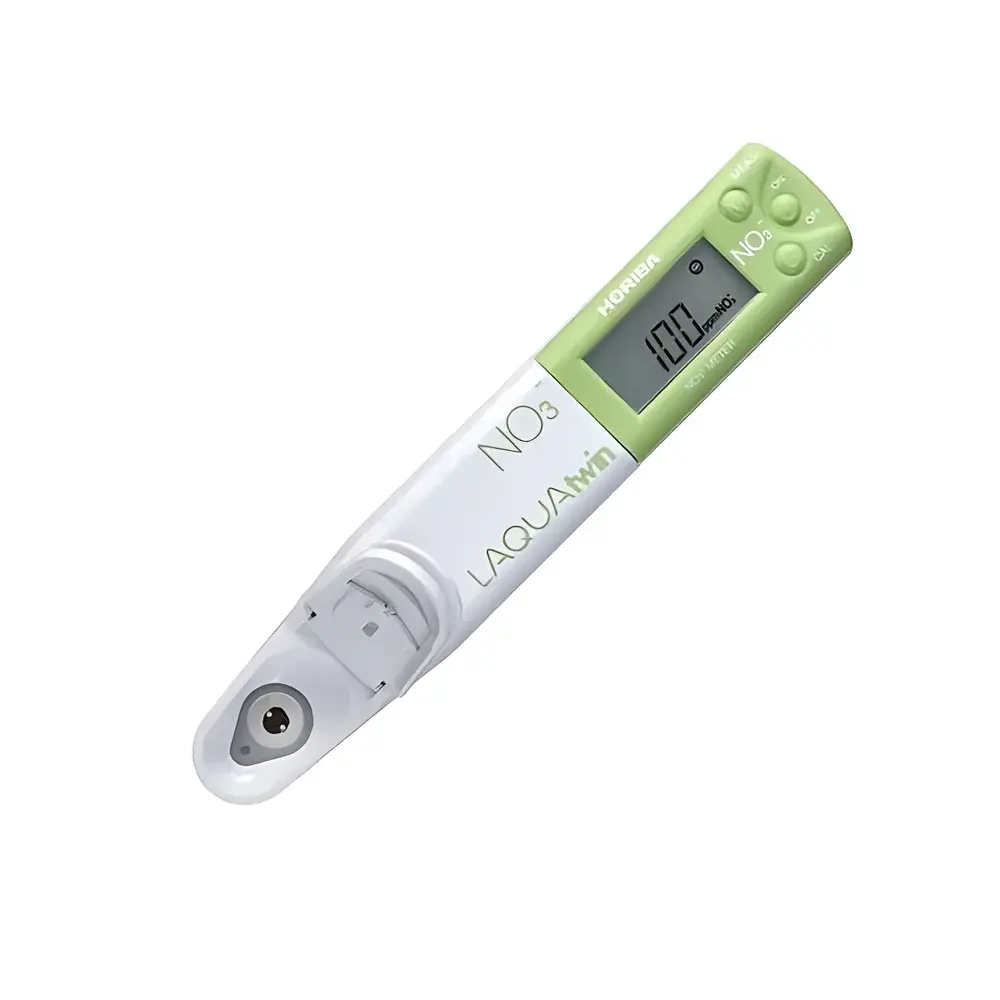
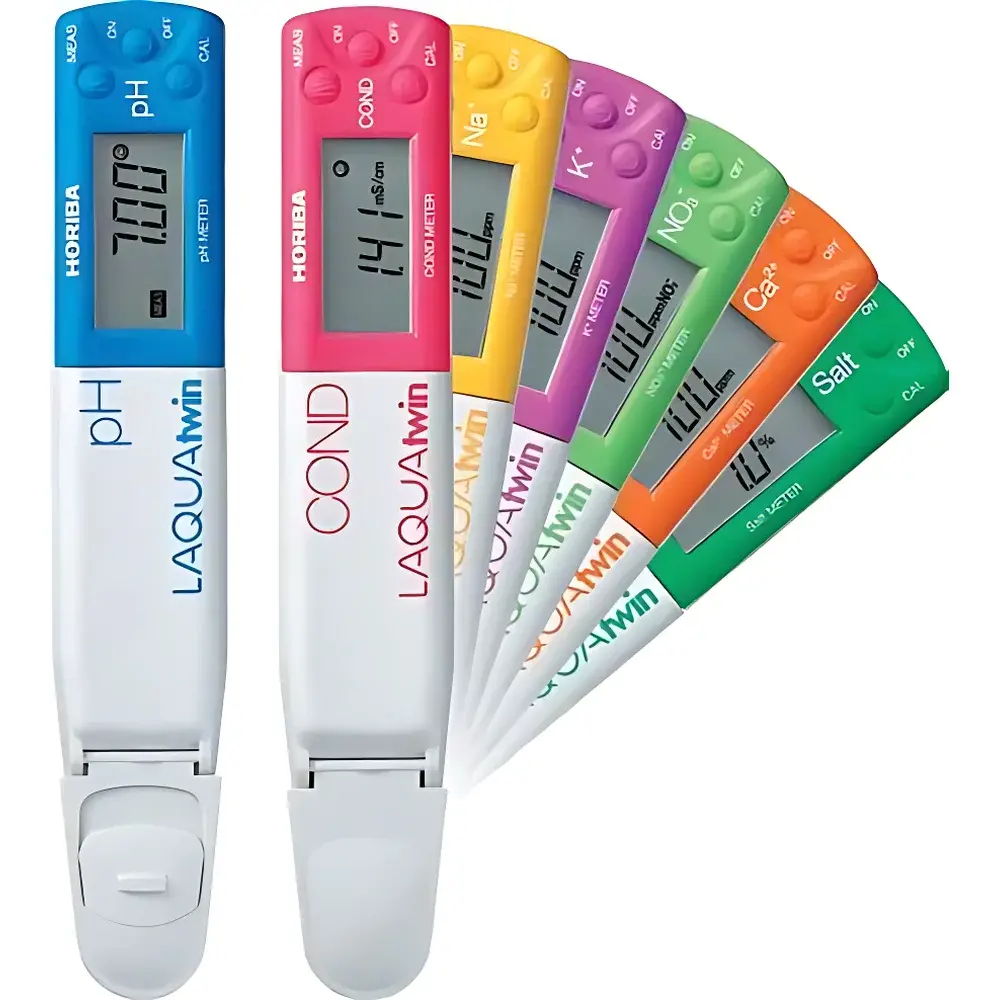
HORIBA LAQUAtwin B-743 Nitrate (NO₃⁻) Pocket Ion Meter
| Brand | HORIBA |
|---|---|
| Origin | Japan |
| Model | B-743 |
| Instrument Type | Portable Ion Meter |
| Measurement Range | 62–6200 ppm NO₃⁻ |
| Accuracy | ±10% of reading |
| Operating Temperature | 5–40°C, ≤85% RH (non-condensing) |
| IP Rating | IP67 |
| Sensor Principle | Solid-State Ion-Selective Electrode (ISE) |
| Minimum Sample Volume | 0.05 mL (with Sampling Sheet B) |
| Display | Custom monochrome LCD |
| Power | 2×CR2032 (≈400 h lifetime) |
| Dimensions | 164 × 29 × 20 mm |
| Weight | ~50 g (instrument only) |
Overview
The HORIBA LAQUAtwin B-743 is a handheld, field-deployable nitrate ion (NO₃⁻) meter engineered for rapid, on-site quantification in environmental, agricultural, and food safety applications. It employs a miniaturized solid-state ion-selective electrode (ISE) based on polymeric membrane technology, delivering laboratory-grade selectivity and response kinetics in a pocket-sized form factor. Unlike optical or colorimetric methods, the B-743 measures electrochemical potential difference generated at the sensor interface in accordance with the Nernst equation, enabling direct, interference-resistant quantification of NO₃⁻ activity in aqueous and semi-solid matrices. Its design targets users requiring immediate, traceable data without reliance on centralized labs—particularly field technicians monitoring surface water, irrigation runoff, soil leachates, hydroponic nutrient solutions, or processed food extracts. The instrument operates independently of external power sources and requires no reagents beyond calibration standards, making it suitable for GLP-aligned routine testing under variable ambient conditions.
Key Features
- IP67-rated enclosure ensures full protection against dust ingress and immersion in water up to 1 m for 30 minutes—validated for use in humid field environments, rain-exposed sampling sites, and wet-lab benchtops.
- Ultra-low sample consumption: as little as 0.05 mL with optional Sampling Sheet B, minimizing waste and enabling analysis of precious or volume-limited samples (e.g., plant xylem sap, infant formula dilutions).
- Multi-mode sampling flexibility: supports drop, dip, scoop, wipe, solid-contact, powder reconstitution, and porous substrate (paper/film) protocols—each optimized for matrix-specific ion extraction efficiency.
- Intuitive user interface with real-time status feedback: smiley-face icon confirms stable electrode response; auto-hold locks measurement upon signal stabilization; auto-ranging eliminates manual scale selection.
- Integrated temperature compensation (5–40°C) using a built-in thermistor, correcting for thermal drift per ISO 10523 and ASTM D1129 guidelines for pH and ion activity measurements.
- Two-point calibration protocol compliant with ISO/IEC 17025 documentation requirements—supports multiplicative and additive correction factors for method validation and matrix-matched standardization.
Sample Compatibility & Compliance
The B-743 demonstrates robust performance across heterogeneous sample types without pretreatment: liquid water (freshwater, wastewater, nutrient solutions), moist soils (slurry extractions), homogenized food matrices (leafy greens, dairy powders), and hydrated porous materials (filter paper, textile swabs). It complies with ISE performance criteria outlined in EPA Method 300.0 and ISO 10304-1 for anion determination, and its operational parameters align with GLP documentation expectations for portable field instruments. While not FDA 21 CFR Part 11–certified out-of-the-box, audit trails—including calibration timestamps, operator IDs (via manual log entry), and measurement history—can be maintained externally in accordance with GMP Annex 11 principles. CE marking and RoHS compliance are certified for EU market deployment.
Software & Data Management
The B-743 operates as a standalone instrument with no embedded Bluetooth or USB connectivity. All measurement data remain on-device until manually recorded. However, its standardized output format (ppm NO₃⁻, NO₃⁻–N equivalent, temperature, date/time stamp) facilitates structured transcription into LIMS or Excel-based QA/QC spreadsheets. Calibration records—including high/low standard values, slope (%/decade), and offset—appear on-screen during setup and may be logged alongside field notes. For regulated environments, users are advised to maintain a bound calibration logbook referencing batch numbers of supplied 14 mL standard solutions (certified traceable to NIST SRM 3189 for nitrate), consistent with ISO/IEC 17025 Clause 7.7 requirements for reference material control.
Applications
- Environmental monitoring: real-time assessment of nitrate contamination in rivers, lakes, groundwater wells, and agricultural drainage ditches—supporting compliance with WHO drinking water guidelines (≤50 mg/L NO₃⁻) and EU Nitrates Directive thresholds.
- Agricultural management: rapid evaluation of fertilizer leaching risk, soil nitrate availability pre-planting, and hydroponic reservoir balance—enabling dynamic nutrient dosing decisions.
- Food safety & quality control: verification of nitrate levels in cured meats, leafy vegetables (e.g., spinach, lettuce), and infant foods per EC Regulation No. 1223/2009 and Codex Alimentarius Standard 262-2005.
- Educational laboratories: hands-on instruction in ion-selective measurement principles, Nernstian behavior, and field analytical method validation—without infrastructure dependency.
- Wastewater treatment: spot-checking of denitrification efficiency in bioreactors and effluent discharge points prior to regulatory submission.
FAQ
What sample preparation is required for solid or powdered samples?
No acid digestion or filtration is needed. For powders, place ~10–20 mg directly on the sensor, add 0.1 mL ultrapure water (18.2 MΩ·cm), and gently mix with the included pipette tip. For solids (e.g., cheese, fruit), cut a <5 mm² piece and press firmly onto the wetted sensor surface.
Can the B-743 measure nitrate in seawater or high-ionic-strength samples?
Yes—but accuracy degrades above 500 mM total dissolved solids due to activity coefficient deviation. Use the built-in multiplication factor (0.01–9.90) to apply matrix-specific correction derived from parallel ICP-MS or ion chromatography validation.
How often must the sensor be cleaned or recalibrated?
Rinse with ultrapure water after each measurement. Recalibrate before each sampling session or every 2 hours of continuous use. Replace the sensor chip every 12 months or after 500 measurements, whichever occurs first.
Is the instrument suitable for ISO 17025-accredited testing?
It may serve as a screening tool within accredited scopes when used with documented uncertainty budgets, verified reference standards, and controlled environmental conditions—though definitive compliance requires validation per ISO/IEC 17025 Clause 7.2.2 for measurement traceability.
What does the ±10% accuracy specification represent?
This reflects combined uncertainty from electrode slope variation, temperature compensation error, and standard solution uncertainty at mid-range concentrations (620 ppm); expanded uncertainty (k=2) is ≤±15% at extremes of the measurement range.







