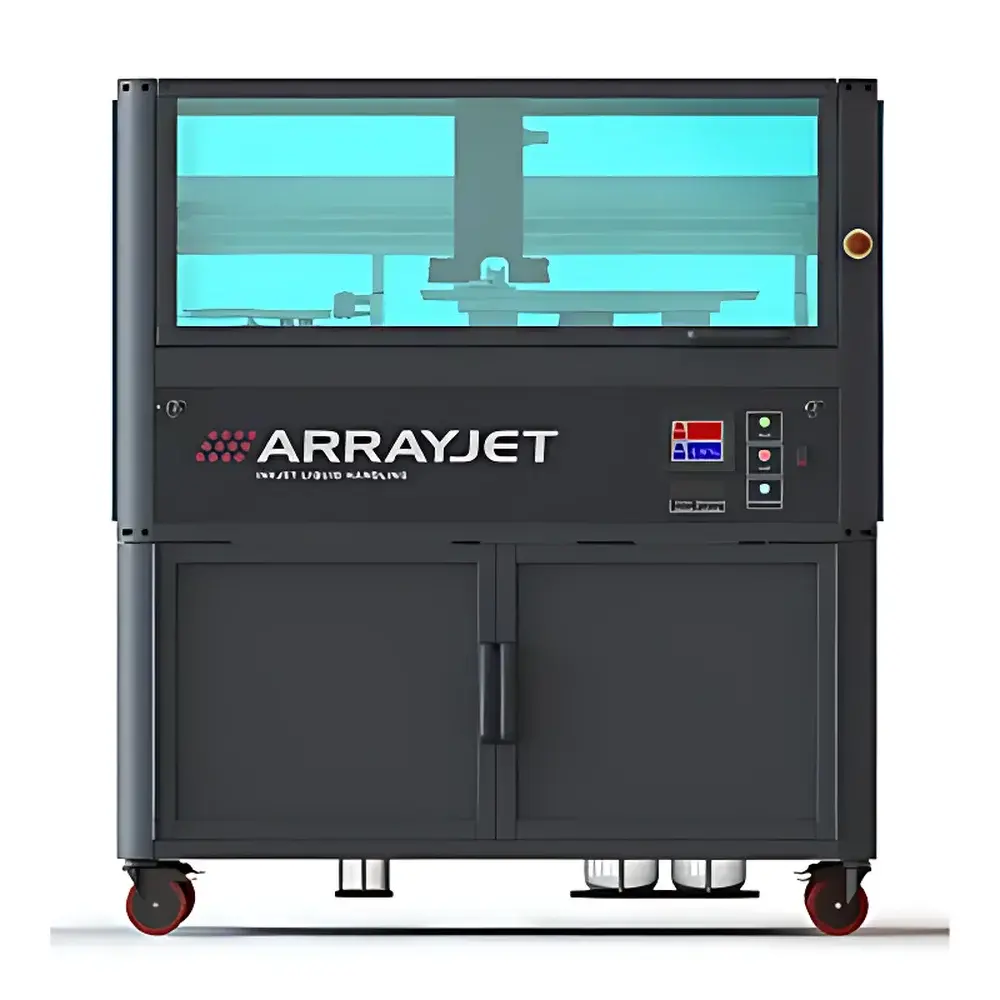
ArrayJet Mercury 1000-S Non-Contact Piezoelectric Microarray Spotting System
| Brand | ArrayJet |
|---|---|
| Origin | United Kingdom |
| Model | Mercury 1000-S |
| Spotting Method | Non-contact piezoelectric inkjet |
| Spot Volume Range | picoliter to nanoliter (pL–nL) |
| Spotting Speed | 711 spots per second |
| Substrate Capacity | 48 SBS-format microplates or 1,000 standard microscope slides |
| Positional Reproducibility | CV < 5% |
| Compliance | CE-marked, ISO 13485–compatible workflow design |
Overview
The ArrayJet Mercury 1000-S is a high-throughput, non-contact piezoelectric microarray spotting system engineered for precision deposition of biological reagents onto solid substrates—including glass slides, nitrocellulose membranes, polymer-coated surfaces, and microtiter plates. Unlike contact-based pin spotters, the Mercury 1000-S utilizes advanced drop-on-demand (DOD) inkjet technology, where each of its 128 independently controlled piezoelectric nozzles generates discrete, calibrated droplets in the pL–nL range without physical substrate contact. This eliminates cross-contamination, minimizes sample carryover, and preserves surface integrity—critical for reproducible immobilization of sensitive biomolecules such as antibodies, oligonucleotides, glycans, and recombinant proteins. The system operates under tightly regulated environmental conditions (temperature, humidity, and laminar airflow), mitigating evaporation-induced concentration drift during spotting and ensuring consistent spot morphology and signal intensity across large-scale arrays.
Key Features
- 128-channel parallel piezoelectric printhead enabling true high-speed, synchronized deposition without mechanical latency
- Non-contact operation ensures zero surface damage and eliminates cleaning cycles required by pin-based systems
- Integrated environmental control module maintains stable ambient conditions (±0.5 °C temperature, ±3% RH) throughout spotting runs
- Optical quality assurance subsystem performs real-time spot detection and positional validation pre- and post-deposition
- Modular SBS-compliant plate handling supports up to 48 microplates simultaneously; slide magazine accommodates 1,000 standard 1″ × 3″ microscope slides
- Positional repeatability with coefficient of variation (CV) < 5% across full working area—validated per ISO/IEC 17025 traceable protocols
Sample Compatibility & Compliance
The Mercury 1000-S accepts a broad spectrum of aqueous and viscous biofluids—including serum, plasma, cell lysates, purified IgG, synthetic peptides, and modified nucleic acids—without requiring surfactant additives or pre-filtration (within recommended viscosity limits: ≤20 cP). Substrate compatibility spans functionalized glass (e.g., epoxy-, aldehyde-, or NHS-activated slides), PVDF and nitrocellulose membranes, silicon wafers, and polymer-based microfluidic chips. All hardware and firmware comply with EU Machinery Directive 2006/42/EC and EMC Directive 2014/30/EU. While not a medical device itself, the system supports GLP/GMP-aligned workflows when integrated with validated SOPs and audit-trail-enabled software configurations compliant with FDA 21 CFR Part 11 requirements.
Software & Data Management
Operation is fully managed via Command Centre™—a Windows-based platform supporting intuitive array layout design, multi-layer pattern scripting, and live preview simulation. The software enables precise control over droplet volume calibration per nozzle, dynamic adjustment of inter-spot spacing, and automatic compensation for substrate warpage or tilt. All spotting events are timestamped and logged with metadata including nozzle ID, voltage waveform parameters, environmental sensor readings, and user credentials. Export formats include TIFF, CSV, and XML-compatible array annotation files (MAGE-TAB), facilitating downstream integration with analysis pipelines (e.g., Bioconductor, GenePattern) and LIMS environments.
Applications
- High-density nucleic acid microarrays for genotyping, methylation profiling, and miRNA screening
- Reverse-phase protein arrays (RPPA) for quantitative phosphoproteomics and biomarker validation
- Glycan and lectin arrays for carbohydrate-binding specificity mapping
- Antibody and aptamer microarrays for multiplexed immunoassay development
- Microbial detection arrays using species-specific probes on membrane supports
- Compound library printing onto functionalized surfaces for fragment-based drug discovery
- Deposition of biorecognition elements onto semiconductor transducers and lab-on-chip devices
FAQ
What types of biological samples are compatible with the Mercury 1000-S?
Aqueous buffers, serum, plasma, purified proteins, oligonucleotides, glycoproteins, and small-molecule solutions—with viscosities up to 20 cP and particulate content < 0.2 µm.
Does the system support custom substrate geometries beyond standard slides and SBS plates?
Yes—custom fixtures and fiducial alignment routines can be configured for non-standard carriers, including flexible films, curved surfaces, and wafer-level substrates.
How is calibration maintained across the 128-nozzle array?
Each nozzle undergoes independent volumetric calibration using gravimetric and optical droplet sizing methods; recalibration is scheduled automatically every 24 hours or after fluid change.
Can the Mercury 1000-S integrate into automated laboratory workflows?
It features RS-232, Ethernet, and OPC UA interfaces for seamless integration with robotic arms, environmental chambers, and central LIMS platforms.
Is training and application support available for method development?
ArrayJet provides on-site installation qualification (IQ), operational qualification (OQ), and dedicated application scientist support for assay optimization and troubleshooting.