
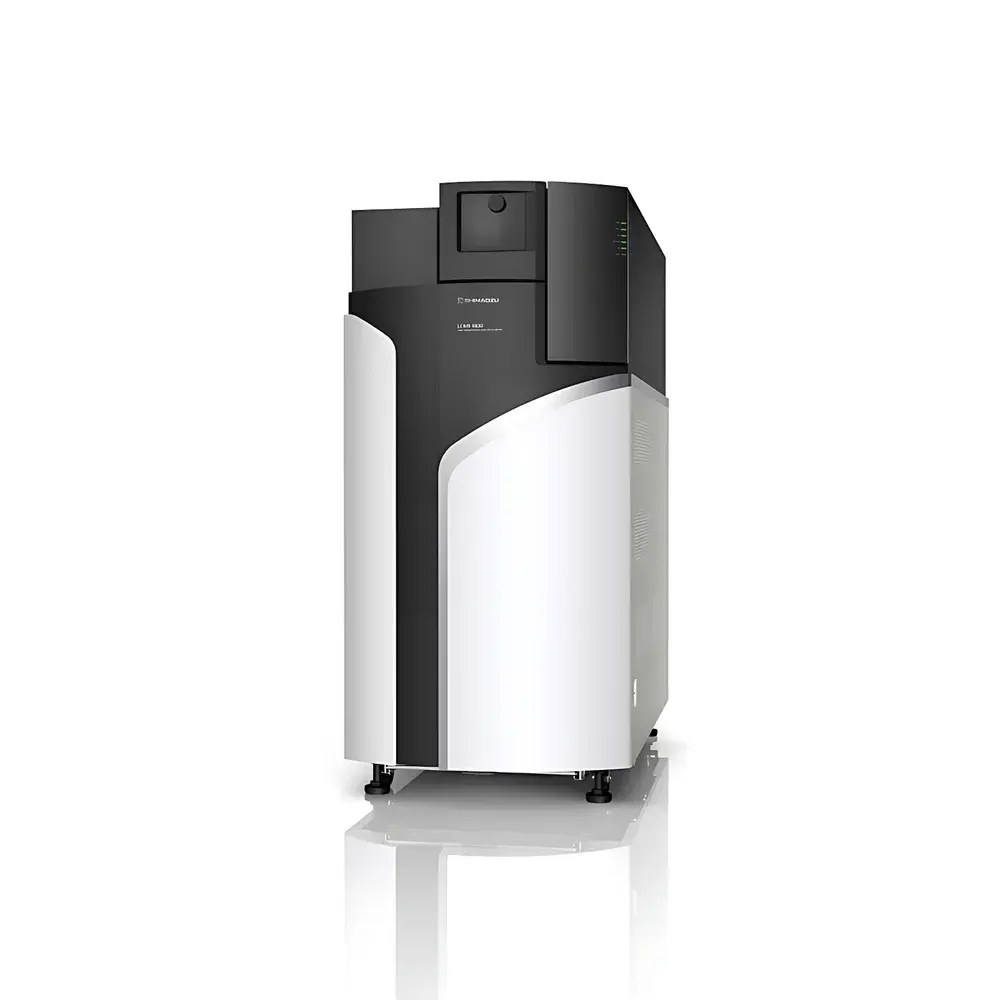
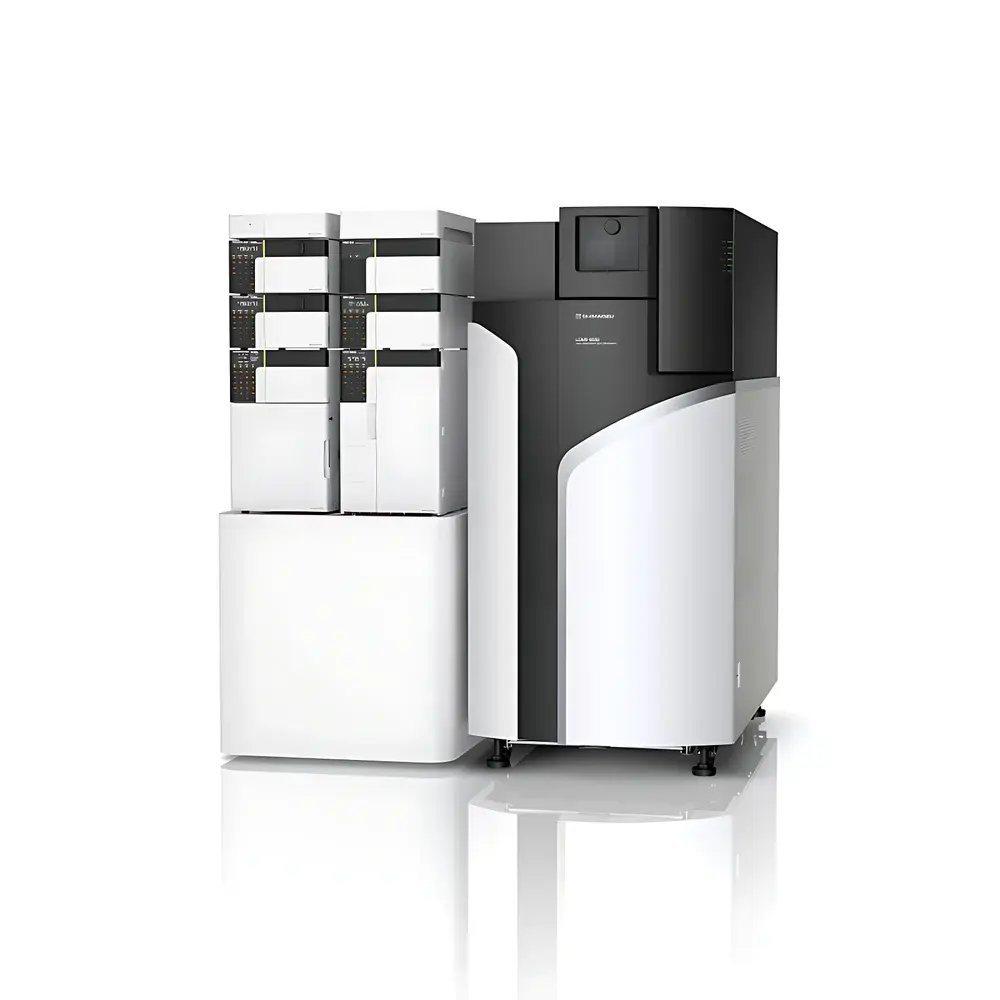
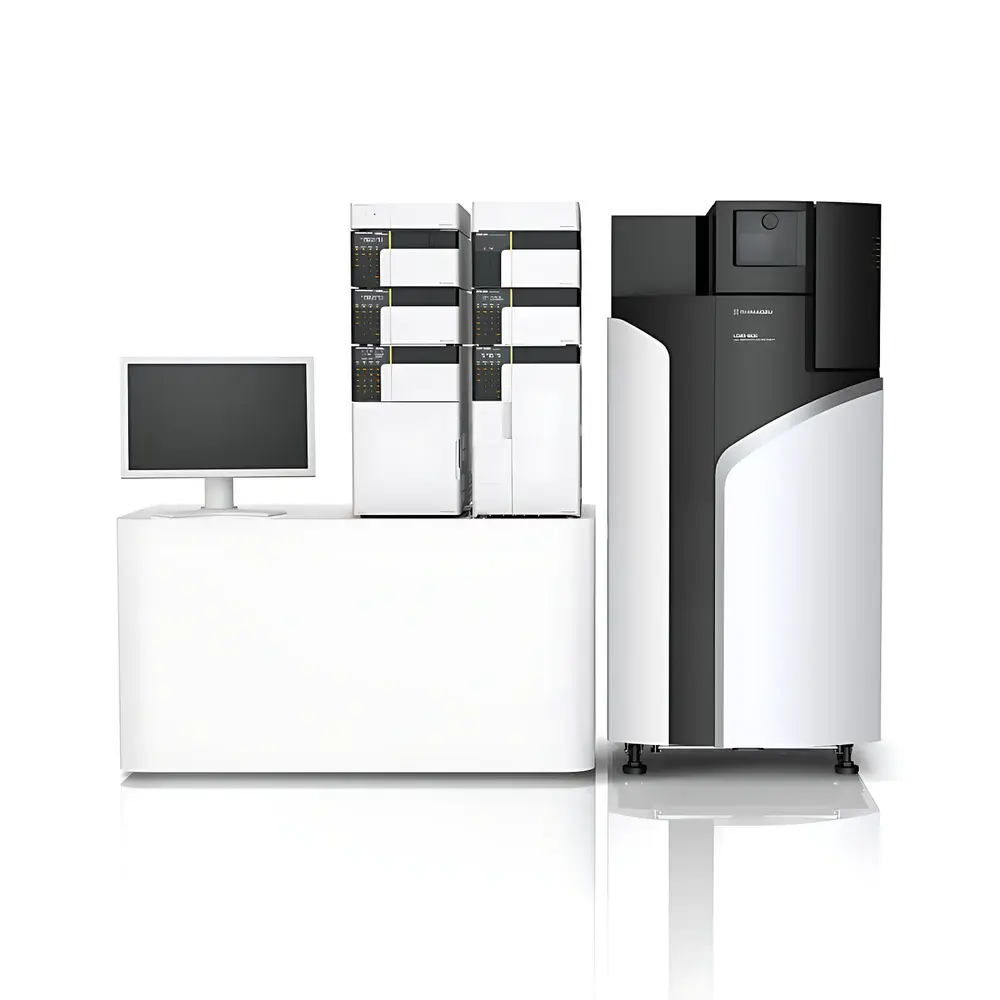
Shimadzu LCMS-9030 Quadrupole-Time-of-Flight Liquid Chromatography Mass Spectrometer
| Brand | Shimadzu |
|---|---|
| Origin | Japan |
| Manufacturer Type | Original Equipment Manufacturer (OEM) |
| Product Category | Imported Instrument |
| Model | LCMS-9030 |
| Instrument Type | Quadrupole-Time-of-Flight (Q-TOF) |
| Mass Range | 10–40,000 m/z |
| Sensitivity | S/N ≥ 50,000 (1 pg reserpine, ESI+) |
| Resolution | >40,000 (FWHM at m/z 609) |
| Mass Accuracy | <1 ppm (internal calibration, 24-h stability) |
Overview
The Shimadzu LCMS-9030 is a high-performance quadrupole-time-of-flight (Q-TOF) liquid chromatography mass spectrometer engineered for untargeted and targeted qualitative and quantitative analysis in regulated and research environments. It integrates a robust RF-driven quadrupole mass filter with an orthogonal acceleration time-of-flight (oa-TOF) analyzer, enabling simultaneous high-resolution, high-mass-accuracy acquisition across a broad dynamic range. The instrument operates on the principle of electrospray ionization (ESI) or atmospheric pressure chemical ionization (APCI), followed by mass-selective filtering in the quadrupole, collision-induced dissociation (CID) in the UF-Sweeper III collision cell, and precise time-of-flight measurement in the reflectron-based TOF analyzer. Its architecture is optimized for reproducible sub-ppm mass accuracy over extended acquisition periods—critical for metabolomics, proteomics, impurity profiling, and structural elucidation in pharmaceutical development and environmental analysis.
Key Features
- UF-Accumulation technology: Enables synchronized ion release from the collision cell with orthogonal acceleration pulses, maximizing ion transmission efficiency without compromising duty cycle or spectral fidelity.
- UF-Grating orthogonal accelerator: Patented grid-type electrode structure fabricated via Shimadzu’s precision micromachining process; maintains mechanical integrity under high extraction fields (>10 kV), ensuring consistent sensitivity and mass accuracy.
- iRefTOF reflectron: Features a custom electrode geometry generating an ideal electrostatic potential distribution, improving energy focusing and reducing trajectory dispersion during ion reflection—key to achieving >40,000 resolution (FWHM) at m/z 609.
- High-precision temperature-controlled TOF unit: Integrated heater and strategically positioned thermal sensors maintain ±0.1 °C stability within the flight tube, minimizing thermal drift and supporting long-term mass calibration integrity (<1 ppm over 24 h).
- Funnel-shaped microchannel plate (MCP) detector: Increases effective open-area ratio versus conventional MCPs, enabling higher ion detection efficiency and improved signal-to-noise performance at low-abundance analytes.
- Tool-free source exchange: ESI, APCI, and DUIS ion sources are fully modular, cable-free, and tube-free—allowing rapid, vacuum-intact swapping in under 60 seconds.
- Dual-probe Calibration Delivery System (CDS-9030): Delivers calibrant solution via a dedicated secondary probe integrated into the auxiliary ion source interface—enabling concurrent analysis and real-time mass recalibration without cross-contamination or workflow interruption.
Sample Compatibility & Compliance
The LCMS-9030 supports direct coupling with UHPLC systems (e.g., Shimadzu Nexera series) and accommodates standard 2.1 mm and 3.0 mm ID columns. It complies with key regulatory requirements for analytical instrumentation used in GLP, GMP, and FDA-regulated laboratories. Data acquisition and processing via LabSolutions LCMS support full 21 CFR Part 11 compliance when deployed with validated server infrastructure—including electronic signatures, audit trails, user access controls, and immutable raw data archiving. The system meets ISO/IEC 17025 method validation prerequisites for mass accuracy, resolution, linearity, and repeatability. All ion source configurations (ESI, APCI, DUIS) are compatible with the CDS-9030 interface, enabling seamless integration into multi-method workflows requiring both polarity-switching and internal calibration.
Software & Data Management
LabSolutions LCMS is the native control and data analysis platform—currently the only fully localized Chinese-language Q-TOF software suite available globally. It provides unified method setup, real-time monitoring, peak integration, formula prediction (via ACD/MS Fragmentor and ChemDraw integration), and customizable reporting. Five acquisition modes are supported: Full Scan MS, Product Ion Scan (MS/MS), Multiple Reaction Monitoring (MRM), Data-Dependent Acquisition (DDA), and Selected Ion Monitoring (SIM). In MS/MS and DDA modes, users define quadrupole isolation windows dynamically, facilitating flexible precursor selection based on intensity, charge state, or inclusion/exclusion lists. Report templates are editable in WYSIWYG mode and export directly to PDF with embedded spectra, chromatograms, and metadata. Raw data files (.qgd) are stored in a hierarchical, timestamped directory structure compliant with LIMS interoperability standards (e.g., ASTM E1897, ANSI/NIST IR 6500).
Applications
The LCMS-9030 delivers proven performance across diverse application domains: small-molecule identification and quantification in pharmaceutical stability studies (ICH Q5A/Q5C); intact protein and peptide characterization in biopharmaceutical QC; non-targeted screening of environmental contaminants (e.g., PFAS, pesticides) per EPA Method 1694; lipidomics profiling using shotgun and LC-MS approaches; and forensic toxicology screening with retrospective data mining. Its 100 Hz acquisition rate enables high-fidelity capture of narrow UHPLC peaks (<5 s wide), while polarity switching in ≤1 s supports comprehensive coverage of both acidic and basic analytes in a single run—eliminating the need for duplicate injections. The system is routinely deployed in national drug control laboratories, academic core facilities, and contract research organizations performing method development under USP , EP 2.2.46, and JP 2.07 guidelines.
FAQ
What mass calibration strategy does the LCMS-9030 support?
It supports both internal and external calibration using the CDS-9030 dual-probe system, allowing continuous real-time recalibration during acquisition without interrupting sample analysis.
Is the instrument compatible with third-party LC systems?
Yes—standard analog and digital I/O interfaces (TTL, RS-232, Ethernet) enable synchronization with non-Shimadzu UHPLC platforms via trigger signals and status feedback.
How is vacuum integrity maintained during routine maintenance?
The dual-stage turbo-molecular pump system (with primary rotary vane pump) isolates the TOF and quadrupole regions; source components—including the DL tube—can be replaced without venting the mass analyzer chamber.
Does LabSolutions LCMS support batch processing of high-resolution datasets?
Yes—the Batch Process Manager handles automated peak detection, alignment, normalization, and statistical analysis across hundreds of samples, with optional integration into R-based chemometric pipelines (e.g., XCMS, MetaboAnalyst).
What level of technical support is available outside Japan?
Shimadzu operates certified service centers in Beijing, Shanghai, Guangzhou, Chengdu, Shenyang, and Xi’an, staffed by >90 field-deployed mass spectrometry engineers and backed by regional bonded spare parts depots for rapid turnaround.





