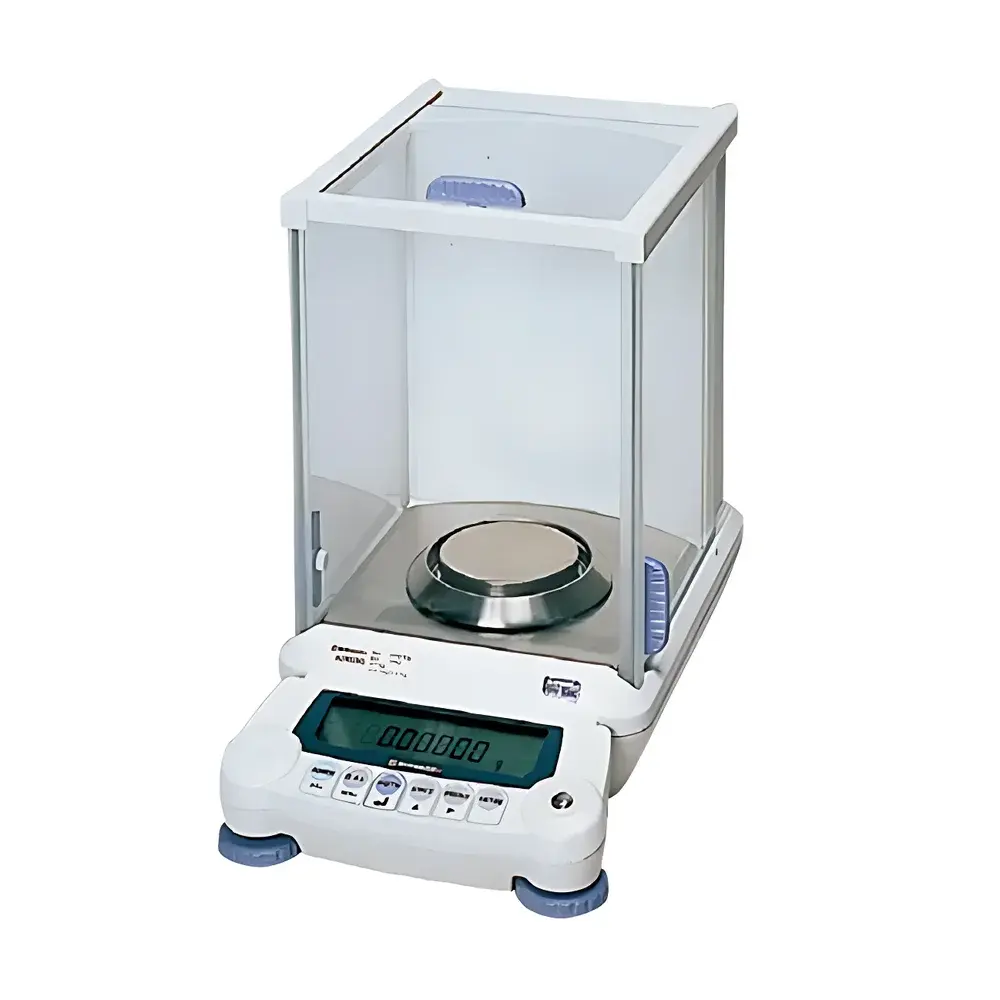
Shimadzu AUW-D Series Semi-Micro Balance
| Brand | Shimadzu |
|---|---|
| Origin | Japan |
| Manufacturer Type | Original Equipment Manufacturer (OEM) |
| Import Status | Imported |
| Model | AUW220D / AUW120D |
| Instrument Type | Analytical Balance |
| Maximum Capacity | 220 g / 120 g |
| Readability | 0.01 mg (10 µg) |
| Repeatability | 0.02 mg |
| Calibration | Internal motorized calibration with built-in weights |
| Calibration Modes | PSC (Programmable Self-Calibration) and Clock-CAL |
| Compliance | GLP/GMP/ISO data integrity support |
| Interface | Standard DATA I/O port for direct printer connection |
| Data Transfer | Native Windows Direct-Window™ functionality (no driver or third-party software required) |
Overview
The Shimadzu AUW-D Series Semi-Micro Balance is an analytical weighing instrument engineered for high-precision mass determination in regulated laboratory environments. Based on Shimadzu’s proprietary Unibloc monolithic sensor technology, the AUW-D eliminates traditional mechanical dependencies—such as screws, springs, and multi-component load cell assemblies—replacing them with a single-piece, stress-optimized ceramic-metallized transducer. This architecture delivers exceptional mechanical stability, thermal inertia resistance, and dynamic response time—critical attributes for applications requiring sub-10 µg readability under variable ambient conditions. Designed specifically for semi-micro applications—including gravimetric standard preparation, pharmaceutical assay validation, reference material certification, and trace-level sample quantification—the AUW-D operates within ISO 9001-compliant manufacturing facilities and meets the mechanical and metrological requirements of OIML R76-1 (Class I) and USP for analytical balances.
Key Features
- Unibloc Monolithic Sensor Platform: A patented one-piece transducer structure ensures long-term zero stability, minimal creep, and immunity to mechanical hysteresis—enabling consistent 0.01 mg readability across extended operational cycles.
- Dual-Range Calibration Architecture: Supports two internal calibration ranges optimized for both low-mass (e.g., 1–10 mg) and high-mass (e.g., 50–200 g) operations, minimizing drift-induced uncertainty during routine switching between sample classes.
- Intelligent Auto-Calibration System: Integrates two autonomous calibration protocols—PSC (Programmable Self-Calibration), triggered by ≥0.5 °C ambient temperature shift, and Clock-CAL, executed at user-defined intervals (e.g., every 2, 4, or 12 hours)—ensuring continuous traceability without manual intervention.
- GLP/GMP-Ready Data Handling: Built-in DATA I/O interface enables direct RS-232 output to certified thermal or dot-matrix printers; all calibration events, weight readings, timestamps, operator IDs (via optional keypad login), and environmental metadata are auto-printed in audit-ready format compliant with FDA 21 CFR Part 11 Annex 11 requirements.
- Windows Direct-Window™ Integration: Native OS-level communication protocol allows real-time drag-and-drop transfer of measurement values into Excel, LIMS, ELN, or custom QA/QC spreadsheets—eliminating middleware, drivers, or API configuration overhead.
Sample Compatibility & Compliance
The AUW-D Series accommodates standard 80 mm × 80 mm draft shield configurations and supports optional anti-static ionizers, draft shield interlocks, and vibration-dampening isolation tables for ultra-low-mass measurements. All models conform to ISO/IEC 17025:2017 clause 6.4.10 (measurement equipment suitability), EU Directive 2014/32/EU (Measuring Instruments Directive), and ASTM E898–22 (Standard Guide for Selection and Use of Analytical Balances). Routine verification procedures align with USP “Weighing on an Analytical Balance” and EP 2.1.6 “Analytical Balance Performance Verification”.
Software & Data Management
No proprietary software installation is required. The Windows Direct-Window™ function leverages native Windows clipboard and COM port abstraction layers, ensuring compatibility with Windows 10/11 (64-bit) and legacy enterprise systems running Windows Server 2016+. Calibration logs include digital signatures, full environmental context (temperature, humidity if external sensor connected), and tamper-evident timestamps. Optional PC-based Shimadzu Balance Utility (v3.2+) provides enhanced audit trail export (CSV/XML), statistical process control (SPC) charting, and integration with LabWare LIMS via HL7 or ODBC.
Applications
- Preparation of certified reference materials (CRMs) per ISO Guide 35
- Gravimetric dilution series for HPLC/UHPLC standard stock solutions
- Residual solvent analysis sample weighing in accordance with ICH Q2(R2)
- API potency assays requiring ≤0.1% relative standard deviation (RSD)
- Quality control of catalysts, nanomaterials, and high-purity metal powders
- Method validation per ICH Q5C and pharmacopoeial general chapters (USP , Ph. Eur. 2.1.6)
FAQ
What does “Unibloc” refer to in the AUW-D sensor architecture?
Unibloc denotes Shimadzu’s monolithic sensor design—a single-crystal ceramic transducer with integrated strain gauges and temperature compensation circuitry, eliminating mechanical interfaces that introduce drift or hysteresis.
Is the AUW-D compliant with FDA 21 CFR Part 11 for electronic records?
Yes—when used with enabled timestamping, operator authentication (via optional numeric keypad), and printed calibration reports, the system satisfies Part 11 requirements for signed electronic records and audit trails.
Can the AUW-D be integrated into a networked LIMS environment?
Direct serial output supports ASCII-based LIMS ingestion; for TCP/IP integration, the optional Shimadzu Balance Utility provides configurable Ethernet-to-RS232 bridging and HL7 message formatting.
What environmental conditions are recommended for optimal 0.01 mg performance?
Stable ambient temperature (±1 °C/hour), relative humidity 30–60% RH, and vibration isolation (≤0.5 µm peak-to-peak at 10 Hz) are advised per USP guidelines.
Does the AUW-D support external environmental monitoring inputs?
Yes—via optional analog input module, the balance can accept signals from external temperature/humidity sensors for contextual metadata stamping in calibration and measurement logs.