
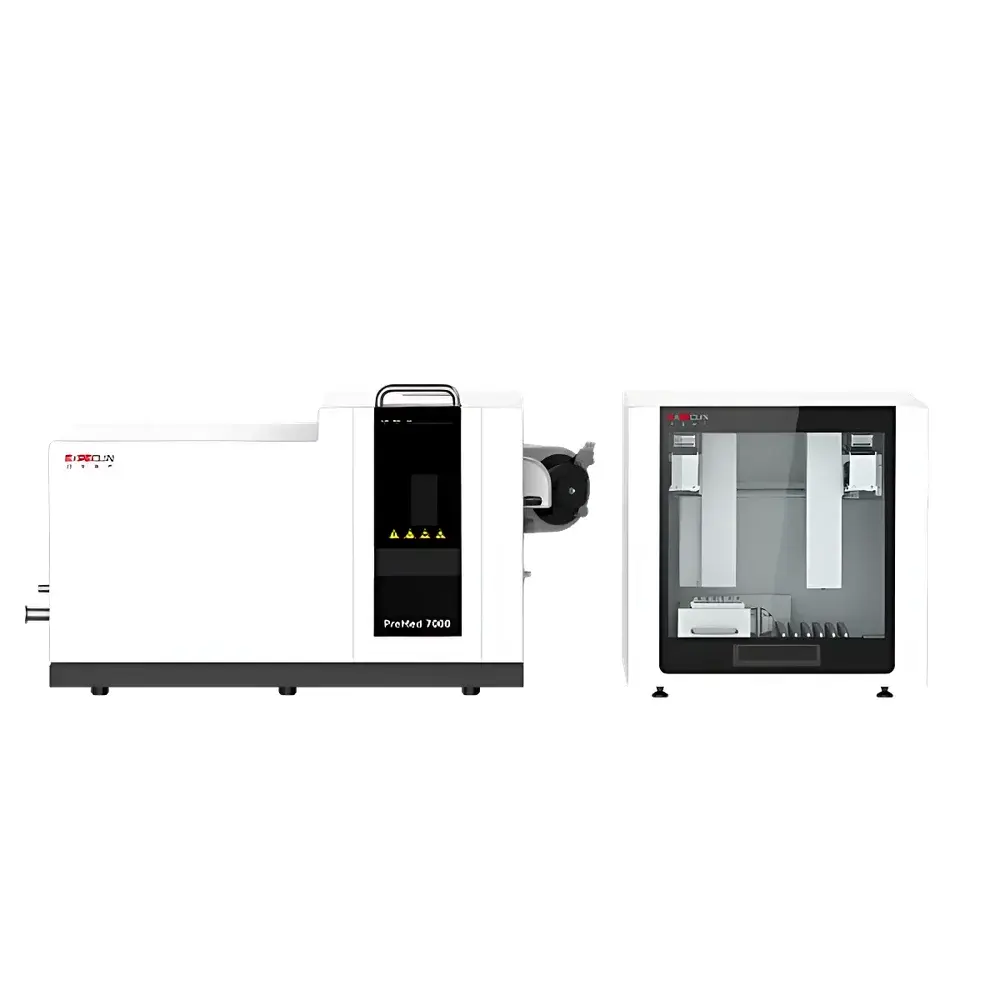
PreMed 7000 Inductively Coupled Plasma Mass Spectrometer (ICP-MS)
| Brand | EXPECLIN / Puju Medical |
|---|---|
| Origin | Zhejiang, China |
| Manufacturer Type | Authorized Distributor |
| Domestic Product Classification | Domestic |
| Model | PreMed 7000 |
| Pricing | Available Upon Request |
Overview
The PreMed 7000 ICP-MS is a high-performance inductively coupled plasma mass spectrometer engineered for clinical trace element analysis, environmental monitoring, and pharmaceutical quality control. It operates on the fundamental principle of ionizing sample atoms in a high-temperature argon plasma (~6,000–10,000 K), followed by mass separation via a quadrupole mass analyzer and detection using a dual-mode detector system capable of analog and digital signal acquisition. Unlike conventional laboratory-grade ICP-MS systems optimized for geological or metallurgical applications, the PreMed 7000 is specifically designed for routine clinical laboratories—featuring robust plasma stability under variable matrix loads, low-background ion optics, and rapid elemental screening across complex biological matrices such as whole blood, serum, and urine without extensive sample pre-treatment.
Key Features
- Self-excited all-solid-state RF generator with frequency-matching tuning and dual-channel closed-loop adaptive power control—ensuring long-term plasma stability during extended batch runs of clinical specimens.
- Dual off-axis ion optical system: separates analyte ions from neutral species and polyatomic interferences through angular deflection, significantly reducing background noise and improving signal-to-noise ratio (S/N) at sub-pg/mL detection levels.
- Distributed collision/reaction gas diffusion technology: enables uniform introduction of He, H2, or NH3 gases into the collision cell, enhancing interference removal efficiency for challenging isotopes (e.g., 40Ar16O+ on 56Fe+, 40Ar40Ar+ on 80Se+).
- Kinetic energy discrimination (KED) mode: selectively filters low-energy polyatomic ions while transmitting high-energy analyte ions, further suppressing oxide and doubly charged interferences.
- Large-aperture beam-bending lens: increases overall ion transmission efficiency by >35% compared to conventional electrostatic lenses, directly contributing to improved sensitivity for trace-level elements in diluted biological samples.
- Aerodynamic simulation-optimized interface between atmospheric-pressure plasma and high-vacuum mass analyzer region: minimizes pressure gradients and thermal fluctuations, ensuring consistent ion extraction and long-term operational reproducibility.
Sample Compatibility & Compliance
The PreMed 7000 supports direct dilution analysis of human serum and whole blood samples (typically 1:10 to 1:50 in 0.5% v/v nitric acid), eliminating the need for offline digestion in most clinical workflows. It complies with key regulatory expectations for clinical instrumentation, including alignment with CLIA requirements for analytical validation, ISO/IEC 17025 principles for method verification, and design features supporting FDA 21 CFR Part 11 compliance when deployed with audit-trail-enabled software configurations. Its hardware architecture allows integration into GLP/GMP-aligned laboratories where instrument qualification (IQ/OQ/PQ) documentation packages are required.
Software & Data Management
The system ships with a native Windows-based Chinese-language mass spectrometry workstation—designed for intuitive navigation and minimal training overhead. Core software capabilities include one-click automatic mass calibration and sensitivity optimization, visual parameter adjustment tools for tuning RF power, lens voltages, and collision gas flow rates, and built-in method templates for clinical multi-element panels (e.g., essential/toxic metals panel: Li, Na, Mg, K, Ca, Cr, Mn, Fe, Co, Ni, Cu, Zn, As, Se, Mo, Cd, Sb, Ba, Tl, Pb, U). Data processing supports automated peak integration, internal standard correction (e.g., Sc, Y, In, Bi), QC flagging per Westgard rules, and export to LIMS-compatible formats (CSV, XML, ASTM E1384). Audit trails, user access levels, and electronic signatures can be enabled to meet clinical data integrity standards.
Applications
- Clinical toxicology and nutritional assessment: quantitative measurement of essential (e.g., Zn, Cu, Se) and toxic elements (e.g., Pb, Cd, As, Hg) in serum, plasma, and whole blood.
- Pharmaceutical impurity profiling: detection of elemental catalyst residues (e.g., Pd, Pt, Rh) in active pharmaceutical ingredients (APIs) per ICH Q3D guidelines.
- Environmental exposure biomonitoring: analysis of urinary metals in occupational health screening programs.
- Research applications in metallomics and redox biology: speciation-ready interface compatibility for future hyphenated LC-ICP-MS workflows.
- Quality control in biologics manufacturing: trace metal contamination screening in cell culture media and final drug products.
FAQ
Does the PreMed 7000 support isotopic ratio measurements?
Yes—when operated in high mass resolution mode with appropriate calibration and standard reference materials, it delivers precision suitable for clinical isotope dilution mass spectrometry (IDMS) applications.
Is the system compatible with third-party autosamplers?
It interfaces with standard RS-232 and Ethernet protocols; however, full synchronization of fast washout cycles and method-triggered sampling is optimized with the original PreMed AS-7000 autosampler.
What vacuum system configuration does it use?
A hybrid turbomolecular pump stack backed by a dry scroll pump ensures stable base pressure (<1×10⁻⁷ Torr) in the mass analyzer region, critical for maintaining sensitivity over multi-hour sequences.
Can the software generate 21 CFR Part 11-compliant reports?
Yes—the optional GxP module provides electronic signatures, change tracking, and audit log generation required for regulated environments.
What maintenance intervals are recommended for routine clinical operation?
Daily torch cleaning, weekly skimmer cone inspection, and quarterly ion lens cleaning are advised; annual preventive maintenance includes RF generator diagnostics and vacuum system performance validation.






