
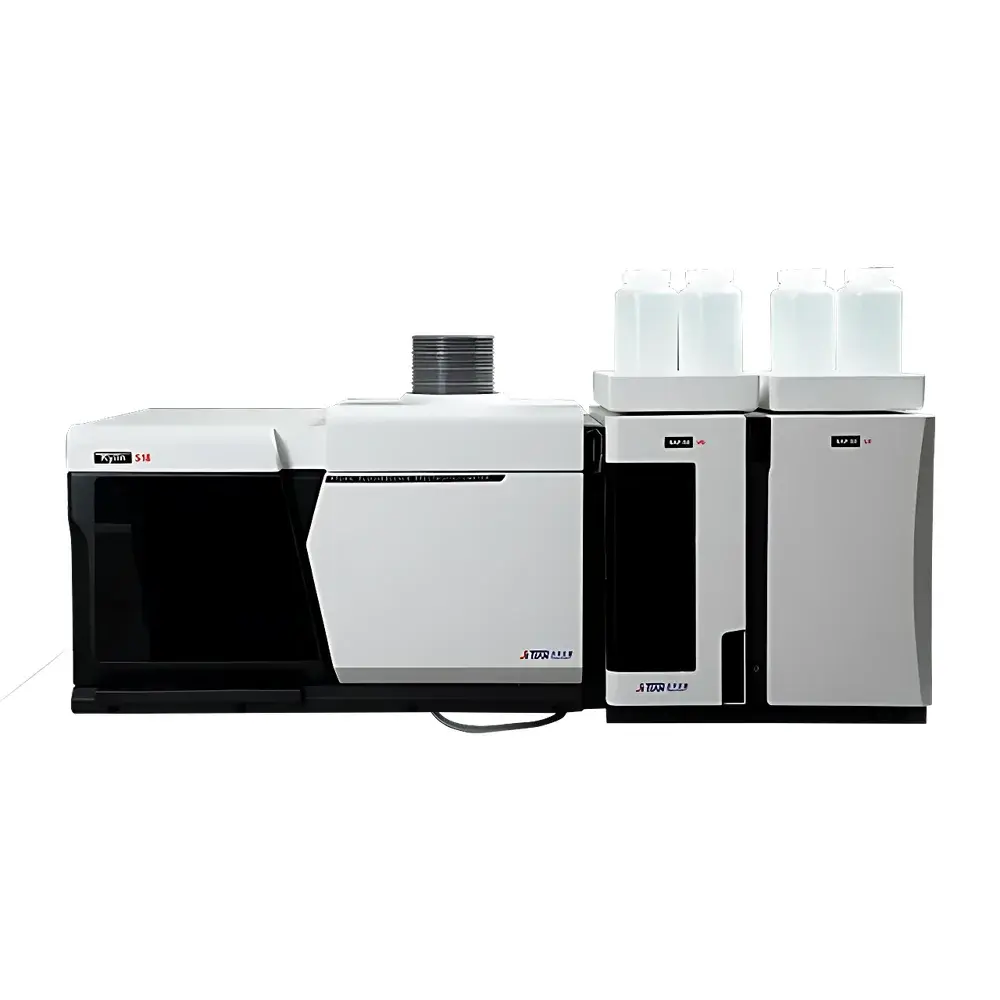
Titan Instruments SA-50 Liquid Chromatography–Atomic Fluorescence Spectrometry System (LC-AFS)
| Brand | Titan Instruments |
|---|---|
| Origin | Beijing, China |
| Model | SA-50 |
| Instrument Type | Ultra-High Performance Liquid Chromatography–Atomic Fluorescence Spectrometry System |
| Application Scope | Elemental Speciation Analysis |
| Configuration | Modular, Integrated LC Pump(s), Dual-Column Oven, Column Switching Valve, UV Photochemical Reactor with Auto-Activation, Four-Channel Peristaltic Pump, LED Status Indicators, Optional Autosampler (96-/120-position) |
| Software | Unified Control Platform for Total Element and Speciation Quantification, Method Management, Hybrid Sequence Scheduling, Real-Time Instrument Monitoring, System Self-Diagnosis, Customizable Reporting Templates |
| Compliance Framework | Designed to support GLP/GMP-aligned workflows |
Overview
The Titan Instruments SA-50 Liquid Chromatography–Atomic Fluorescence Spectrometry (LC-AFS) system is an integrated analytical platform engineered for quantitative elemental speciation analysis—specifically targeting hyphenated separation and selective detection of organometallic and inorganic species of arsenic, mercury, selenium, antimony, bismuth, and tellurium. Unlike conventional total-element assays, the SA-50 couples high-resolution liquid chromatographic separation with highly sensitive, element-specific atomic fluorescence detection following post-column photochemical hydride generation. This methodology leverages the principle of selective volatile hydride formation under UV irradiation, followed by atomization in a quartz cell and measurement of characteristic atomic fluorescence emission at defined wavelengths. The system is optimized for trace-level speciation in complex matrices—including food extracts, environmental water and sediment digests, biological tissues, and pharmaceutical excipients—where accurate differentiation between toxic (e.g., As(III), MeHg⁺) and less toxic (e.g., As(V), Hg²⁺) forms is essential for risk assessment and regulatory compliance.
Key Features
- Modular LC-AFS Architecture: Fully integrated design featuring either single or dual high-pressure LC pumps (domestic or imported options available), enabling flexible method development for isocratic or gradient elution protocols.
- Dual-Column Thermostatted Oven: Removable, thermally insulated chamber accommodating two analytical columns simultaneously; supports pre-equilibration and seamless column switching via integrated valve manifold—minimizing carryover and downtime during multi-method sequences.
- Automated UV Photochemical Reactor: Programmable on/off control of low-pressure UV lamps synchronized with chromatographic runtime; eliminates manual intervention and ensures reproducible hydride generation efficiency across batches.
- Four-Channel Precision Peristaltic Pump: Newly engineered pump head with individually calibrated tubing paths for carrier, reductant, acid, and purge gas delivery—delivering stable flow rates critical for stoichiometric hydride formation and signal stability.
- Intuitive Visual Status Interface: Multi-color LED indicators provide real-time feedback on operational state (standby, active analysis, maintenance alert, fault condition), enhancing laboratory workflow transparency and troubleshooting efficiency.
- Expandable Autosampling Capability: Optional 96- or 120-position autosamplers support full-loop, partial-loop, and micro-volume injection modes; include automated standard dilution, calibration curve generation, and programmable needle wash routines to mitigate cross-contamination.
Sample Compatibility & Compliance
The SA-50 is validated for direct injection of aqueous extracts prepared from solid samples via EPA Method 1638 (for methylmercury), ISO 17294-2 (for arsenic species), and GB 5009.11/5009.17 (Chinese national standards for As/Hg speciation in food). It accommodates sample volumes from 1 µL to 100 µL and tolerates moderate levels of organic modifiers (e.g., methanol ≤15% v/v) and chelating agents (e.g., EDTA, cysteine) commonly used in extraction protocols. All fluidic pathways employ inert PEEK and fused silica components to prevent adsorption or redox interference. When operated with Titan’s validated firmware and electronic logbook enabled, the system meets foundational data integrity requirements aligned with FDA 21 CFR Part 11, EU Annex 11, and ISO/IEC 17025 documentation practices—particularly when paired with time-stamped audit trails, user-access controls, and electronic signature functionality.
Software & Data Management
The Titan LC-AFS Control Suite provides unified management of both total-element quantification (via direct AFS readout) and speciated analysis (via chromatographic peak integration). It supports hybrid sequence scheduling—allowing concurrent runs of different methods (e.g., As-speciation followed by Hg-speciation) without manual reconfiguration. Real-time monitoring includes pressure traces, lamp intensity, detector voltage, and pump flow verification. Built-in system self-diagnostic routines verify pump priming status, valve actuation timing, UV lamp ignition, and peristaltic tube wear indicators. Report generation is template-driven, supporting customizable layouts compliant with ISO/IEC 17025 clause 7.8.2; outputs include peak tables with retention time, area/height, %RSD, calibration curve statistics (r², LOD/LOQ), and annotated chromatograms with overlay capability.
Applications
The SA-50 serves as a dedicated tool for laboratories engaged in regulatory testing and research requiring species-resolved data. Key application domains include: routine monitoring of inorganic arsenic and dimethylarsinic acid (DMA) in rice and infant cereals (per EU Commission Regulation (EU) No 2023/915); speciation of monomethylmercury and ethylmercury in fish tissue and vaccines; determination of selenomethionine vs. selenite in dietary supplements; differentiation of antimony(III) and antimony(V) in drinking water distribution systems; and investigation of bismuth citrate transformation in gastric simulant studies. Its robustness and modularity also make it suitable for university teaching laboratories conducting hands-on instruction in hyphenated analytical techniques and environmental toxicology.
FAQ
What types of elements can be speciated using the SA-50 LC-AFS system?
The system is optimized for hydride-forming elements including As, Se, Sb, Bi, Te, and Hg (via cold vapor AFS mode). Non-hydride elements require alternative detection strategies and are not supported.
Is the SA-50 compatible with third-party liquid chromatographs?
No—the SA-50 is a fully integrated system with proprietary pump control, valve sequencing, and reactor synchronization logic; external LC modules cannot be substituted without compromising method reproducibility and safety interlocks.
Can the software generate reports compliant with ISO/IEC 17025?
Yes—when configured with electronic signatures, audit trails, and version-controlled method templates, the reporting engine satisfies documentation requirements outlined in ISO/IEC 17025:2017 clause 7.8.2 for test reports.
What maintenance intervals are recommended for the UV reactor and peristaltic pump tubing?
UV lamp output should be verified monthly; typical service life is 1,000–1,500 hours. Peristaltic tubing in all four channels is recommended for replacement every 3 months under continuous operation or after 500 injections, whichever occurs first.
Does the SA-50 support method validation per ICH Q2(R2)?
While the instrument itself does not perform validation, its hardware stability, software traceability, and parameter logging capabilities enable users to execute and document ICH Q2(R2)-aligned validation protocols—including specificity, linearity, accuracy, precision, and robustness assessments.




