
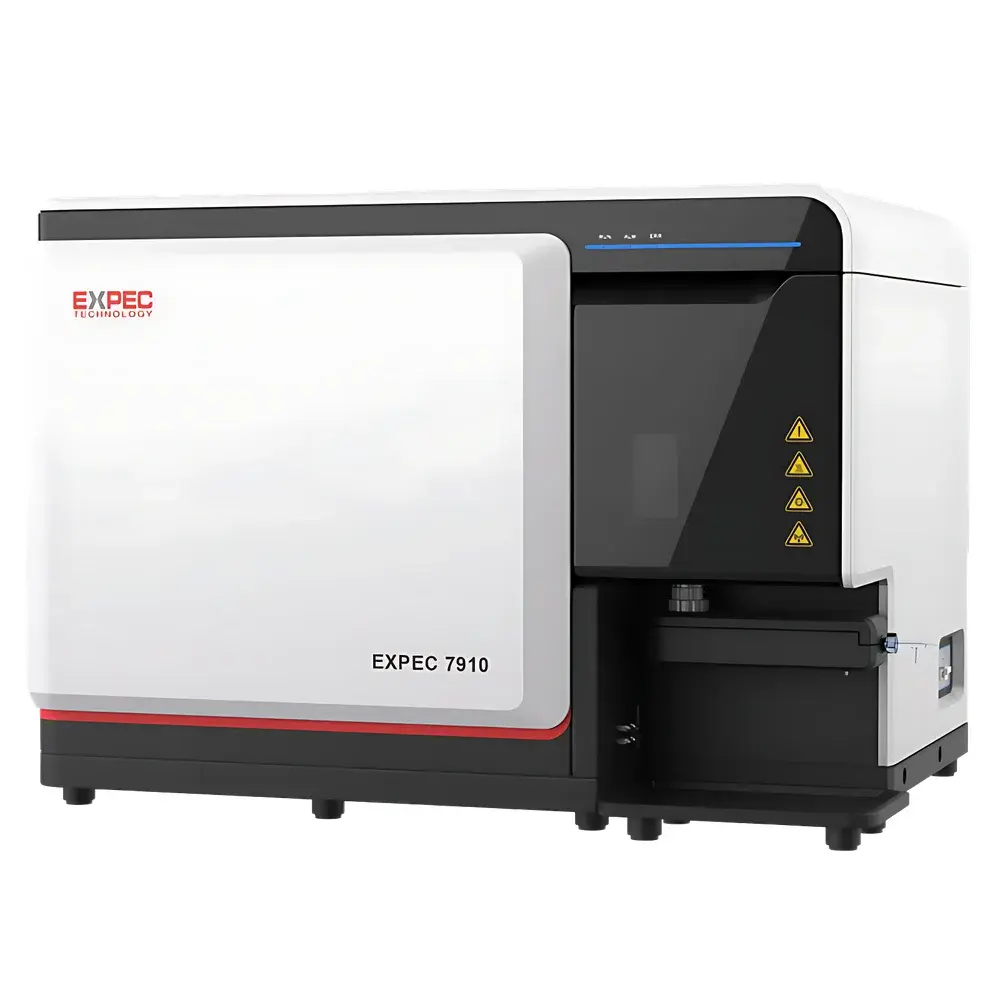
EXPEC 7910 ICP-QTOF Inductively Coupled Plasma Quadrupole-Time-of-Flight Mass Spectrometer
| Brand | EXPEC (Puyu Technology) |
|---|---|
| Origin | Zhejiang, China |
| Model | EXPEC 7910 |
| Instrument Type | Quadrupole-Time-of-Flight ICP-MS |
| Application Environment | Laboratory-Based Elemental Analysis |
| Ion Source | Inductively Coupled Plasma (ICP) |
| Mass Analyzer | Orthogonal-Acceleration Reflectron Time-of-Flight (oa-TOF) |
| Ion Optics | 90° Off-Axis RIO System with Neutral Particle Trap |
| Collision/Reaction Cell | Third-Generation Distributed-Flow Collision/Reaction Cell (DFC) |
| Quadrupole | High-Stability Molybdenum Quadrupole (MMQ) with Unit-Mass Resolution, Stepped Scan, and RF-Only Modes |
| Ion Beam Conditioning | ISO High-Compression Rectangular Ion Shaping Optics |
| Torch Configuration | Vertically Oriented ICP Torch with Integrated Coil Movement Mechanism |
Overview
The EXPEC 7910 ICP-QTOF is a high-performance quadrupole-time-of-flight inductively coupled plasma mass spectrometer engineered for simultaneous multi-element detection with isotopic resolution, sub-part-per-trillion (sub-pg/g) detection sensitivity, and full-spectrum acquisition at up to 50 kHz transient recording rates. It integrates an ICP ion source with orthogonal acceleration (oa) into a reflectron-based time-of-flight mass analyzer, enabling true simultaneous detection across the entire mass range (m/z 5–280) without scanning—preserving temporal fidelity critical for single-particle, single-cell, and transient signal analysis. Unlike conventional quadrupole or magnetic sector ICP-MS systems, the oa-TOF architecture delivers intrinsic mass accuracy ( 40,000 FWHM at m/z 202), and linear dynamic range exceeding 8 orders of magnitude—all within a single acquisition. The system is designed for rigorous laboratory environments where elemental speciation, isotopic ratio stability, and high-throughput screening demand metrological traceability and long-term reproducibility.
Key Features
- Vertically Oriented ICP Torch (VIP Design): Reduces argon consumption by up to 30% versus horizontal configurations; integrated coil translation mechanism ensures precise, repeatable torch centering—minimizing plasma instability and extending consumable lifetime.
- 90° Off-Axis Ion Optics (RIO System): Separates ion beam path from neutral particle trajectory; includes a dedicated neutral particle trap eliminating the need for periodic lens cleaning or replacement—reducing downtime and maintenance variability.
- Molybdenum Quadrupole (MMQ): Fabricated from ultra-low-outgassing pure molybdenum; operates in unit-resolution mode for mass selection prior to TOF injection, or in RF-only mode for full-mass transmission—enabling flexible pre-filtering strategies.
- Distributed-Flow Collision/Reaction Cell (DFC): Employs orthogonal, spatially distributed gas injection to achieve uniform collision/reaction conditions across the ion beam cross-section—enhancing polyatomic interference removal (e.g., 40Ar16O+, 40Ar40Ar+) while preserving analyte transmission efficiency.
- ISO Rectangular Ion Shaping Optics: Compresses ion beam spatial and energy spread before TOF injection—increasing duty cycle and improving mass peak shape fidelity without sacrificing resolution or sensitivity.
- Vertical Reflection oa-TOF Analyzer: Features dual-stage reflectron with dynamic voltage tuning; supports both high-resolution (R > 40,000) and high-sensitivity (R ≈ 15,000) acquisition modes via software-selectable reflectron settings.
Sample Compatibility & Compliance
The EXPEC 7910 accepts liquid samples introduced via standard concentric or microflow nebulizers (e.g., PFA, quartz, or sapphire), laser ablation aerosols (with compatible LA systems), and single-particle ICP-MS suspensions (e.g., Au, Ag, CeO2 nanoparticles). It complies with ISO/IEC 17025 requirements for testing laboratories and supports audit-ready data integrity workflows aligned with FDA 21 CFR Part 11 (electronic records/signatures), EU Annex 11, and GLP/GMP documentation standards. All calibration, tuning, and QC procedures are scriptable and timestamped with operator authentication; raw data files adhere to ANDI-MS (Analytical Data Interchange) format for third-party processing.
Software & Data Management
Controlled by EXPEC MS Suite v4.x, the platform provides real-time spectral visualization, automated mass calibration (using internal or external reference gases), and batch processing for transient signal deconvolution (e.g., nanoparticle sizing, cell-by-cell quantification). Quantitative workflows support isotope dilution mass spectrometry (IDMS), standard addition, and external calibration with internal standard correction. Raw data is stored in vendor-neutral HDF5 containers with embedded metadata (instrument parameters, sample ID, acquisition time, operator log)—ensuring FAIR (Findable, Accessible, Interoperable, Reusable) data principles. Export options include mzML, CSV, and direct integration with statistical platforms (R, Python via API).
Applications
- Mass Cytometry (CyTOF): Enables simultaneous quantification of ≥ 40 metal-tagged antibodies per single cell with minimal signal spillover—supporting immunophenotyping and signaling pathway analysis.
- Single-Particle ICP-MS (spICP-MS): Detects and sizes metal-containing nanoparticles (e.g., Ag, TiO2, quantum dots) at concentrations down to 103 particles/mL with size resolution < 5 nm.
- Atmospheric Single-Particle Analysis: Couples with aerosol time-of-flight mass spectrometers (ATOFMS) or aerodynamic lens systems to resolve elemental composition of individual ambient particles (0.1–3 µm) in real time.
- Micro-Region Elemental Mapping: Interfaces with femtosecond or excimer LA systems for sub-5 µm lateral resolution mapping of geological sections, metallurgical inclusions, or biological tissues.
- Biological Tissue Imaging: Supports matrix-assisted laser desorption ionization (MALDI)-compatible workflows when used with laser ablation ion sources—generating quantitative 2D elemental distribution maps (e.g., Fe, Cu, Zn, P) in brain, liver, or tumor sections.
FAQ
What regulatory standards does the EXPEC 7910 support for data integrity?
It meets FDA 21 CFR Part 11 requirements for electronic records and signatures, including audit trails, user access controls, and secure data archiving.
Can the system perform isotope ratio measurements with certified uncertainty?
Yes—when operated in IDMS mode with certified isotopic reference materials (e.g., NIST SRM 3100 series), it achieves long-term ratio precision < 0.1% RSD for elements such as Pb, Sr, and Nd.
Is the DFC compatible with both collision (He) and reaction (NH3, O2) gases?
Yes—the DFC supports programmable gas selection, flow control, and reaction dwell timing for multi-gas sequential or mixed-gas interference removal protocols.
Does the oa-TOF require daily mass recalibration?
No—its dual-reference calibration routine (using 103Rh and 203Tl) maintains mass accuracy within ±2 ppm over 24 hours under typical lab conditions.
How is instrument performance verified post-installation?
A full IQ/OQ/PQ protocol is executed per ISO/IEC 17025, including sensitivity (cps/pg), oxide ratio (16O16O+/140Ce+), doubly charged ion ratio (138Ba2+/138Ba+), and background equivalent concentration (BEC) validation.





