
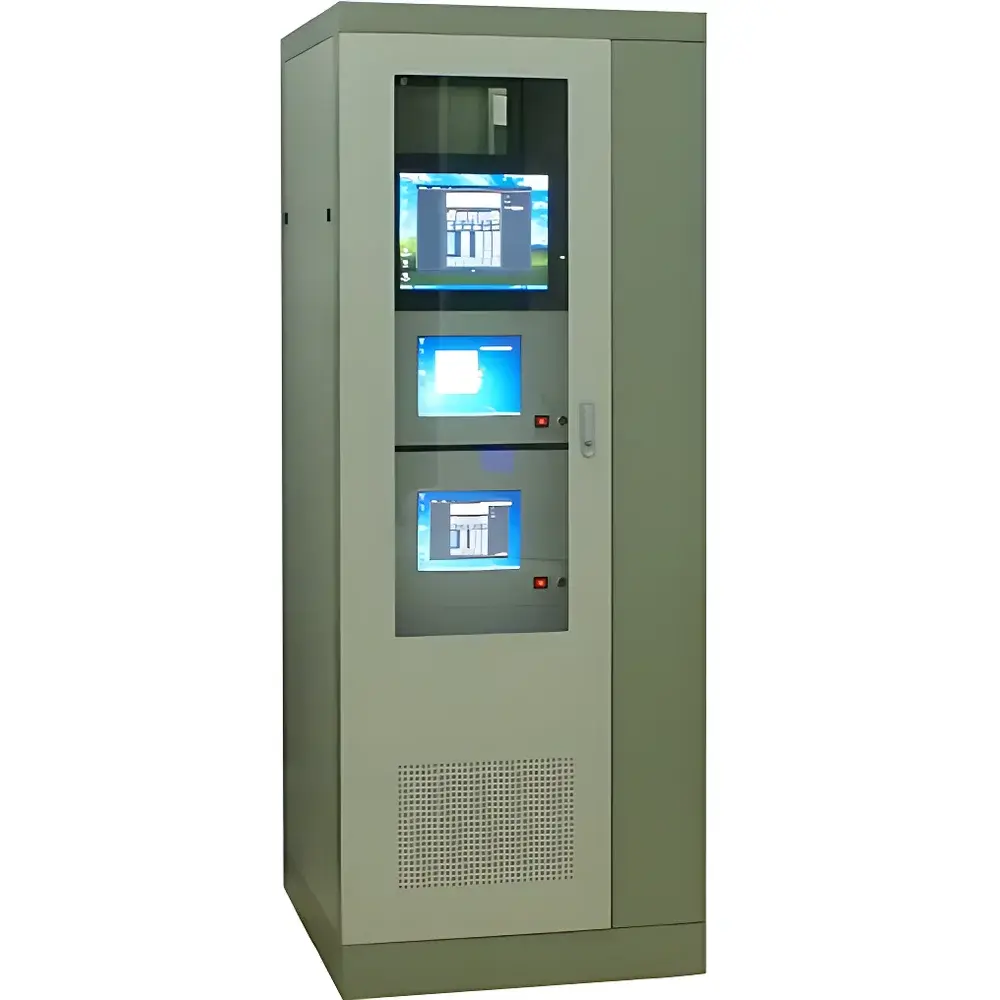
TH-830 Tianhong Fixed Source VOCs Online Monitoring System for Methane and Non-Methane Hydrocarbons (NMHC)
| Brand | Tianhong |
|---|---|
| Origin | Hubei, China |
| Manufacturer Type | Authorized Distributor |
| Country of Origin | China |
| Model | TH-830 |
| Pricing | Available Upon Request |
Overview
The TH-830 Tianhong Fixed Source VOCs Online Monitoring System is a fully automated, laboratory-grade gas chromatographic analyzer engineered for continuous, real-time quantification of methane (CH₄) and non-methane hydrocarbons (NMHC) in industrial exhaust streams. It operates on the principle of dual-column gas chromatography with center-cutting and back-flush modulation, coupled with flame ionization detection (FID). This architecture enables selective separation and independent measurement of total hydrocarbons (THC), methane, and NMHC—calculated as THC minus CH₄—without reliance on subtraction-based estimation or catalytic oxidation. The system maintains all critical flow paths—including sampling line, quantitative loop, and column oven—at a precisely controlled 180 °C to prevent condensation and adsorption of volatile organic compounds, ensuring representative sampling from hot, humid, or particulate-laden flue gases typical of stack emissions.
Key Features
- Dual-column GC configuration with center-cutting and back-flush valve sequencing per HJ/T 38–1999 methodology, enabling direct, simultaneous determination of CH₄ and NMHC
- High-temperature sample path (180 °C) throughout the entire analytical train—from probe to detector—to eliminate cold spots and minimize memory effects
- Hydrogen Flame Ionization Detector (FID) with auto-ignition capability, wide linear dynamic range (>10⁷), and stable baseline performance under varying ambient conditions
- Electronic Pressure Control (EPC) for carrier gas (N₂ or He), hydrogen, and synthetic air—precision ±0.01 psi, ensuring retention time stability and method reproducibility
- Integrated system diagnostics: power-on self-test, carrier gas failure protection, automatic restart after brief interruption (<5 min), and configurable alarm outputs for fault conditions (e.g., low H₂ pressure, FID extinguishment, column oven over-temperature)
- Core components sourced from globally recognized suppliers—including valves, detectors, and EPC modules—to ensure long-term operational reliability and mean time between failures (MTBF) exceeding 12,000 hours
Sample Compatibility & Compliance
The TH-830 is validated for use with extractive sampling systems compliant with EPA Method 25A and Chinese standard HJ/T 38–1999. It accommodates sample matrices containing up to 10% v/v CO₂, ≤500 ppm SO₂, and ≤100 ppm NOₓ without interference—provided appropriate conditioning (e.g., particle filtration, moisture removal via Nafion dryer or chiller) is implemented upstream. The system supports both stack-mounted and shelter-based deployment configurations and meets IP54 ingress protection requirements for outdoor instrument enclosures. Data integrity features—including audit-trail-enabled event logging and user-access-controlled parameter modification—align with GLP and ISO/IEC 17025 documentation expectations for environmental monitoring laboratories.
Software & Data Management
The embedded control software provides full remote operation via Ethernet (TCP/IP) or optional 4G LTE modem. Chromatographic acquisition, peak integration, calibration management, and report generation are handled through a web-accessible interface compatible with modern browsers. Raw chromatograms, calibration curves, and maintenance logs are stored locally on industrial-grade SSD with 30-day circular buffer; export options include CSV, PDF, and XML formats compliant with China’s national emission monitoring platform (MEP-EMIS) data transmission protocols. All critical events—including valve actuations, detector status changes, and calibration validations—are timestamped and archived with user ID attribution, satisfying traceability requirements under GB/T 32200–2015 and supporting regulatory audits.
Applications
- Continuous emission monitoring (CEMS) at fixed sources including petrochemical refineries, ethylene crackers, and aromatic production units
- Compliance verification for VOC abatement systems (e.g., RTOs, catalytic oxidizers) in coating, printing, and automotive painting facilities
- Boundary-line monitoring for fugitive emission assessment in chemical manufacturing parks
- Research-grade source profiling and speciation support when integrated with pre-concentration or GC×GC modules
- Method validation and reference analysis in provincial environmental monitoring stations operating under CNAS accreditation
FAQ
Does the TH-830 comply with HJ 38–2017, the updated version of HJ/T 38–1999?
Yes—the hardware architecture and chromatographic method logic are fully compatible with HJ 38–2017 requirements for NMHC measurement, including mandatory use of methane-specific column separation and FID detection.
Can the system be integrated into existing DCS or SCADA infrastructure?
Yes—standard 4–20 mA analog outputs (for CH₄, NMHC, and system status) and Modbus TCP digital communication are supported out-of-the-box.
What is the minimum detectable concentration for methane under typical operating conditions?
At 1-minute cycle time and using N₂ carrier gas, the system achieves a method detection limit (MDL) of ≤0.05 ppmv CH₄ (as carbon) with signal-to-noise ratio ≥3, per EPA 40 CFR Part 60, Appendix A–1.
Is routine maintenance limited to consumables only?
Yes—primary scheduled tasks include FID jet cleaning every 3 months, septum replacement every 6 months, and annual calibration verification; no column reconditioning or detector refurbishment is required within first 24 months of operation.
Does the system support unattended operation for extended periods?
Yes—it is rated for 7×24 continuous operation with remote diagnostics, automated zero/span checks (configurable interval), and email/SMS alerting via optional gateway module.







