
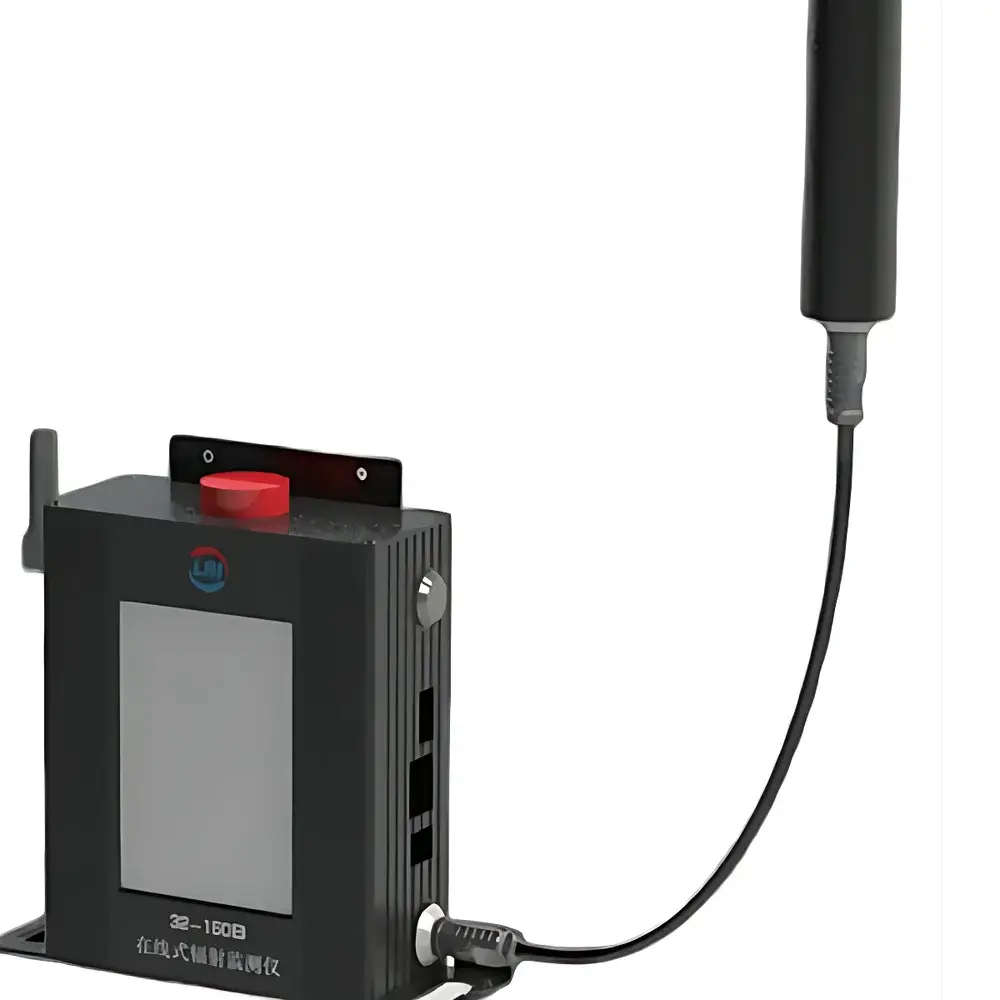
Aolong 32-150B Online Radiation Monitor
| Brand | Aolong |
|---|---|
| Origin | Liaoning, China |
| Manufacturer Type | Manufacturer |
| Country of Origin | China |
| Model | 32-150B |
| Price | Upon Request |
| Detection Radiation | X-ray and γ-ray |
| Dose Rate Range | 0.01 µSv/h to 10 mSv/h |
| Cumulative Dose Range | 0.1 µSv to 1 Sv |
| Energy Response Range | 30 keV to 3 MeV |
| Dose Rate Accuracy | < ±30% |
| Operating Temperature | −20 °C to +50 °C |
| Relative Humidity | < 90% (non-condensing) |
| Power Input | DC 5 V |
| Dimensions | 110 mm × 135 mm × 47 mm |
| Weight | < 500 g |
| Display | Large-color high-brightness LED |
| Alarm | Audible and visual alarm with user-adjustable threshold |
| Mounting | Wall-mountable or benchtop placement |
| Connectivity | Ethernet port, USB interface, optional Wi-Fi antenna |
Overview
The Aolong 32-150B Online Radiation Monitor is a continuously operating, real-time environmental radiation surveillance instrument engineered for reliable detection and quantification of ionizing X-ray and gamma (γ) radiation in controlled and uncontrolled environments. Based on solid-state scintillation or energy-compensated semiconductor detection principles (configurable per probe variant), the system employs a dual-unit architecture—comprising a compact main unit and a physically separable external probe—to enable flexible deployment while maintaining signal integrity over extended cable lengths. Designed for continuous duty in nuclear medicine departments, industrial radiography facilities, nuclear power plant auxiliary zones, research laboratories, and border control checkpoints, the monitor delivers second-level response latency for dose rate anomalies, ensuring timely intervention in accordance with ALARA (As Low As Reasonably Achievable) safety protocols. Its microprocessor-based signal processing engine supports dynamic background subtraction and pulse-height discrimination, reducing false positives from natural background fluctuations.
Key Features
- Dual-unit modular design: detachable external probe enables optimal sensor placement while isolating electronics from high-radiation or thermally unstable zones
- Real-time dose rate monitoring with sub-second update frequency and configurable alarm thresholds compliant with IEC 60846-1:2014 requirements for area monitors
- High-visibility color LED display (128 × 64 pixel resolution, adjustable brightness) supporting remote readability up to 15 meters under ambient lighting conditions
- Redundant communication interfaces: standard 10/100 Mbps Ethernet (RJ45), USB 2.0 for local data dump and firmware updates, plus optional IEEE 802.11 b/g/n Wi-Fi module for wireless mesh network integration
- Ruggedized housing rated IP54 for dust and splash resistance; operating temperature range validated per MIL-STD-810G Method 502.6 for thermal shock tolerance
- Low-power DC 5 V operation compatible with PoE injectors (via optional adapter) or uninterruptible power supplies for mission-critical 24/7 deployments
Sample Compatibility & Compliance
The 32-150B is calibrated using traceable Cs-137 and Co-60 reference sources and meets performance criteria outlined in ISO 4037-3:2019 (X- and gamma-ray reference radiation fields) and ANSI N42.17B-2003 for portable radiation survey instruments. It is suitable for continuous monitoring of low-to-medium intensity photon fields encountered in diagnostic radiology suites (e.g., CT control rooms), radioisotope handling labs (e.g., Tc-99m, I-131), and decommissioning sites. The energy response curve (30 keV–3 MeV) covers diagnostic X-ray beams (e.g., 60–140 kVp), industrial Ir-192 (316–612 keV), and reactor-associated gamma spectra. While not certified for personal dosimetry, its cumulative dose function provides supplementary trend data aligned with ICRP Publication 103 recommendations for area dose assessment.
Software & Data Management
The monitor generates time-stamped dose rate logs (CSV format) with UTC synchronization via NTP when connected to Ethernet. Local USB export supports direct ingestion into third-party radiation management platforms such as RadNet™, RADMIS, or custom Python/Pandas workflows. Optional Wi-Fi configuration enables TLS 1.2-secured MQTT publishing to centralized SCADA or cloud-based dashboards (e.g., Grafana + InfluxDB). Audit trails—including parameter changes, alarm events, and calibration timestamps—are retained onboard for ≥30 days and comply with GLP documentation requirements for routine environmental monitoring records. Firmware updates are digitally signed to ensure integrity per NIST SP 800-193 guidelines.
Applications
- Continuous surveillance of controlled areas in hospitals (radiology, nuclear medicine, PET/CT facilities)
- Perimeter monitoring around industrial gamma irradiators and radiography exposure cells
- Environmental baseline surveys near nuclear fuel cycle facilities and waste storage sites
- Mobile deployment on robotic platforms for hot-cell or containment zone reconnaissance
- Integration into emergency response vehicle networks for rapid radiological situational awareness
FAQ
Is the 32-150B suitable for neutron radiation monitoring?
No. The instrument is optimized exclusively for photon radiation (X- and γ-rays) and does not incorporate neutron-sensitive conversion materials or moderators.
Can the alarm threshold be configured remotely?
Yes—thresholds may be adjusted via Ethernet-connected web interface or serial command protocol (Modbus RTU over USB); Wi-Fi-enabled units support OTA configuration through RESTful API endpoints.
What is the recommended recalibration interval?
Annual recalibration against accredited reference sources is advised; field verification using check sources (e.g., 137Cs disc source) is recommended prior to each shift in high-risk applications.
Does the device support Modbus TCP for PLC integration?
Yes—Modbus TCP register mapping is documented in the technical manual and enables seamless integration with Allen-Bradley, Siemens, and Schneider Electric control systems.
Is the unit compliant with FDA 21 CFR Part 11 for electronic records?
While the hardware supports audit-trail generation, full Part 11 compliance requires implementation of organizational SOPs, electronic signature workflows, and access controls at the enterprise software layer—not embedded in the device firmware.
Related Products







