
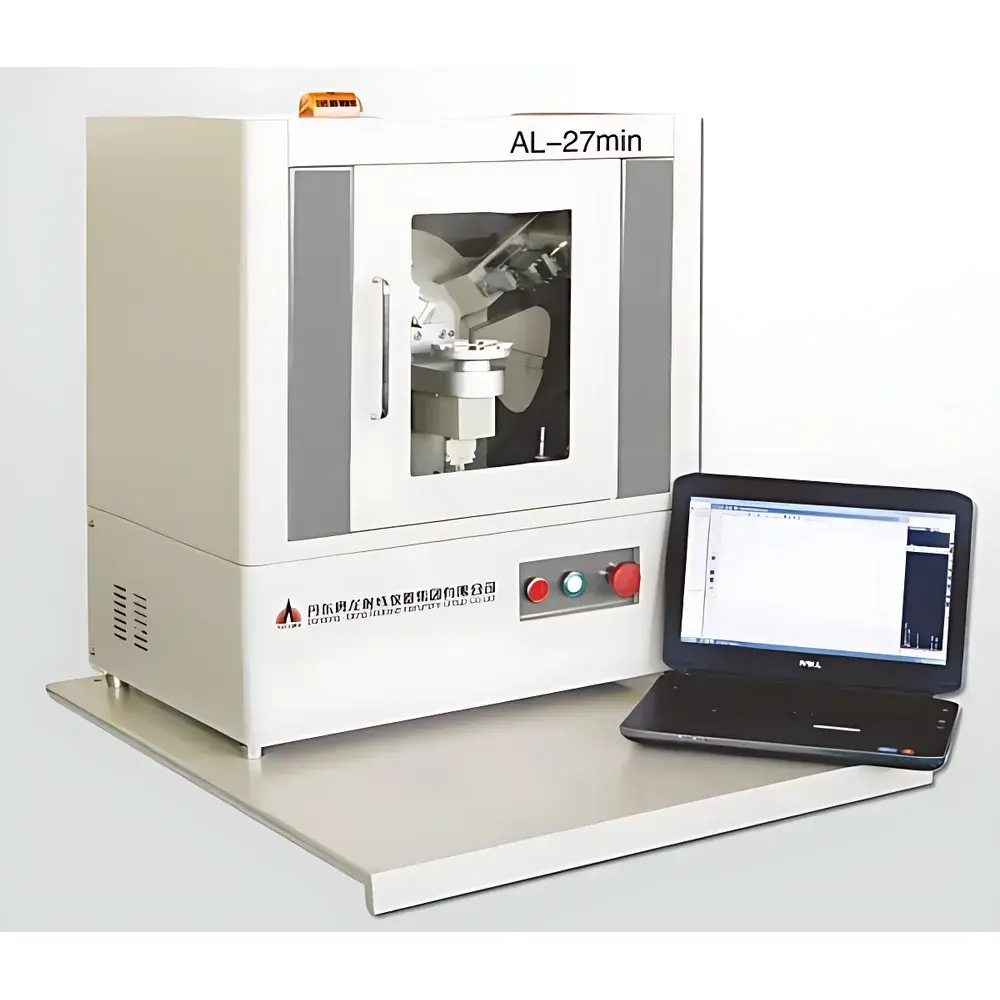
Aolong AL-27min Benchtop X-ray Diffractometer
| Brand | Aolong |
|---|---|
| Origin | Liaoning, China |
| Manufacturer Type | Direct Manufacturer |
| Instrument Type | Powder X-ray Diffractometer |
| Model | AL-27min |
| X-ray Tube | Metal-ceramic Cu anode (2.4 kW), focal spot 1×10 mm |
| Generator Power Options | 600 W (40 kV / 15 mA) or 1200 W (40 kV / 30 mA) |
| Voltage/Current Stability | ±0.005% |
| Goniometer Configuration | Horizontal θs–θd geometry, radius 150 mm |
| Angular Range (θs/θd coupled) | –3° to 150° |
| Minimum Step Size | 0.0001° |
| Angular Reproducibility | ±0.0005° |
| Maximum Goniometer Speed | 1500°/min |
| Detector Options | Sealed proportional counter or high-speed 1D semiconductor array |
| Energy Resolution | <25% (FWHM at Cu Kα) |
| Maximum Linear Count Rate | ≥5×10⁵ cps (proportional), ≥9×10⁷ cps (1D semiconductor) |
| Sample Changer Capacity | Up to 6 samples per loading |
| Radiation Shielding | Lead + lead-glass interlocked shutter |
| Overall Instrument Stability | ≤0.1% (RSD over 8 h) |
| Dimensions (W×D×H) | 600×410×670 mm |
| Operating System | Windows 7 (dedicated Dell commercial laptop) |
Overview
The Aolong AL-27min Benchtop X-ray Diffractometer is a compact, laboratory-grade powder X-ray diffractometer engineered for routine phase identification, quantitative analysis, and crystallographic characterization in industrial quality control and R&D environments. It operates on the principle of Bragg diffraction using monochromatic Cu Kα radiation (λ = 1.5418 Å), enabling precise determination of interplanar spacings (d-values) and lattice parameters via angular position and intensity measurement of diffracted X-rays. Designed for robustness and operational simplicity, the AL-27min integrates a high-stability metal-ceramic X-ray tube, precision θs–θd goniometer with 150 mm radius, and dual detector compatibility—supporting both sealed proportional and high-throughput 1D semiconductor detection. Its benchtop footprint (600 × 410 × 670 mm) and integrated radiation shielding (lead + interlocked lead-glass viewport, ≤1 μSv/h scatter dose) meet international safety requirements for Class I X-ray equipment under IEC 61010-1 and GBZ 117–2020. The system is calibrated and validated for compliance with ASTM E975 (Standard Practice for X-ray Diffraction Analysis of Metals), ISO 21379:2020 (XRD for crystalline phase quantification), and USP <1112> (for pharmaceutical solid-state characterization).
Key Features
- Precision goniometric architecture: Horizontal θs–θd configuration with 150 mm radius ensures mechanical rigidity and minimizes eccentricity error during scanning.
- High-resolution angular control: Minimum step size of 0.0001° and reproducibility of ±0.0005° support accurate peak position determination for lattice parameter refinement and microstrain analysis.
- Dual-power X-ray generator: Switchable 600 W (40 kV / 15 mA) and 1200 W (40 kV / 30 mA) modes enable optimization between resolution (low-power, low-heat-load operation) and throughput (high-power, high-intensity acquisition).
- Thermally stable metal-ceramic X-ray tube: Cu anode with 2.4 kW nominal rating, 1 × 10 mm focal spot, and optional air- or water-cooling (≥2.5 L/min flow rate) ensures long-term tube life and consistent beam intensity.
- Integrated 6-position automated sample changer: Enables unattended multi-sample analysis while maintaining alignment integrity and minimizing operator exposure.
- Comprehensive radiation safety design: Interlocked shutter, lead-lined housing, and real-time dose monitoring comply with occupational exposure limits per ICRP and national regulatory frameworks.
Sample Compatibility & Compliance
The AL-27min accommodates standard 25 mm Ø or 32 mm Ø flat-plate powder specimens, as well as thin-film, bulk metal, ceramic, and polymer samples mounted on low-background silicon or zero-diffraction quartz holders. It supports conventional reflection geometry (Bragg–Brentano) and optional transmission or grazing-incidence configurations via accessory kits. All hardware and software functions adhere to GLP and GMP documentation requirements: audit trails for instrument parameters, user authentication logs, electronic signatures (per FDA 21 CFR Part 11 readiness), and calibration certificate traceability to NIST-traceable reference standards (e.g., SRM 660c LaB₆, SRM 640e Si). Data files are stored in industry-standard formats (raw .raw, .xy, .csv, and CIF-compatible outputs) to ensure interoperability with third-party crystallographic databases including ICDD PDF-4+ and Cambridge Structural Database (CSD).
Software & Data Management
Control and analysis are executed via a dedicated Dell commercial laptop running Windows 7 Embedded (long-term support mode), preloaded with Aolong’s proprietary XRD Suite v3.2. The suite comprises two modular components: (1) AL-ScanControl, providing real-time regulation of tube voltage/current, shutter actuation, goniometer motion (continuous, step-scan, or omega scans), and synchronized data acquisition; and (2) AL-QuantX, a comprehensive processing engine supporting background subtraction (polynomial, rolling-ball), smoothing (Savitzky–Golay), peak detection (derivative-based and centroid algorithms), full-pattern Rietveld refinement (WPF), Kα₁/Kα₂ doublet deconvolution, crystallite size (Scherrer/Hall–Williamson), microstrain, and residual stress (Type II) calculations. All processing workflows are scriptable and exportable for SOP-driven QA/QC pipelines. Raw and processed datasets are timestamped, version-controlled, and archived with metadata (operator ID, sample ID, acquisition date/time, instrument configuration) to satisfy ISO/IEC 17025 documentation mandates.
Applications
- Pharmaceutical manufacturing: Polymorph screening, amorphous content quantification, excipient compatibility studies, and stability-indicating assays per ICH Q5A and Q6A guidelines.
- Cement & construction materials: Quantitative phase analysis of clinker minerals (alite, belite, aluminate, ferrite), sulfate phases, and supplementary cementitious materials (SCMs) per ASTM C150 and EN 196-2.
- Catalyst development: Crystallite size distribution mapping, support–metal interaction assessment, and thermal degradation kinetics via in situ or ex situ XRD.
- Pigments & coatings: TiO₂ rutile/anatase ratio determination, crystallinity index calculation, and particle size correlation via Scherrer analysis.
- Metallurgy & additive manufacturing: Phase transformation tracking (e.g., α↔β Ti, martensitic steels), texture analysis (pole figure generation), and residual stress profiling in laser-sintered components.
FAQ
Is the AL-27min compliant with FDA 21 CFR Part 11 for electronic records and signatures?
Yes—the software supports role-based user access, electronic signature capture, and immutable audit trails for all instrument parameter changes and data processing steps, meeting baseline requirements for Part 11 compliance when deployed within a validated IT infrastructure.
Can the system perform in situ temperature-resolved XRD experiments?
The base configuration does not include a heating stage; however, the goniometer’s modular flange interface is compatible with third-party HTK or TCU stages (up to 1200 °C) for controlled in situ measurements.
What reference standards are recommended for daily intensity and angle calibration?
NIST SRM 660c (LaB₆) is recommended for d-spacing calibration, while SRM 640e (Si) is used for intensity normalization and peak shape verification. Daily checks should include at least three reflections across the 2θ range.
Does the instrument support Rietveld refinement for quantitative phase analysis?
Yes—AL-QuantX includes a built-in Rietveld engine with access to ICDD PDF-4+ database integration, enabling whole-pattern fitting, scale factor optimization, and weight fraction calculation with uncertainty propagation.
What maintenance intervals are recommended for the X-ray tube and detector?
The metal-ceramic tube requires annual performance verification (output stability, focal spot integrity); the sealed proportional counter has a typical service life of >5 years under normal use, while the 1D semiconductor detector warrants biannual energy calibration and vacuum integrity checks.




