
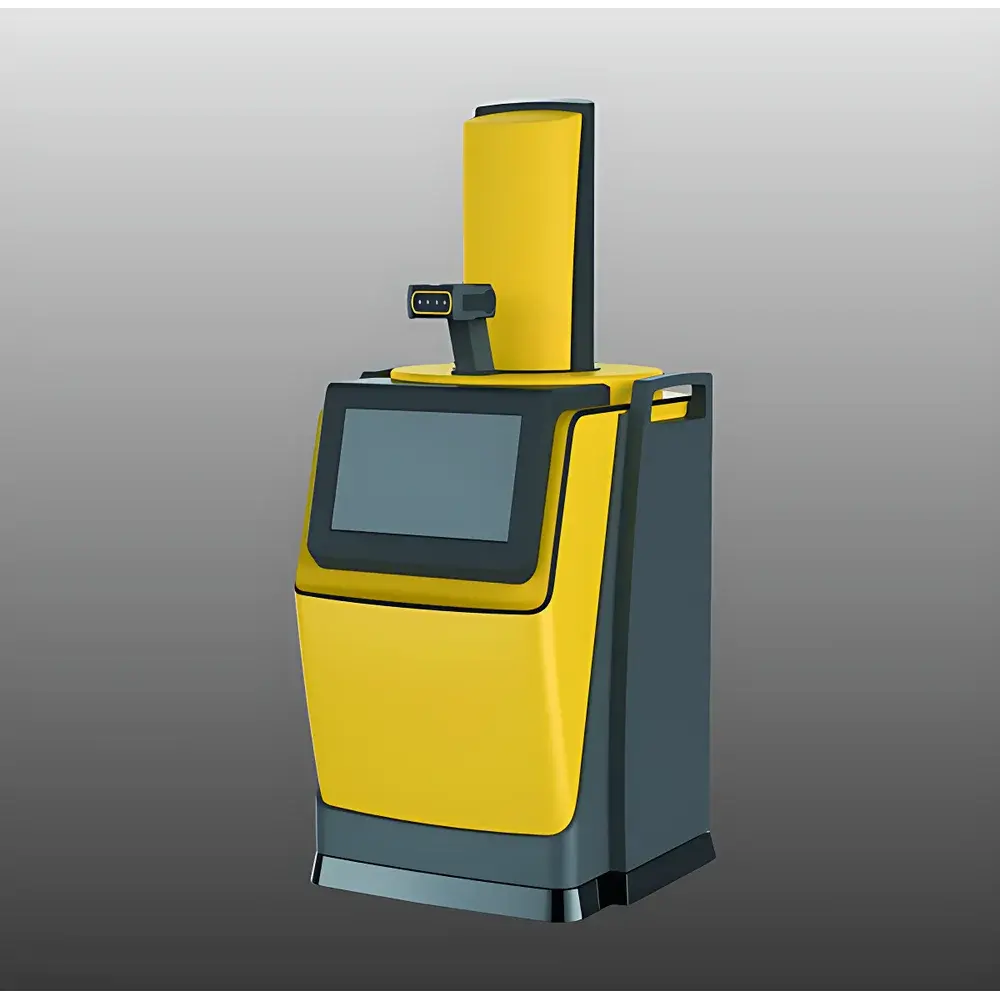
Aolong HENT33-051A Omnidirectional Gamma Radiation Source Locator
| Brand | Aolong |
|---|---|
| Origin | Liaoning, China |
| Manufacturer Type | Manufacturer |
| Product Category | Domestic |
| Model | HENT33-051A |
| Instrument Type | Dose Rate Meter |
| Radiation Type | Gamma Rays |
| Energy Range | 59 keV – 1.33 MeV |
| Dose Rate Range | 0.1 µSv/h – 100 µSv/h |
| Count Rate Range | 10 cps – 100,000 cps |
| Azimuth Accuracy | ±10° (horizontal), ±20° (vertical) |
| Azimuth Coverage | 0°–360° (horizontal), −45° to +90° (vertical) |
| Source Localization Time | ≤30 s for 10 µCi ¹³⁷Cs at 1 m |
| Isotope Identification | 20 common radionuclides |
| Power Supply | Internal rechargeable battery (12 V DC external input supported) |
| Battery Life | 5 hours |
| IP Rating | IP54 (dust and rain resistant) |
| Operating Temperature | −20 °C to +60 °C |
Overview
The Aolong HENT33-051A Omnidirectional Gamma Radiation Source Locator is a field-deployable radiation detection instrument engineered for rapid spatial localization and preliminary isotopic identification of gamma-emitting radioactive sources. Unlike conventional dose rate meters that provide only scalar intensity measurements, this device employs a segmented scintillation detector array—comprising multiple thallium-doped sodium iodide (NaI:Tl) or cerium-doped lanthanum bromide (LaBr₃:Ce) crystal units arranged in a hemispherical geometry—to capture directional photon flux distribution. By analyzing the relative count density across discrete detector segments using centroid-based angular reconstruction algorithms, the system calculates real-time source bearing in both horizontal (azimuth) and vertical (elevation) planes. Its operational principle is grounded in collimator-free directional sensitivity—a technique validated under ISO 4037-3 for calibration of directional response in photon fields—and enables first-response personnel to triangulate unknown sources without mechanical scanning or manual repositioning.
Key Features
- Omnidirectional detection architecture with 360° azimuthal coverage and −45° to +90° elevation range, eliminating blind zones during rapid survey operations.
- High-sensitivity scintillation array optimized for energy discrimination between 59 keV and 1.33 MeV, supporting accurate spectral deconvolution for isotope identification.
- Real-time directional localization algorithm delivering azimuth accuracy within ±10° and elevation accuracy within ±20° under controlled reference conditions (¹³⁷Cs point source at 1 m distance).
- Integrated dose rate measurement compliant with IEC 60846-1:2014 for portable radiation protection instruments, reporting ambient dose equivalent rate (H*(10)) from 0.1 µSv/h to 100 µSv/h.
- Onboard isotope identification engine capable of classifying up to 20 commonly encountered radionuclides—including ¹³⁷Cs, ⁶⁰Co, ²⁴¹Am, ¹⁹²Ir, and natural uranium series isotopes—based on full-spectrum peak matching against a factory-calibrated library.
- Ruggedized housing rated IP54 for dust ingress protection and resistance to light rain exposure, enabling reliable operation across outdoor environmental monitoring, nuclear facility perimeter surveillance, and emergency response scenarios.
Sample Compatibility & Compliance
The HENT33-051A is designed for direct detection of unshielded or lightly shielded gamma-emitting point sources in air. It does not require sample preparation, liquid scintillation counting, or spectral stripping techniques. The instrument meets fundamental performance criteria outlined in ANSI N42.33-2022 (Portable Radiation Detection Instrumentation for Homeland Security) and conforms to electromagnetic compatibility requirements per IEC 61000-6-2 and IEC 61000-6-3. While not certified for clinical or pharmaceutical use, its dose rate output is traceable to national standards via factory calibration using calibrated ¹³⁷Cs and ⁶⁰Co reference sources. Data logging and reporting functions support audit readiness for radiological protection programs aligned with IAEA Safety Standards Series No. RS-G-1.9.
Software & Data Management
Field data—including time-stamped dose rate readings, directional vectors, energy spectra, and identified isotopes—are stored internally with timestamp, GPS coordinates (when paired with optional GNSS module), and operator ID tags. Export is supported via USB-C interface in CSV and binary .RAD formats compatible with third-party analysis platforms such as ORTEC GammaVision and Canberra Genie 2000. Firmware updates are delivered through secure signed packages; configuration parameters (alarm thresholds, identification libraries, display units) are modifiable via password-protected GUI. Audit trail functionality records all user-initiated configuration changes, satisfying basic GLP documentation requirements for field instrumentation used in regulatory monitoring.
Applications
- Radiological emergency response: Rapid isolation of orphan sources during search-and-assessment missions following transportation incidents or illicit trafficking events.
- Environmental radiation mapping: Integration into mobile survey platforms for baseline characterization near nuclear facilities, waste repositories, or legacy mining sites.
- Decommissioning and D&D (decontamination & decommissioning): Pinpointing residual hotspots in structural components prior to cutting or removal.
- Border and port security: Secondary screening tool for detecting concealed radioactive materials in cargo containers or vehicles where portal monitors indicate anomalies.
- Academic and training laboratories: Pedagogical platform for teaching radiation physics concepts including inverse-square law verification, angular response modeling, and spectral analysis fundamentals.
FAQ
Does the HENT33-051A require annual recalibration?
Yes. To maintain metrological traceability, the instrument must undergo full energy and angular response recalibration every 12 months at an accredited laboratory using certified reference sources per ISO/IEC 17025 requirements.
Can it distinguish between naturally occurring radioactive material (NORM) and artificial isotopes?
Yes. Its spectral resolution and built-in library enable differentiation between NORM (e.g., ⁴⁰K, ²²⁶Ra, ²³²Th progeny) and anthropogenic nuclides (e.g., ¹³⁷Cs, ⁶⁰Co) based on characteristic gamma-ray energies and relative peak intensities.
Is the device suitable for underwater or high-humidity environments?
No. Although rated IP54, it is not submersible or rated for continuous high-humidity exposure (>95% RH). Prolonged condensation may impair optical coupling between scintillator and photomultiplier tube assembly.
What is the minimum detectable activity for a ¹³⁷Cs source at 1 meter?
Under typical background conditions (<0.1 µSv/h), the system achieves reliable directional localization for sources ≥10 µCi at 1 m within 30 seconds, consistent with ANSI N42.33 detection sensitivity benchmarks.
Does the firmware support custom isotope library uploads?
No. The identification library is fixed and pre-validated during type testing. Custom nuclide additions are not permitted to preserve regulatory compliance and analytical reproducibility.







