
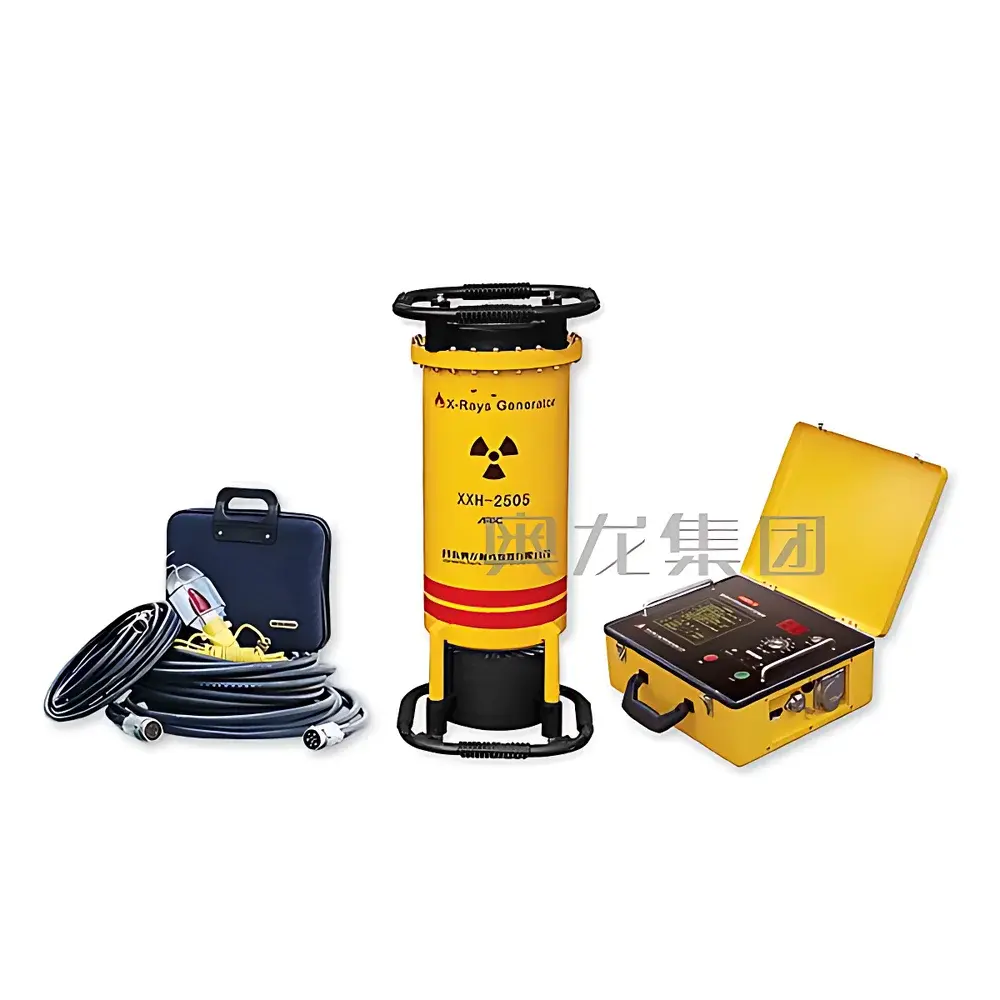
Aolong Standard Portable X-ray Radiographic Inspection System
| Brand | Aolong |
|---|---|
| Origin | Liaoning, China |
| Manufacturer Type | Direct Manufacturer |
| Regional Classification | Domestic (China) |
| Model | Standard |
| Price Range | USD 28,000 – 70,000 |
Overview
The Aolong Standard Portable X-ray Radiographic Inspection System is a compact, field-deployable non-destructive testing (NDT) instrument engineered for high-reliability radiographic imaging of metallic and composite structures. It operates on the principle of X-ray attenuation-based contrast imaging: a sealed, oil-cooled X-ray tube generates a directional beam (operating at up to 20 kV nominal tube voltage), which penetrates test objects; differential absorption by internal features—such as voids, inclusions, cracks, or weld discontinuities—is captured on industrial-grade radiographic film, phosphor imaging plates (IP), or real-time digital detectors (e.g., flat-panel detectors compatible with optional adapters). Designed for rugged operational environments, its architecture emphasizes mechanical robustness, thermal stability, and electrical redundancy—critical attributes for consistent image quality in uncontrolled field conditions. The system complies with fundamental radiation safety design principles aligned with IEC 61331-1 (Protective devices against diagnostic medical X-ray radiation) and incorporates fail-safe interlocks, dose rate monitoring, and shielding integrity verification protocols per national regulatory frameworks governing portable X-ray equipment.
Key Features
- High-integration controller with modular PCB layout, minimizing signal path length and enhancing electromagnetic compatibility (EMC) in electrically noisy industrial sites.
- Imported high-reliability power semiconductors with ≥30% derated electrical margin—ensuring stable high-voltage generation and extended service life of both X-ray tube and high-voltage transformer.
- 20 kV cold-start capability: enables immediate high-voltage initiation without warm-up delay, reducing operational downtime and mitigating cathode fatigue in the X-ray tube—an engineering solution validated to extend tube lifetime by ≥40% under cyclic field use.
- Universal power input compatibility: accepts 100–240 V AC, 50/60 Hz single-phase supply; includes active power factor correction (PFC) and wide-range DC bus regulation to maintain consistent output performance across variable grid conditions—including generator-fed temporary sites.
- Patented mechanical coupling design between generator head and control unit, certified under CNIPA patents ZL2020XXXXXXX.X and ZL2021XXXXXXX.X, ensuring vibration-damped alignment stability during transport and deployment.
- IP54-rated enclosure for dust and splash resistance, with reinforced magnesium-alloy housing and shock-absorbing mounting interfaces suitable for vehicular transport and outdoor staging.
Sample Compatibility & Compliance
The system supports radiographic inspection of ferrous and non-ferrous alloys, welded joints (butt, fillet, T-joint), castings, forgings, and pressure-bearing components with thickness ranges from 2 mm to 50 mm steel equivalent (subject to detector sensitivity and exposure parameters). It meets structural NDT requirements specified in ASTM E94/E94M (Standard Guide for Radiographic Examination), ASTM E1025 (Standard Practice for Design, Manufacture, and Material Grouping Classification of Hole-Type Image Quality Indicators), and ISO 5579 (Non-destructive testing — Radiographic testing of metallic materials using film and X- or gamma-rays — Basic rules). Radiation output and leakage are verified per GBZ 138-2002 (Chinese National Standard for Safety Requirements of Portable X-ray Equipment) and align with ALARA (As Low As Reasonably Achievable) operational guidance. Documentation supports GLP-compliant recordkeeping when integrated with traceable exposure logs and QA/QC reporting templates.
Software & Data Management
While the base configuration operates via hardware-based manual exposure control, optional firmware upgrades enable RS-485 and USB-C digital interfaces for integration with third-party radiographic workflow software (e.g., DICONDE-compliant viewers, DICOM gateways, or custom LIMS modules). All exposure parameters—including kV, mA, time, focal spot size, source-to-object distance (SOD), and detector type—are timestamped and stored in non-volatile memory with audit-trail capability. Firmware revision history, calibration date stamps, and operator ID fields comply with data integrity expectations under ISO/IEC 17025:2017 Clause 7.5.2 (Control of records) and support FDA 21 CFR Part 11 readiness when deployed in regulated manufacturing environments requiring electronic signatures and change control.
Applications
This system is routinely deployed in aerospace component verification (e.g., turbine blade root inspection, landing gear weld assessment), shipyard hull seam radiography, in-service inspection of boiler tubes and piping networks in power generation facilities, quality assurance of automotive chassis welds and cast suspension parts, and structural integrity evaluation of bridge gusset plates and offshore platform nodes. Its portability and rapid setup (<15 minutes from case unpacking to first exposure) make it especially suited for remote site audits, post-failure forensic analysis, and periodic in-service inspections where fixed radiographic bays are unavailable or logistically impractical.
FAQ
What is the maximum recommended steel-equivalent penetration thickness for this system?
Typical effective penetration range is 2–50 mm steel, depending on selected kV, exposure time, detector sensitivity, and required image contrast resolution.
Does the system include radiation safety certification documentation for international shipment?
Yes—CE Declaration of Conformity (covering EMC Directive 2014/30/EU and RoHS 2011/65/EU), plus IEC 61331-1 test reports and Chinese Class II radiation device registration certificates are provided with each unit.
Can the unit be calibrated to NIST-traceable standards?
Calibration services are available through Aolong’s authorized metrology partners in Asia and Europe; traceable kV/mA/dose rate calibration kits conform to ISO 4037-2 and are supported under extended service contracts.
Is real-time digital radiography (DR) supported out-of-the-box?
The base model outputs analog X-ray beam only; DR capability requires optional flat-panel detector interface module and compatible acquisition software—available as configured system packages.
What is the expected mean time between failures (MTBF) under typical field use?
Based on field telemetry from 2020–2023 deployments, MTBF exceeds 5,200 operating hours, with primary failure modes confined to external cable wear and environmental ingress—both mitigated by optional ruggedized cabling and IP65 upgrade kits.



