
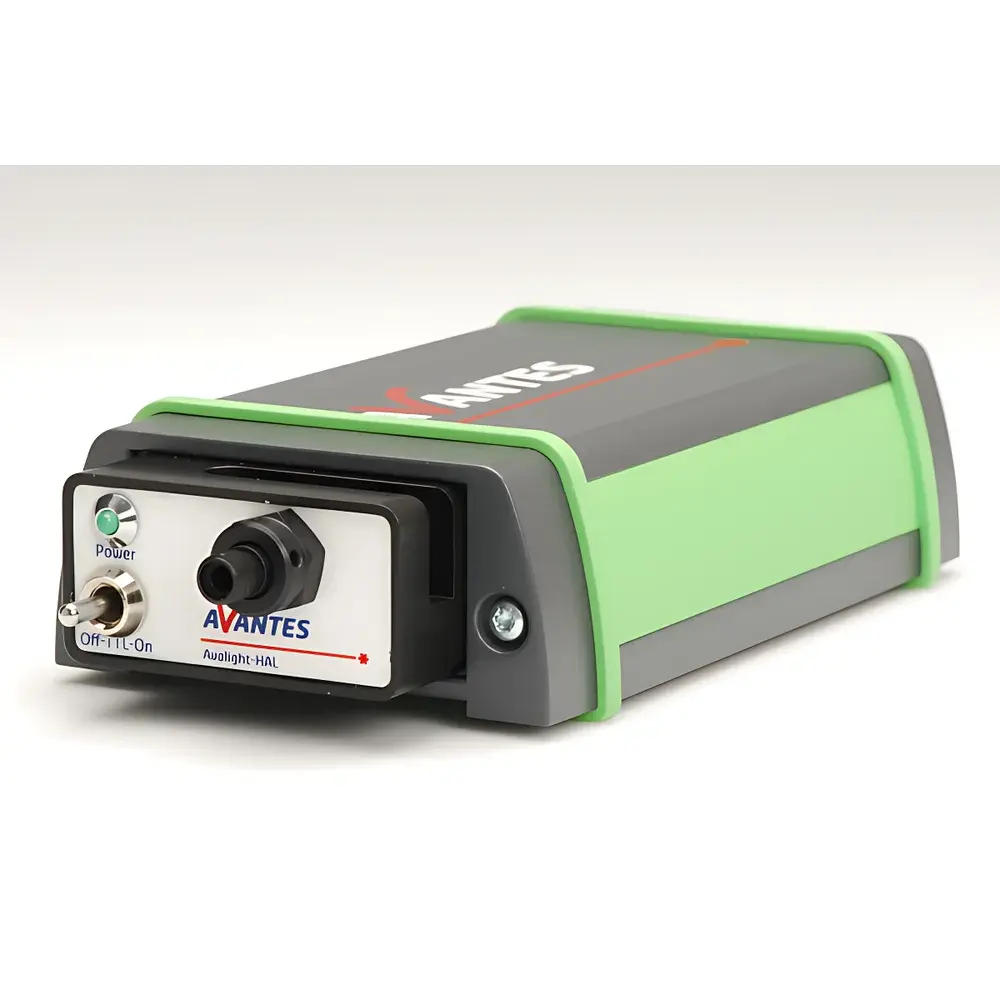
Avantes AvaLight-HAL-S-Mini Compact Halogen Light Source
| Brand | Avantes |
|---|---|
| Origin | Netherlands |
| Model | AvaLight-HAL-S-Mini |
| Light Source Type | Broadband Visible–NIR Halogen |
| Illumination Mode | Internal (Fiber-Coupled) |
| Wavelength Range | 360–2500 nm |
| Power Stability | < 0.1 %/°C |
| Warm-up Time | < 10 min |
| Lamp Lifetime | 1000–13,000 hrs (mode-dependent) |
| Color Temperature | 2647–2879 K |
| Output Power (via 1000 µm fiber) | 9.5–15.9 mW |
| Dimensions | 150 × 78 × 37 mm |
| Weight | 510 g |
| Cooling | Air-cooled |
| Fiber Interface | SMA-905, Focusable |
| Filter Slot | Accepts 25.4 mm round or 50.8 × 50.8 mm square filters |
| TTL Shutter | Integrated, Software-Controlled via AvaSpec Spectrometers |
| Power Control | Rear-panel potentiometer or external TTL/Dongle interface |
| Compliance | CE, RoHS |
Overview
The Avantes AvaLight-HAL-S-Mini is a compact, air-cooled broadband halogen light source engineered for precision optical measurement systems requiring stable, continuous spectral output across the visible and near-infrared (VIS–NIR) range (360–2500 nm). Based on a tungsten-halogen filament architecture, it operates under controlled DC voltage regulation to deliver high radiometric stability (< 0.1 %/°C) and reproducible spectral irradiance—critical for quantitative absorbance, reflectance, and transmittance measurements in laboratory and industrial settings. Its integrated focusing mechanism enables optimal coupling efficiency into optical fibers (SMA-905), ensuring maximal power transfer—particularly essential when interfacing with spectrometers, integrating spheres, or custom optical benches. Designed for long-term operational reliability, the unit supports three user-selectable operating modes—Long-Life, Standard, and High-Power—each balancing spectral radiance, color temperature (2647–2879 K), and lamp lifetime (1000–13,000 hours) to match application-specific duty cycles and metrological requirements.
Key Features
- Three configurable operating modes: Long-Life (2647 K, 13,000 h), Standard (2759 K, 4000 h), and High-Power (2879 K, 1000 h), each with calibrated DC voltage and current specifications
- Focusable SMA-905 output port enabling precise alignment and >90% coupling efficiency into 200–1000 µm core fibers
- Integrated mechanical TTL shutter, fully synchronized with Avantes AvaSpec spectrometers and controllable via AvaSoft software—including automated dark background acquisition (requires IC-DB26-2 interface cable)
- Dedicated 1-inch (25.4 mm) circular or 2×2-inch (50.8×50.8 mm) square filter slot for spectral shaping, neutral density attenuation, or UV-blocking
- Front-panel accessible lamp module—replacement completed in under 3 minutes without tools or realignment
- Rear-panel analog potentiometer and TTL-compatible dongle input for remote power modulation; compatible with LabVIEW, Python, and third-party DAQ systems
- Robust aluminum chassis with passive thermal management; rated for continuous operation from 0 to 55 °C ambient
Sample Compatibility & Compliance
The AvaLight-HAL-S-Mini is optimized for use with standard silica-based optical fibers (200 µm to 1000 µm core), cuvette holders (e.g., CUV-ATT-DA-HAL), inline attenuators (ATT-INL), and filter mounts (FH-INL). Its broadband emission profile complies with ASTM E308-22 for colorimetric calculations and supports ISO 13406-2 and CIE 15:2018 spectral irradiance reference conditions. The unit meets CE marking requirements for electromagnetic compatibility (EN 61326-1) and safety (EN 61010-1), and conforms to RoHS Directive 2011/65/EU. While not intrinsically certified for GMP/GLP environments, its stable output, audit-ready TTL shutter control, and software-integrated dark-reference acquisition support traceable calibration workflows aligned with FDA 21 CFR Part 11 data integrity principles when deployed with validated AvaSoft configurations.
Software & Data Management
Control and monitoring are fully integrated into Avantes’ AvaSoft spectroscopy platform (v10.x and later). Users can trigger the internal shutter, acquire dark references automatically, log power mode changes, and timestamp operational parameters—including lamp voltage, runtime, and thermal status. Raw spectral data generated during illumination sequences retain embedded metadata (wavelength calibration, integration time, lamp mode), facilitating post-acquisition normalization and inter-instrument comparability. For OEM or automated QA/QC integration, ASCII-based SCPI-like commands are supported over USB or RS-232, enabling seamless orchestration within Python, MATLAB, or PLC-driven test benches. Firmware updates are delivered via Avantes’ secure customer portal, with version history and release notes traceable for quality system documentation.
Applications
- Reference-grade VIS–NIR calibration of array and scanning spectrometers
- Quantitative absorbance spectroscopy in liquid-phase chemistry (e.g., concentration assays per Beer–Lambert law)
- Diffuse reflectance measurements of powders, coatings, and biological tissues
- In-line process monitoring in pharmaceutical tablet coating and food moisture analysis
- Spectral validation of integrating sphere systems and goniophotometers
- Teaching laboratories for optics, photonics, and analytical instrumentation courses
FAQ
What is the spectral output stability over time and temperature?
Output intensity drift is specified at < 0.1 % per °C ambient change after thermal equilibrium (achieved within 10 minutes), with short-term noise < 0.05 % RMS over 60 seconds at constant power mode.
Can the AvaLight-HAL-S-Mini be used with non-Avantes spectrometers?
Yes—the SMA-905 interface and analog/digital control signals are hardware-agnostic; users may drive the shutter via TTL and modulate power via 0–5 V input using third-party controllers.
Is the lamp replacement a field-serviceable procedure?
Yes—lamp modules are pre-aligned and hot-swappable; no optical recalibration is required post-replacement.
Does the unit support spectral irradiance calibration certificates?
Avantes offers NIST-traceable spectral irradiance calibration (optional add-on), including uncertainty budgets per ISO/IEC 17025:2017, valid for 12 months from issuance.
How does the focusing mechanism affect coupling efficiency into multimode fiber?
The adjustable collimator allows optimization of beam waist position relative to fiber face, achieving >92% power coupling into 1000 µm core fiber under optimal alignment—verified via integrating sphere measurements per IEC 61228.



