
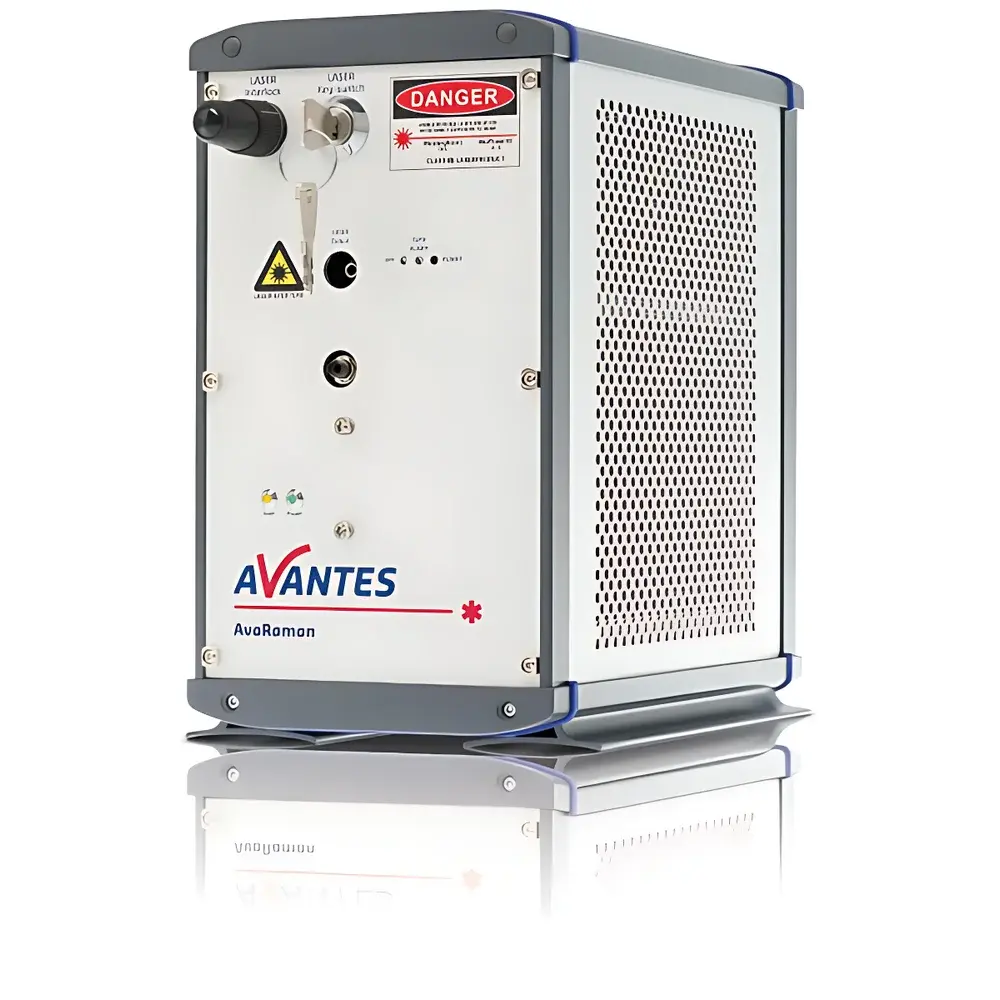
Avantes AvaRaman Series Raman Spectrometer
| Brand | Avantes |
|---|---|
| Origin | Netherlands |
| Model | AvaRaman-532TEC / AvaRaman-785TEC / AvaRaman-532HERO-EVO |
| Instrument Type | Portable Raman Spectrometer |
| Spectral Range | 100–5400 cm⁻¹ (AvaRaman-532TEC), 100–3500 cm⁻¹ (AvaRaman-785TEC), 100–3650 cm⁻¹ (AvaRaman-532HERO-EVO) |
| Spectral Resolution | 6–10 cm⁻¹ |
| Excitation Wavelength | 532 nm or 785 nm |
| Laser Linewidth | <0.2 nm |
| Detector Cooling | Thermoelectrically cooled to constant 5 °C (ΔT ≤ −35 °C vs ambient) |
| Signal-to-Noise Ratio | 200:1 (benzene, AvaRaman-532TEC), 300:1 (benzene, AvaRaman-785TEC), 800:1 (benzene, AvaRaman-532HERO-EVO) |
| Integration Time | Up to 600 s |
| Optical Platform | AvaSpec-ULS2048L-TEC (TE-cooled 3-stage CCD) or AvaSpec-HERO (HSC1200-0.75 grating, FC/PC input) |
| Slit Options | 25 µm standard, exchangeable |
| Stray Light Suppression | Enhanced ULS-TEC optical architecture |
| Dimensions | 240 × 140 × 250 mm (L × W × H) |
Overview
The Avantes AvaRaman Series is a family of portable, turnkey Raman spectroscopy systems engineered for high-fidelity molecular fingerprinting in field-deployable and laboratory-grade environments. Based on the principle of inelastic light scattering—where monochromatic laser photons interact with molecular vibrational modes—the AvaRaman instruments deliver calibrated Raman shift spectra across broad wavenumber ranges (100–5400 cm⁻¹). Unlike conventional benchtop systems constrained by trade-offs between sensitivity and resolution, the AvaRaman platform integrates proprietary optical innovations—including virtual slit technology (–XHS) and thermoelectrically stabilized detector architectures—to achieve simultaneous optimization of throughput, spectral fidelity, and signal integrity. The system employs narrow-linewidth (<0.2 nm), wavelength-stabilized lasers (532 nm or 785 nm) matched to high-efficiency holographic gratings and low-stray-light optical benches. Its modular probe interface supports fiber-coupled, focus-adjustable collection optics compatible with solid, liquid, and powder samples—enabling direct measurement without extensive sample preparation.
Key Features
- Virtual slit (–XHS) technology increases optical throughput to >95%, enhancing sensitivity up to 6× without compromising spectral resolution.
- Triple-stage thermoelectrically cooled CCD detectors (AvaSpec-ULS2048L-TEC and AvaSpec-HERO) operate at a stable 5 °C (ΔT ≤ −35 °C), reducing dark current noise by >6× and extending dynamic range by 10× versus uncooled counterparts.
- Ultra-low stray light design minimizes fluorescence interference and background distortion, supporting reliable detection of weak Raman signals—even under extended integration times (up to 600 seconds).
- Modular laser selection: 532 nm (50 mW) for higher Raman cross-sections in non-fluorescing materials; 785 nm (500 mW, Class 3B) for reduced fluorescence in organics, pharmaceuticals, and biological matrices.
- Interchangeable slits (25 µm standard) and optimized grating configurations enable application-specific resolution tuning (6–10 cm⁻¹) across three distinct models: AvaRaman-532TEC, AvaRaman-785TEC, and high-performance AvaRaman-532HERO-EVO.
- Integrated Panoraman software provides real-time spectral acquisition, baseline correction, peak identification, and multivariate analysis (PCA, PLS) with export-compatible data formats (CSV, ASCII, JCAMP-DX).
Sample Compatibility & Compliance
The AvaRaman series accommodates diverse physical states—crystalline solids, amorphous polymers, aqueous solutions, gels, and thin films—via standardized fiber-optic probes with adjustable working distance and spot size. Sample holders include reflective trays, cuvette mounts, and custom fixtures for industrial QA/QC workflows. All systems comply with IEC 61000-6-3 (EMC emissions) and IEC 61000-6-2 (immunity), and meet CE marking requirements for laboratory instrumentation. Laser safety conforms to IEC 60825-1:2014 (Class 3B for 785 nm configuration). While not pre-certified for regulated GMP environments, the platform supports audit-ready operation when paired with validated SOPs and electronic lab notebook (ELN) integration—facilitating alignment with FDA 21 CFR Part 11 data integrity principles where user-defined metadata logging, electronic signatures, and version-controlled method files are implemented.
Software & Data Management
Panoraman software serves as the unified control and analysis environment, offering intuitive instrument parameterization (integration time, laser power, averaging cycles), real-time preview, and automated calibration routines (wavelength and intensity). Spectral processing includes Savitzky-Golay smoothing, asymmetric least-squares baseline correction, and peak deconvolution using Voigt profiles. Quantitative modules support univariate calibration (peak height/area vs concentration) and multivariate regression (PLS-1/2) for complex mixtures. Data export adheres to ASTM E131-22 and ISO 14644-1 compliant formats, enabling traceable transfer to LIMS or statistical process control (SPC) platforms. Raw spectral data is stored in HDF5 containers with embedded metadata (timestamp, instrument ID, calibration checksum), ensuring long-term reproducibility and FAIR (Findable, Accessible, Interoperable, Reusable) data stewardship.
Applications
- Pharmaceutical Quality Control: Polymorph identification, API-excipient interaction mapping, and counterfeit drug screening per USP and Ph. Eur. 2.2.48 guidelines.
- Materials Science: Carbon nanotube chirality assignment, graphene layer counting, stress/strain profiling in semiconductor wafers, and degradation monitoring in photovoltaic encapsulants.
- Food & Agriculture: Pesticide residue detection on produce surfaces, adulterant identification in edible oils, and authenticity verification of honey, olive oil, and spices.
- Geoscience & Gemology: In situ mineral phase discrimination (e.g., quartz vs. cristobalite), gemstone origin tracing (corundum, diamond), and micro-inclusion analysis.
- Environmental Monitoring: Microplastic identification in wastewater sludge, airborne particulate composition, and soil contaminant speciation (e.g., arsenic-bearing minerals).
- Biomedical Research: Label-free cell/tissue classification, protein secondary structure analysis (amide I/III bands), and real-time monitoring of biochemical reactions in microfluidic devices.
FAQ
What laser excitation wavelengths are available, and how do they affect measurement performance?
The AvaRaman series supports 532 nm (50 mW) and 785 nm (500 mW, Class 3B) lasers. The 532 nm option delivers higher Raman scattering efficiency but may induce fluorescence in aromatic or conjugated compounds. The 785 nm configuration significantly suppresses fluorescence and is preferred for pharmaceuticals, biological tissues, and pigmented samples.
Can the system perform quantitative analysis out-of-the-box?
Yes—Panoraman includes built-in calibration tools for intensity normalization and reference-based quantification. For regulatory applications, users must establish method-specific validation protocols (linearity, LOD/LOQ, precision) per ICH Q2(R2) or ISO/IEC 17025 requirements.
Is the AvaRaman compatible with third-party chemometrics software?
All spectral exports (CSV, JCAMP-DX, HDF5) are fully interoperable with MATLAB, Python (scikit-learn, PyMca), Unscrambler X, and SIMCA, enabling custom model deployment and cloud-based AI inference pipelines.
How is thermal drift managed during long integrations?
The ULS-TEC optical platform incorporates passive thermal mass stabilization and active detector temperature regulation (±0.1 °C), ensuring spectral centroid stability <0.1 cm⁻¹ over 10-minute acquisitions—critical for kinetic studies and low-concentration detection.
What accessories are required for fiber-optic probe coupling?
Standard configurations include SMA905-terminated Raman probes with adjustable focus, collimating lenses, and sample illumination modules. Custom FC/PC or ST interfaces are supported via optional adapter kits.





