
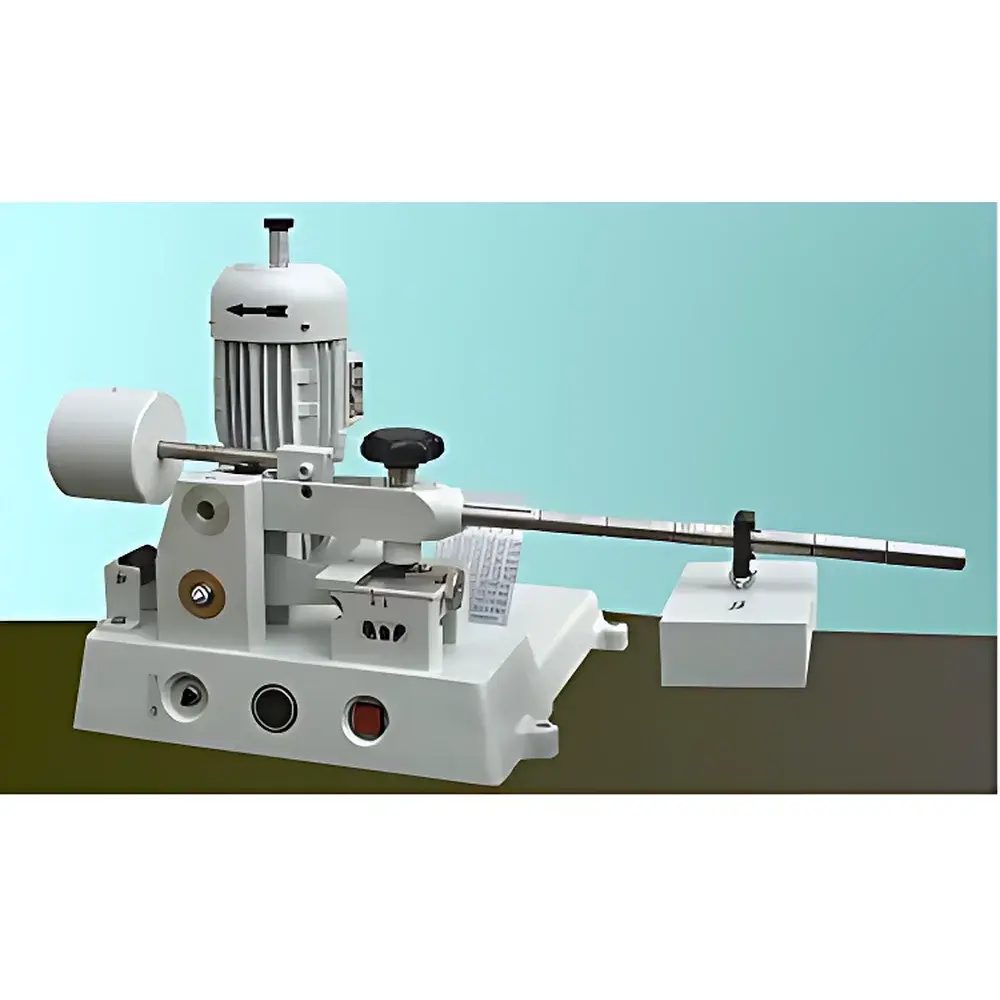
BAM Friction Sensitivity Tester
| Brand | R&P |
|---|---|
| Origin | Germany |
| Manufacturer Status | Authorized Distributor |
| Origin Category | Imported |
| Model | BAM Type |
| Price Range | USD 27,000 – 68,000 (FOB Hamburg) |
| Compliance | BAM Method 13.5.1 Test 3(b)(i), UN Manual of Tests and Criteria Part I, Section 10.3, EU Directive 2008/43/EC, ADR/RID/IMDG Code Annexes |
| Friction Stroke | 10 mm |
| Motor Drive Speed | 141 rpm |
| Load Range | 0.5–36 kg (5–360 N) via calibrated weights on 6-groove loading arm |
| Ceramic Components | Alumina ceramic rod (Ø10 × 15 mm), ceramic plate (25 × 25 × 5 mm), surface roughness Ra 9–32 µm |
| Standard Accessories | 1 cast-iron base plate, 1 loading arm with 6 grooves, 9 calibrated weights, 1 hook, 400 ceramic rods, 100 ceramic plates |
Overview
The BAM Friction Sensitivity Tester is a precision-engineered laboratory instrument designed to quantitatively assess the friction-induced initiation propensity of energetic materials—including explosives, propellants, pyrotechnic compositions, and hazardous chemical formulations. Developed in accordance with the internationally recognized BAM Method 13.5.1 Test 3(b)(i), this tester implements a standardized mechanical friction stimulus under strictly controlled conditions to determine whether a given sample undergoes deflagration or detonation when subjected to defined normal load and reciprocating motion. The measurement principle relies on deterministic mechanical energy input: a motor-driven ceramic plate slides 10 mm back-and-forth at 141 rpm beneath a fixed ceramic rod, while calibrated masses apply reproducible normal forces ranging from 5 N to 360 N. This configuration replicates critical frictional contact scenarios encountered during handling, transport, or processing of sensitive substances—enabling classification per UN Transport Regulations (UN Manual of Tests and Criteria, Part I, Section 10.3) and regulatory alignment with EU Directive 2008/43/EC and ADR/RID/IMDG Code requirements.
Key Features
- Robust cast-iron base plate ensuring mechanical stability and vibration damping during high-force friction cycles
- 6-groove precision-machined loading arm enabling rapid, repeatable load selection from 0.5 kg to 36 kg (5–360 N) without recalibration
- High-purity alumina ceramic components—rod (Ø10 × 15 mm) and plate (25 × 25 × 5 mm)—with certified surface roughness (Ra 9–32 µm) to ensure consistent tribological interaction
- Motor-driven linear actuation system delivering precise 10 mm stroke at constant 141 rpm, compliant with BAM 13.5.1 timing specifications
- Modular accessory set including 400 ceramic rods, 100 ceramic plates, 9 calibrated weights, and dedicated mounting hardware for immediate operational readiness
- Dual-voltage configuration options (3-phase 380 V / 50 Hz or single-phase 220 V / 50 Hz) supporting global laboratory infrastructure standards
Sample Compatibility & Compliance
The instrument accommodates solid powders, pressed pellets, crystalline aggregates, viscous liquids, gels, and pasty formulations—provided samples are loaded within the defined test cavity between ceramic surfaces. Sample mass is standardized per BAM protocol (typically 10–30 mg for solids; volume-equivalent for liquids). All testing procedures conform to ISO/IEC 17025–accredited methodologies where implemented, and results support hazard classification under UN GHS, CLP Regulation (EC) No. 1272/2008, and transport safety assessments required by IATA DGR, IMDG Code, and ADR Annexes. The system meets the physical and procedural specifications mandated by BAM’s official test method documentation and is routinely accepted by national authorities including the German Federal Institute for Materials Research and Testing (BAM), UK HSE, and US DOT PHMSA for regulatory submission packages.
Software & Data Management
While the core BAM Friction Sensitivity Tester operates as a manually initiated, analog-controlled mechanical system—consistent with the original BAM validation framework—it supports full traceability through integrated laboratory documentation workflows. Operators record test parameters (load, sample ID, ambient T/RH, operator ID, date/time) in standardized test logs aligned with GLP principles. Optional digital data capture modules (e.g., USB-connected load cell interface and motion encoder) enable time-synchronized force/displacement logging compatible with LIMS platforms. Audit trails comply with FDA 21 CFR Part 11 requirements when paired with validated electronic lab notebooks (ELN) and secure user authentication protocols. Calibration certificates for weights and ceramic component dimensions are supplied with each shipment and maintained per ISO 9001:2015 calibration management schedules.
Applications
- Hazard classification of novel energetic compounds during R&D phase prior to scale-up
- Quality control of batch-manufactured explosives and initiators to verify consistency in sensitivity profile
- Regulatory submission support for UN transport classification (Class 1 divisions)
- Comparative friction sensitivity screening of formulation variants (e.g., binder-modified propellants)
- Root-cause analysis of accidental ignition incidents involving mechanical handling equipment
- Validation of desensitization efficacy following nanocarrier encapsulation or phlegmatization treatments
FAQ
What standards does the BAM Friction Sensitivity Tester comply with?
It conforms to BAM Method 13.5.1 Test 3(b)(i), UN Manual of Tests and Criteria Part I Section 10.3, EU Directive 2008/43/EC, and harmonized transport regulations (ADR, RID, IMDG Code).
Can the instrument test liquid or gel samples?
Yes—liquids and gels are tested using standardized containment fixtures that maintain defined contact geometry between ceramic surfaces during reciprocation.
How often must ceramic components be replaced?
Ceramic rods and plates are consumables; replacement frequency depends on usage intensity and observed wear—typically after 50–100 tests per set under standard loads, verified via surface profilometry.
Is operator training included with purchase?
Yes—R&P provides on-site or remote commissioning support, including hands-on operation, safety protocol review, and interpretation of pass/fail criteria per UN criteria.
Does the system support automated data export?
The base unit is mechanically autonomous; however, optional sensor interfaces enable CSV/Excel export of force-time and displacement-time datasets for statistical analysis in MATLAB, JMP, or Minitab.
Related Products





