
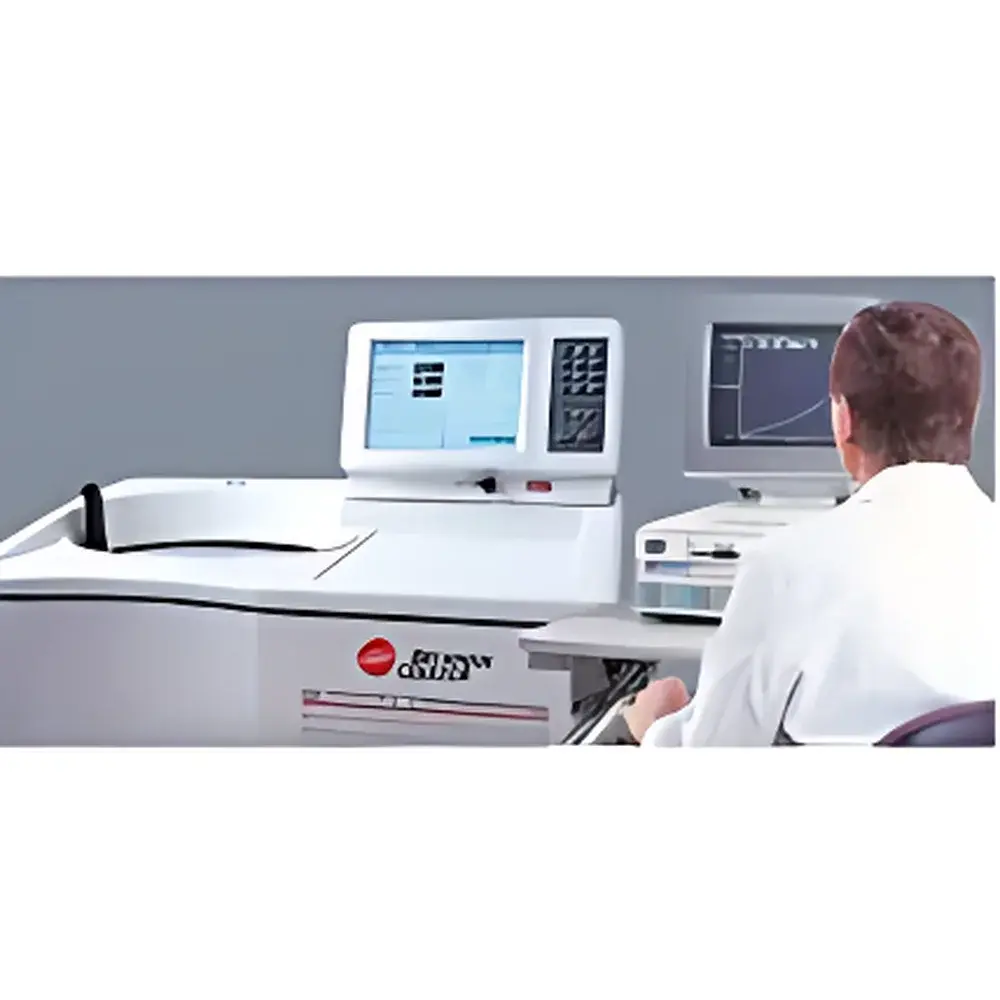
Beckman Coulter ProteomeLab™ XL-A/XL-I Analytical Ultracentrifuge
| Brand | Beckman Coulter |
|---|---|
| Origin | USA |
| Model | ProteomeLab™ XL-A/XL-I |
| Instrument Type | Floor-standing Analytical Ultracentrifuge |
| Speed Range | Up to 70,000 rpm |
| Maximum RCF | 601,000 × g |
| Dimensions | 94 × 68.1 × 125.7 cm |
| Detection Systems | UV-Vis (XL-A: 190–800 nm) or Interference Optics (XL-I) |
| Sample Capacity | Up to 21 cells simultaneously |
| Vacuum System | High-efficiency dehydration-type |
| Power Consumption | 3.4 kW/h |
| Compliance | Designed for GLP/GMP environments with audit-trail-capable software |
| Safety Features | Dynamic rotor inertia monitoring, hermetic vacuum drive, HEPA-filtered exhaust |
Overview
The Beckman Coulter ProteomeLab™ XL-A/XL-I is a high-precision analytical ultracentrifuge engineered for first-principles characterization of macromolecules in solution. Unlike preparative or routine centrifuges, it operates on the physical principles of sedimentation velocity and sedimentation equilibrium—enabling direct, label-free determination of molecular weight, shape, conformational stability, association/dissociation constants, and hydrodynamic properties. Its optical detection systems—either UV-Vis absorbance (XL-A) or Rayleigh interference (XL-I)—allow quantitative analysis across diverse sample classes including proteins, nucleic acids, viruses, lipoproteins, and synthetic polymers—even those lacking chromophores or exhibiting high optical density (<5 OD). The instrument’s ultra-stable vacuum environment, hermetically sealed drive system, and real-time rotor dynamics monitoring ensure reproducible data acquisition under stringent regulatory conditions.
Key Features
- Two optical detection configurations: XL-A model equipped with high-sensitivity photomultiplier-based UV-Vis optics (190–800 nm); XL-I model utilizing interferometric detection for non-absorbing analytes such as carbohydrates, polysaccharides, and highly concentrated samples.
- Touch-screen interface with 12-inch graphical display and intuitive eXPert™ software—designed specifically for analytical ultracentrifugation workflows.
- Optimized optical train featuring holographic elliptical sector scanner and quadruple-light-speed acquisition to minimize stray light and enhance signal-to-noise ratio.
- Advanced vacuum system with integrated dehydration module reduces maintenance frequency and improves long-term rotor bearing integrity.
- Dynamic rotor inertia sensing continuously monitors mechanical stability during acceleration/deceleration, triggering automatic shutdown if deviations exceed safety thresholds.
- HEPA-filtered exhaust path ensures containment of aerosols—critical for biosafety Level 2 (BSL-2) applications and compliant with laboratory ventilation standards.
- Energy-efficient operation at 3.4 kW/h—approximately one-third the power demand of comparable analytical ultracentrifuges.
Sample Compatibility & Compliance
The ProteomeLab™ XL-A/XL-I accommodates standard and specialty analytical cells—including OptiSeal™, Konical™, g-Max™, and Quick-Seal™ tubes—enabling precise sample loading and visual balancing within ±5 mL tolerance. It supports both single-channel and multi-channel cell configurations for parallel analysis of up to 21 samples under identical or varied solvent conditions (e.g., pH, ionic strength, temperature). All hardware and software components are designed to meet international quality system requirements: data integrity is preserved through time-stamped, user-authenticated audit trails; electronic records comply with FDA 21 CFR Part 11 when deployed with validated IT infrastructure; and operational parameters align with ISO/IEC 17025 and ASTM E2917 guidelines for analytical centrifugation methodology validation.
Software & Data Management
eXPert™ software provides an integrated platform for experiment design, real-time data acquisition, and advanced modeling—including Lamm equation fitting, continuous size-distribution analysis (c(s), c(M)), and thermodynamic binding models (e.g., monomer-dimer, hetero-association). Raw scans are stored in vendor-neutral formats (e.g., ASCII, HDF5) and support third-party processing via SEDFIT, SEDPHAT, or UltraScan. Software updates follow controlled release protocols with version-controlled documentation, and configuration settings can be exported/imported for method transfer between instruments. Remote monitoring and diagnostics are available via secure network interfaces—facilitating centralized lab management without compromising data sovereignty.
Applications
This instrument serves as a primary tool in structural biology, biopharmaceutical development, and polymer science. Typical use cases include: determination of absolute molecular mass and oligomeric state of therapeutic antibodies and fusion proteins; quantification of aggregation propensity under stress conditions (e.g., thermal, pH, excipient screening); characterization of viral capsid assembly kinetics; analysis of lipoprotein particle heterogeneity in clinical research; and validation of small-molecule–protein binding stoichiometry and affinity. Its capacity to resolve subtle differences in sedimentation coefficient (s-value) and diffusion coefficient (D) makes it indispensable for orthogonal verification of SEC-MALS or DLS results—and particularly valuable in regulatory submissions requiring mechanistic evidence of product consistency.
FAQ
What distinguishes analytical ultracentrifugation from preparative ultracentrifugation?
Analytical ultracentrifugation combines high-speed rotation with in situ optical detection to monitor macromolecular behavior in real time, yielding quantitative biophysical parameters. Preparative ultracentrifugation separates components for recovery but provides no direct solution-phase characterization.
Can the XL-A/XL-I be used for GMP-compliant manufacturing support?
Yes—when operated within a validated environment using documented procedures, eXPert™’s audit-trail functionality satisfies traceability requirements for process characterization and comparability studies per ICH Q5E and USP .
Is interferometric detection compatible with high-concentration samples?
Yes—the XL-I’s Rayleigh interference optics operate independently of UV absorbance and remain linear up to optical densities of 5, making it suitable for crude lysates or formulation buffers where UV signal saturation occurs.
How is rotor safety ensured during extended runs?
The system performs continuous dynamic inertia assessment, cross-referencing actual angular acceleration against theoretical profiles; any anomaly triggers immediate deceleration and fault logging.
Does the instrument require external cooling water?
No—it employs an integrated closed-loop refrigeration system capable of maintaining rotor temperature between 4 °C and 30 °C with ±0.3 °C stability, eliminating dependency on facility chillers.



