
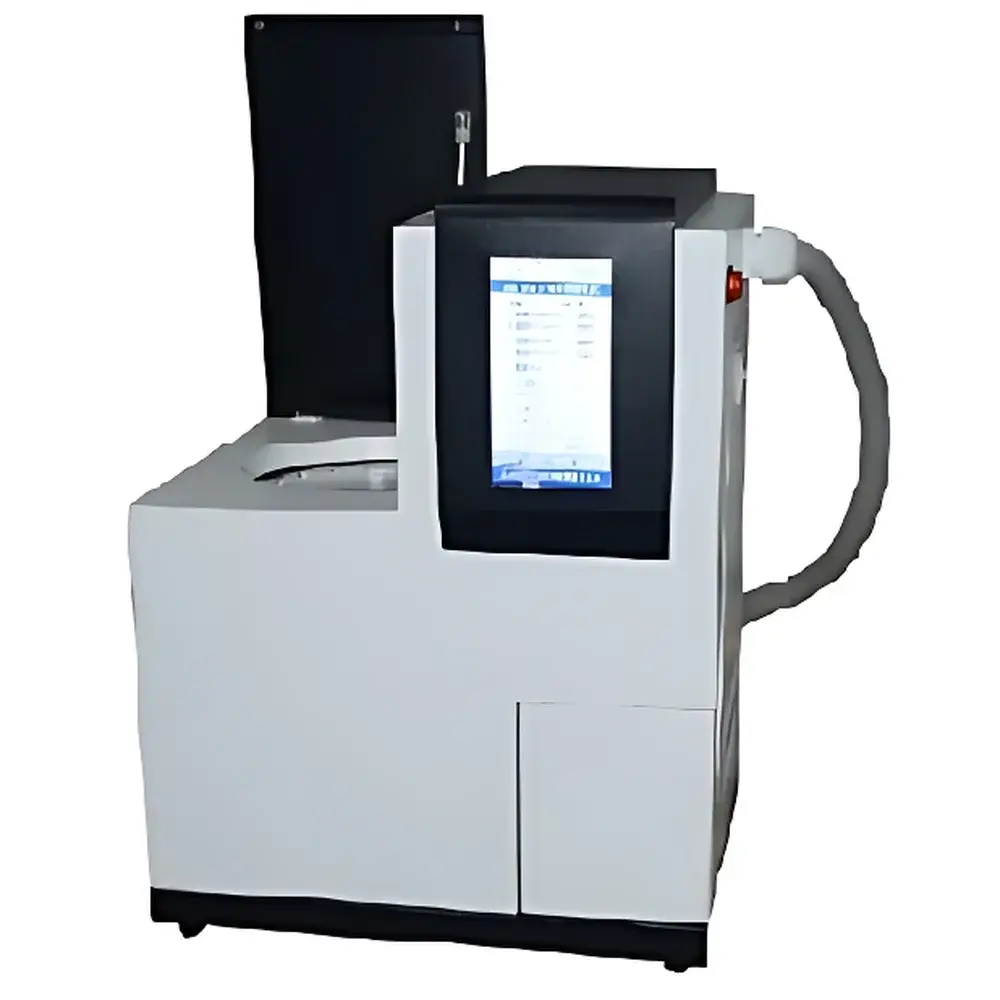
Beifen Sanpu ATDS-20A Automated Dual-Stage Thermal Desorber for Environmental TVOC Analysis
| Brand | Beifen Sanpu |
|---|---|
| Origin | Beijing, China |
| Manufacturer Type | Direct Manufacturer |
| Instrument Type | Dual-Stage Thermal Desorber |
| Primary Desorption Temperature Range | Ambient to 400 °C |
| Secondary Desorption Temperature Range | 100–400 °C |
| Cryo-Focusing Trap Temperature Range | Down to −35 °C |
| Desorption Recovery Rate | >90% |
| Sample Capacity | 20 Sample Tubes |
Overview
The Beifen Sanpu ATDS-20A is an automated dual-stage thermal desorber engineered for high-fidelity preconcentration and quantitative analysis of trace-level volatile organic compounds (VOCs) and total volatile organic compounds (TVOC) in ambient air, indoor air, and occupational environments. It operates on the principle of thermally assisted desorption coupled with cryogenic focusing—where analytes adsorbed onto sorbent tubes during active or passive sampling are sequentially heated (first-stage desorption), refocused in a cryogenically cooled trap (−35 °C), and then rapidly transferred (second-stage desorption) as a narrow, solvent-free band into the inlet of a gas chromatograph (GC). This two-step thermal transfer process eliminates cold-spot losses, minimizes breakthrough, and delivers exceptional sensitivity—enabling reliable detection at sub-ppb (parts-per-trillion) levels when paired with flame ionization detection (FID) or mass spectrometry (MS). Designed for compliance-driven laboratories, the ATDS-20A supports standardized methodologies including GB 50325–2020 (Chinese standard for indoor air quality control), ASTM D6196, ISO 16017-1, and EPA TO-17, serving as a critical front-end interface between field sampling and laboratory-based GC analysis.
Key Features
- Integrated dual-stage thermal desorption architecture with independent temperature control for primary desorption (ambient to 400 °C), secondary desorption (100–400 °C), and cryo-trap cooling (down to −35 °C)
- 20-position auto-sampler tray accommodating standard 6 mm OD stainless steel or quartz sorbent tubes (e.g., Tenax TA, Carbopack B/C, Carboxen 1000)
- Reverse-flow desorption configuration ensures optimal analyte transfer efficiency and minimizes tube wall carryover
- On-board sample tube activation station enabling in-situ conditioning prior to sampling—eliminating off-line oven steps and reducing contamination risk
- Carrier gas flow control with precision mass flow meters (N₂, He, or Air); programmable flow ramping during desorption and transfer phases
- Robust industrial-grade construction with PID-controlled heating zones, thermal insulation shielding, and real-time temperature monitoring with ±0.5 °C accuracy
Sample Compatibility & Compliance
The ATDS-20A is compatible with all major GC platforms—regardless of manufacturer—including Agilent, Thermo Fisher, Shimadzu, PerkinElmer, and domestic Chinese systems (e.g., GC-9860 series). It accepts industry-standard sorbent tubes per ISO 16017-1 and EPA TO-17 specifications. The system supports full method validation under GLP and GMP frameworks, with audit-trail-capable operation logs (time-stamped temperature profiles, gas flow events, and sequence execution records). It meets essential regulatory requirements for environmental testing labs accredited to CNAS (China National Accreditation Service) and ISO/IEC 17025:2017. Method transfers comply with GB 50325–2020 Sections E.1 (benzene) and E.2 (TVOC), where quantification relies on external calibration using certified reference standards (e.g., NIST SRM 1849a) and retention time alignment against internal standards (e.g., isopropanol, 1,4-dichlorobenzene).
Software & Data Management
The instrument is operated via embedded firmware with USB- or RS232-connected PC software (BF-2002 Chromatography Workstation). The interface supports fully customizable desorption sequences—including multi-step temperature ramps, hold times, trap cool-down/reheat cycles, and carrier gas modulation. All method parameters are saved as encrypted .mth files with version control. Raw event logs—including desorption start/stop timestamps, peak detection triggers, and hardware fault alerts—are exported in CSV format for integration into LIMS or ELN systems. Software adheres to ALCOA+ principles (Attributable, Legible, Contemporaneous, Original, Accurate, Complete, Consistent, Enduring, Available) and provides electronic signature support aligned with FDA 21 CFR Part 11 readiness (when deployed with validated IT infrastructure).
Applications
- Indoor air quality (IAQ) assessment per GB 50325–2020, ISO 16000-6, and WHO guidelines
- Occupational exposure monitoring for benzene, toluene, ethylbenzene, xylenes (BTEX), styrene, and aliphatic hydrocarbons
- Rapid forensic identification of unknown airborne contaminants in incident response scenarios
- Residual solvent analysis in pharmaceutical packaging materials (ICH Q3C compliant screening)
- Head-space profiling of flavor and fragrance compounds in consumer products
- Exhaled breath metabolite profiling in clinical research settings (e.g., acetone, isoprene, ethanol)
- Environmental boundary monitoring near chemical storage facilities or remediation sites
FAQ
What sorbent tube types are supported by the ATDS-20A?
Standard 6 mm OD stainless steel or quartz tubes packed with single- or multi-bed sorbents (e.g., Tenax TA, Carbopack B/C, Carboxen 1000, Graphitized Carbon Black) compliant with ISO 16017-1 and EPA TO-17.
Can the ATDS-20A be used with GC-MS systems?
Yes—its narrow-band desorption profile and inert transfer path ensure compatibility with both FID and MS detectors; splitless or cold-on-column injection modes are recommended.
Is method validation documentation provided?
Yes—the system includes a factory-verified performance qualification report covering desorption recovery (>90%), carryover (<0.1%), temperature uniformity, and linearity across 3 orders of magnitude.
Does the instrument support unattended overnight operation?
Yes—full 20-tube sequences can be scheduled with automatic shutdown, trap regeneration, and error logging; power-fail recovery retains current run state.
How is calibration traceability maintained?
All temperature sensors are calibrated against NIST-traceable references; gas flow controllers are certified per ISO 6145-2; user-accessible calibration certificates are supplied with each unit.






