
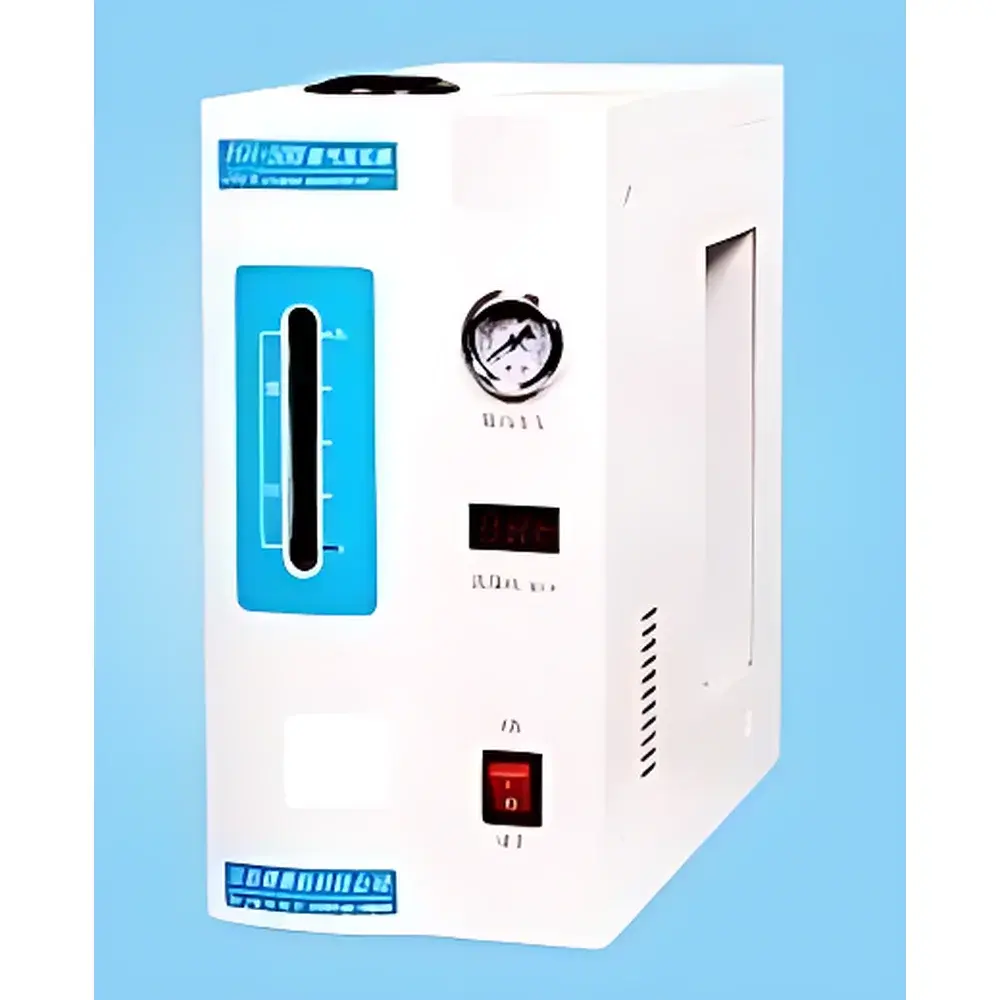
BF-3L Air Generator by Beifen Sanpu
| Brand | Beifen Sanpu |
|---|---|
| Origin | Hebei, China |
| Manufacturer Type | OEM Manufacturer |
| Country of Origin | China |
| Model | BF-3L |
| Hydrocarbon Removal Principle | High-Temperature Catalytic Oxidation |
| Output Flow Rate | 0–3000 mL/min (3.0 L/min) |
| Maximum Output Pressure | 0.4 MPa (4 bar) |
| Hydrocarbon Content | <0.1 ppm (as CH₄ equivalent) |
| Dew Point | –60 °C |
| Noise Level | ≤42 dB(A) |
| Power Supply | AC 220 V, 50 Hz |
| Rated Power | 150 W |
| Net Weight | 23 kg |
| Dimensions (L×W×H) | 490 × 240 × 380 mm |
| Operating Temperature | 15–40 °C |
| Relative Humidity | <70% RH (non-condensing) |
| Ambient Conditions | Low-dust, non-corrosive environment |
| Filtration Stages | Three-stage purification (particulate → desiccant → catalytic hydrocarbon removal) |
| Pressure Regulation | Dual-stage precision pressure regulation |
| Safety Features | Over-pressure relief valve, manual condensate drain port |
| Compliance | Designed for laboratory use in accordance with IEC 61010-1 (Safety Requirements for Electrical Equipment for Measurement, Control, and Laboratory Use) |
Overview
The BF-3L Air Generator by Beifen Sanpu is an engineered solution for laboratories requiring a continuous, on-demand supply of high-purity, oil-free compressed air for analytical instrumentation—including gas chromatographs (GC), GC–MS systems, flame ionization detectors (FID), nitrogen–phosphorus detectors (NPD), and other pneumatic-driven analytical modules. Unlike conventional compressed air cylinders, the BF-3L eliminates reliance on high-pressure gas storage, thereby mitigating safety risks associated with cylinder handling, leakage, and regulatory compliance burdens. Its core operation relies on ambient air intake, followed by multi-stage compression, cooling, and purification—culminating in catalytic oxidation of residual hydrocarbons at elevated temperatures (>350 °C)—to achieve HC <0.1 ppm (methane-equivalent) and a dew point of –60 °C. This performance envelope meets or exceeds the air quality requirements specified in ASTM D6299 (for GC carrier and detector gases) and ISO 8573-1 Class 1:2:1 (for particulate, water, and oil content), making it suitable for routine QC/QA environments operating under GLP or GMP frameworks.
Key Features
- Three-stage purification architecture: Particulate pre-filter → desiccant dryer → high-temperature catalytic hydrocarbon converter—ensuring consistent removal of moisture, oil aerosols, and volatile organic compounds.
- Dual-stage pressure regulation system delivering stable output pressure up to 0.4 MPa (4 bar), optimized for direct connection to GC air inlets or as feed gas for nitrogen generators.
- Integrated over-pressure protection and manual condensate drainage port—enabling safe, maintenance-aware operation without tooling.
- Low-noise operation (<42 dB[A]) achieved via acoustic enclosure design and vibration-damped compressor mounting—critical for open-plan or shared laboratory spaces.
- Compact footprint (490 × 240 × 380 mm) and lightweight construction (23 kg) support benchtop integration without dedicated utility space or floor reinforcement.
- Plug-and-play usability: Fully automatic startup; no warm-up time required; compatible with intermittent or 24/7 continuous duty cycles.
Sample Compatibility & Compliance
The BF-3L supplies instrument-grade air compliant with critical analytical applications where background interference must be minimized. It is validated for use with flame-based detectors (FID, NPD, FPD), headspace samplers, and pneumatic autosamplers requiring dry, hydrocarbon-free air. The unit conforms to IEC 61010-1 for electrical safety and incorporates thermal cut-off protection and pressure-relief mechanisms meeting EN 8573-1:2010 air purity classification standards. While not certified to FDA 21 CFR Part 11, its stable output and mechanical logging capability (via optional analog pressure gauge or digital interface module) support audit-ready documentation in regulated environments when integrated into broader lab data management workflows.
Software & Data Management
The BF-3L operates as a standalone hardware platform with no embedded firmware or network connectivity. All operational parameters—including flow rate (0–3000 mL/min), outlet pressure, and internal temperature—are monitored via front-panel analog gauges and status LEDs. For laboratories requiring traceable gas delivery logs, the generator may be paired with external pressure transducers or flow meters equipped with 4–20 mA or RS-485 outputs. Raw sensor data can be ingested into LIMS or ELN platforms via standard industrial protocols (Modbus RTU, OPC UA), enabling alignment with ALCOA+ data integrity principles when configured with appropriate audit trail and user access controls.
Applications
- Primary air supply for GC detectors (FID, TCD, ECD) requiring ultra-low hydrocarbon background.
- Feed gas source for membrane- or PSA-based nitrogen generators used in LC–MS or elemental analyzers.
- Pneumatic actuation in automated sample introduction systems (e.g., PAL autosamplers).
- Zero-air generation for environmental air monitoring calibrations (when coupled with ozone scrubbers or CO converters).
- Replacement for high-pressure aluminum or steel air cylinders in pharmaceutical QC labs seeking reduced cylinder logistics and storage hazards.
FAQ
What is the maximum continuous output flow rate of the BF-3L?
The BF-3L delivers up to 3000 mL/min (3.0 L/min) at rated pressure (0.4 MPa), with flow stability maintained across 10–100% of full scale.
Does the BF-3L require periodic catalyst replacement?
Yes—the high-temperature catalytic hydrocarbon converter has a typical service life of 12–18 months under continuous operation; replacement intervals depend on ambient air quality and usage frequency.
Can the BF-3L be used in tandem with a nitrogen generator?
Yes—its 0.4 MPa output pressure and low-hydrocarbon specification make it suitable as the primary air feed for most commercial nitrogen generators requiring clean, dry air input.
Is the BF-3L compatible with ISO/IEC 17025-accredited laboratories?
It supports accreditation requirements through documented calibration of connected pressure/flow instrumentation and adherence to preventive maintenance schedules outlined in the operator manual.
What maintenance is required beyond catalyst replacement?
Routine tasks include monthly visual inspection of filters and condensate drain, quarterly verification of pressure regulation accuracy, and annual validation of dew point and hydrocarbon content using certified test kits or third-party gas analyzers.



