
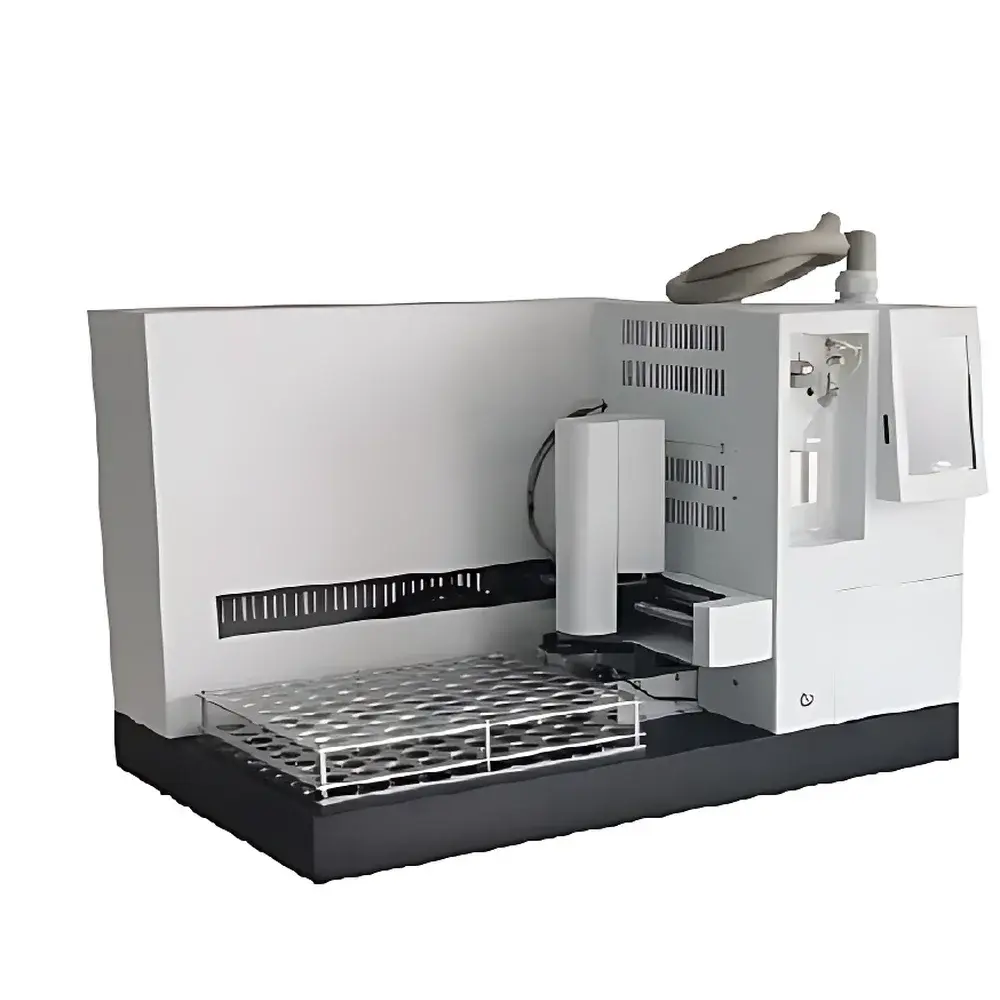
Beifen Sanpu PT-80A Fully Automated Solid-Liquid Integrated Purge and Trap Concentrator
| Brand | Beifen Sanpu |
|---|---|
| Origin | Beijing, China |
| Manufacturer Type | Manufacturer |
| Product Category | Domestic |
| Model | PT-80A |
| Instrument Type | Water-and-Soil Integrated Purge and Trap System |
| Sample Tray Capacity | 80 positions (40 mL VOA vials) |
| Injection Precision | RSD ≤ 3% |
| Trap Temperature Range | Ambient to 380 °C |
| Cooling | 250 °C → 35 °C in ≤ 90 s |
| Purge Tube Temperature | Ambient to 95 °C |
| Sample Chilling | Ambient (no active cooling) |
Overview
The Beifen Sanpu PT-80A Fully Automated Solid-Liquid Integrated Purge and Trap Concentrator is a robust, laboratory-grade sample introduction system engineered for the quantitative enrichment and transfer of volatile organic compounds (VOCs) from aqueous and solid matrices prior to gas chromatographic analysis. Based on the established purge-and-trap principle—where inert gas continuously sweeps VOCs from the sample matrix into a sorbent-packed trap—the PT-80A implements precise thermal desorption, cryogenic trapping, and integrated moisture management to ensure high recovery, low carryover, and analytical reproducibility. Designed for compliance with U.S. EPA Method 502.2, 524.2, 624, and 8260, as well as Chinese environmental standards including HJ 605–2011, HJ 639–2012, and HJ 686–2014, the instrument supports routine regulatory monitoring of VOCs in drinking water, groundwater, soil, sediment, and food extracts. Its architecture integrates solid-phase handling (e.g., soil slurry preparation), liquid-phase purging, and full thermal control across all fluidic pathways—eliminating cold spots and minimizing analyte loss or degradation.
Key Features
- Fully automated 80-position autosampler compatible with standard 40 mL VOA vials; accommodates both liquid samples and solid samples pre-mixed with 5 mL distilled water under programmable vortex agitation.
- Electronically controlled Peltier-based cold trap capable of reaching −40 °C (at ambient 20 °C), eliminating reliance on liquid nitrogen while maintaining consistent cryofocusing performance for C2–C12 VOCs.
- High-speed resistive-heated quartz trap (Φ4 mm × 80 mm × 1 mm) with rapid thermal ramping (>2000 °C/min) and ultra-fast cooldown (250 °C → 35 °C in ≤90 s), enabling sharp, narrow-band desorption pulses for optimal GC peak shape.
- Integrated moisture removal module (heatable up to 400 °C) positioned upstream of the trap to reduce water vapor load on downstream GC columns and MS sources—critical for sustained detector sensitivity and column longevity.
- PEEK-lined and silanized stainless-steel fluid paths throughout; all valves, transfer lines, and purge tubes actively heated (ambient to 220 °C) to prevent condensation and adsorption losses.
- Real-time foam detection sensor within the purge tube prevents overfoaming during soil/slurry purging, safeguarding trap integrity and system contamination risk.
- Dual independent purge gas flow control (0–150 mL/min) with pressure regulation ≤0.6 MPa; programmable purge duration (0.1 s–100 min) and timing accuracy <0.1 s.
- Two TTL-compatible synchronization outputs (1–2 s trigger delay) for seamless integration with GC oven start, data system acquisition, and external event logging.
Sample Compatibility & Compliance
The PT-80A processes diverse sample types without hardware modification: raw water, preserved wastewater, homogenized soil/sediment (with on-board aqueous slurry preparation), and food extracts. Solid sample handling includes programmable heating (ambient to 100 °C), timed vortex mixing, and direct water addition—all executed within the sealed sample vial. The system meets essential design criteria for GLP-compliant laboratories: full audit trail support via PC-based software, user-level access controls, parameter change logging, and electronic signature capability aligned with FDA 21 CFR Part 11 requirements when deployed with validated LIMS/GC-MS workflows. It conforms to ISO/IEC 17025 method validation prerequisites for VOC enrichment efficiency, precision (RSD ≤3%), and blank integrity.
Software & Data Management
Control and method development are performed through a Windows-based graphical interface supporting multi-user configuration, method library management, and remote instrument supervision. All temperature zones, timing sequences, gas flows, and valve actuation events are fully programmable and stored with timestamped metadata. Software enables automated calibration sequence execution (e.g., standard addition, surrogate recovery tracking), real-time status monitoring (trap temperature, purge pressure, foam alert), and export of structured CSV/Excel reports compliant with laboratory QA/QC documentation protocols. Raw method files include embedded version stamps and checksums to ensure traceability during regulatory audits.
Applications
- Regulatory analysis of VOCs in drinking water per GB/T 5750.8–2023 and EPA 524.2.
- Soil and sediment testing per HJ 605–2011 (VOCs) and HJ 741–2015 (halogenated hydrocarbons).
- Wastewater and surface water monitoring per HJ 639–2012 and HJ 686–2014.
- Food safety screening for residual solvents (e.g., acetonitrile, ethyl acetate) and off-flavor compounds.
- Environmental forensics and landfill leachate characterization requiring sub-pptr sensitivity and matrix tolerance.
FAQ
Is the PT-80A compatible with third-party GC and GC-MS systems?
Yes—its universal pneumatic and electrical interfaces support direct integration with Agilent, Thermo Fisher, Shimadzu, and PerkinElmer platforms via standard TTL triggers and analog voltage inputs.
Does the system require liquid nitrogen for cold trapping?
No—the Peltier-cooled trap achieves −40 °C without cryogens, reducing operational cost and logistical complexity.
How is carryover minimized between solid and liquid samples?
By thermally isolating the purge gas path from the trap desorption effluent and implementing configurable needle/trap bake-out cycles with hot water rinsing (up to 90 °C).
Can the instrument perform method validation per ISO 17025?
Yes—software logs all critical parameters and operator actions; combined with documented SOPs and periodic verification using certified reference materials, it satisfies ISO 17025 clause 7.7 requirements for equipment suitability.
What maintenance intervals are recommended for routine operation?
Trap cartridge replacement every 200–300 injections; quarterly inspection of PEEK tubing, valve seals, and foam sensor calibration; annual verification of temperature accuracy across all zones per ASTM E74.




