
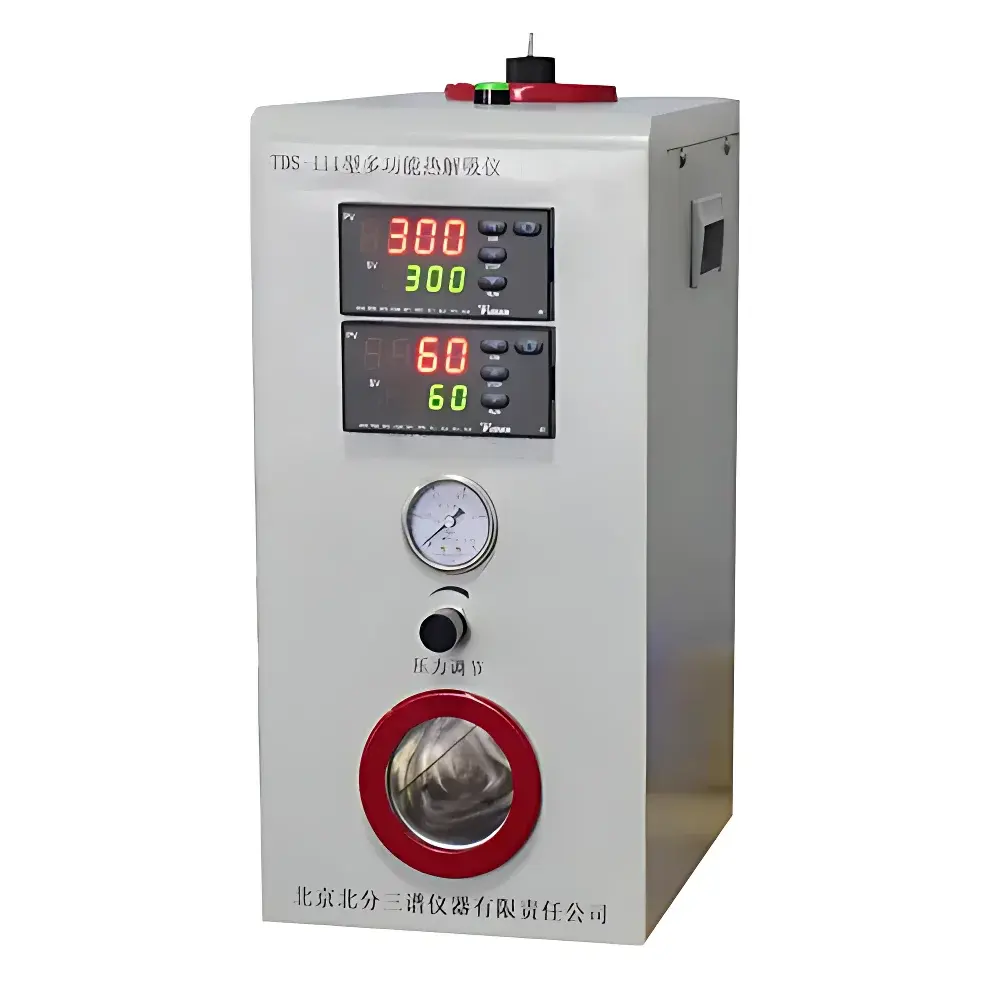
Beifen Sanpu TDS-III Dedicated Thermal Desorber for Solvent Gasoline, Raffinate Oil, and Vinyl Chloride
| Brand | Beifen Sanpu |
|---|---|
| Model | TDS-III |
| Origin | Hebei, China |
| Manufacturer Type | Direct Manufacturer |
| Regional Category | Domestic (China) |
| Pricing | Upon Request |
Overview
The Beifen Sanpu TDS-III Dedicated Thermal Desorber is a precision-engineered instrument designed for the quantitative analysis of volatile organic compounds (VOCs) in workplace air samples—specifically solvent gasoline, raffinate oil, and vinyl chloride—per Chinese national occupational health standards GBZ/T 300.62–2017 and GBZ/T 300.78–2017. It operates on the principle of thermal desorption coupled with gas chromatography–flame ionization detection (GC–FID). In this method, airborne vapors are collected onto activated carbon sorbent tubes under controlled flow conditions. The TDS-III thermally desorbs analytes from the tube using precise temperature ramping and carrier gas purging, transferring the re-volatilized compounds quantitatively into a GC system for separation and detection. Its architecture supports trace-level quantification with high reproducibility, robustness against matrix interference, and compatibility with standard GC autosampler interfaces.
Key Features
- Programmable dual-zone heating: Independent control of sample tube furnace (up to 400 °C) and transfer line (up to 300 °C) ensures complete desorption without cold spots or breakthrough.
- Dedicated application firmware: Pre-configured thermal desorption protocols aligned with GBZ/T 300.62–2017 (solvent gasoline & raffinate oil) and GBZ/T 300.78–2017 (vinyl chloride, dichloroethylene, trichloroethylene, tetrachloroethylene).
- Quantitative transfer design: Integrated 100 mL gas-tight syringe interface enables direct collection of desorbed vapor volume—eliminating losses associated with cryofocusing or secondary trapping.
- Carrier gas management: Built-in mass flow controller for nitrogen (N₂), calibrated at 50 mL/min ±2% accuracy, compliant with standard desorption flow requirements.
- Thermal stability: PID-controlled heating system maintains ±0.5 °C isothermal precision across full operating range, critical for method reproducibility in regulated environments.
- Modular integration: Designed for seamless coupling with common laboratory GC systems—including Shimadzu GC-2010 platforms equipped with FID—via standard heated transfer lines.
Sample Compatibility & Compliance
The TDS-III accepts standard 6 mm o.d. × 90 mm glass thermal desorption tubes packed with 100 mg of coconut-shell-based activated carbon (ASTM D3803–18 grade). It supports both single-stage desorption and direct injection workflows, eliminating the need for cryogenic focusing hardware. Method validation aligns with GBZ/T 300 series occupational exposure assessment guidelines, which reference ISO 16000–6 for VOC sampling and ASTM D5466 for thermal desorption performance criteria. While not inherently 21 CFR Part 11 compliant, its operation supports GLP/GMP-aligned documentation when paired with validated GC data systems featuring audit trails and electronic signatures.
Software & Data Management
The instrument includes embedded firmware with non-volatile memory for storing up to 20 user-defined methods, each containing desorption temperature profile, hold time, carrier gas flow setpoint, and cool-down parameters. All method executions generate timestamped log files (CSV format) recording actual furnace temperature, measured flow rate, and cycle duration—enabling retrospective review during internal audits. No proprietary PC software is required; method loading and status monitoring occur via front-panel LCD interface with tactile keypad navigation. For laboratories implementing LIMS integration, raw log files can be exported via USB flash drive for ingestion into validated chromatography data systems (CDS) such as OpenLab CDS or Chromeleon.
Applications
- Occupational hygiene monitoring: Routine quantification of solvent gasoline (C4–C12 aliphatic/aromatic hydrocarbons), raffinate oil (C5–C9 naphtha fraction), and vinyl chloride monomer (VCM) in refinery, petrochemical, and polymer manufacturing facilities.
- Exposure assessment: Support for OEL (Occupational Exposure Limit) verification per GBZ 2.1–2019, including short-term exposure limit (STEL) and time-weighted average (TWA) calculations.
- Method transfer: Validated compatibility with GC–FID configurations used in third-party testing labs accredited to CNAS-CL01 (equivalent to ISO/IEC 17025).
- Quality assurance: Use in QA/QC programs requiring adherence to national standard test methods for workplace air analysis—particularly where regulatory reporting mandates traceability to GBZ/T 300 series protocols.
FAQ
What types of sorbent tubes are compatible with the TDS-III?
Standard 6 mm o.d. × 90 mm glass tubes packed with 100 mg of activated carbon (e.g., Carbopack™ B or equivalent) are fully supported. Tubes must be thermally conditioned prior to use per GBZ/T 300.62–2017 Annex A.
Does the TDS-III support automated calibration verification?
No built-in auto-calibration function exists; however, the instrument’s thermal and flow stability allows manual verification using certified gas standards and NIST-traceable flow meters per ISO 17025 requirements.
Can the TDS-III be used for compounds beyond those listed in GBZ/T 300.62 and 300.78?
Yes—provided analytes are thermally stable below 400 °C and exhibit adequate volatility for desorption. Users must validate recovery, linearity, and LOD/LOQ independently for non-standard applications.
Is the TDS-III suitable for unattended overnight operation?
Yes. The unit features overtemperature protection, automatic cooldown sequencing, and power-failure memory retention—enabling safe execution of multi-sample batches without operator supervision.
How is data integrity ensured during long-term deployment?
All operational logs include UTC timestamps, method ID, and real-time sensor readings. When integrated with a validated CDS, full chain-of-custody compliance—including electronic signatures and audit trails—is achievable per GLP principles.





