
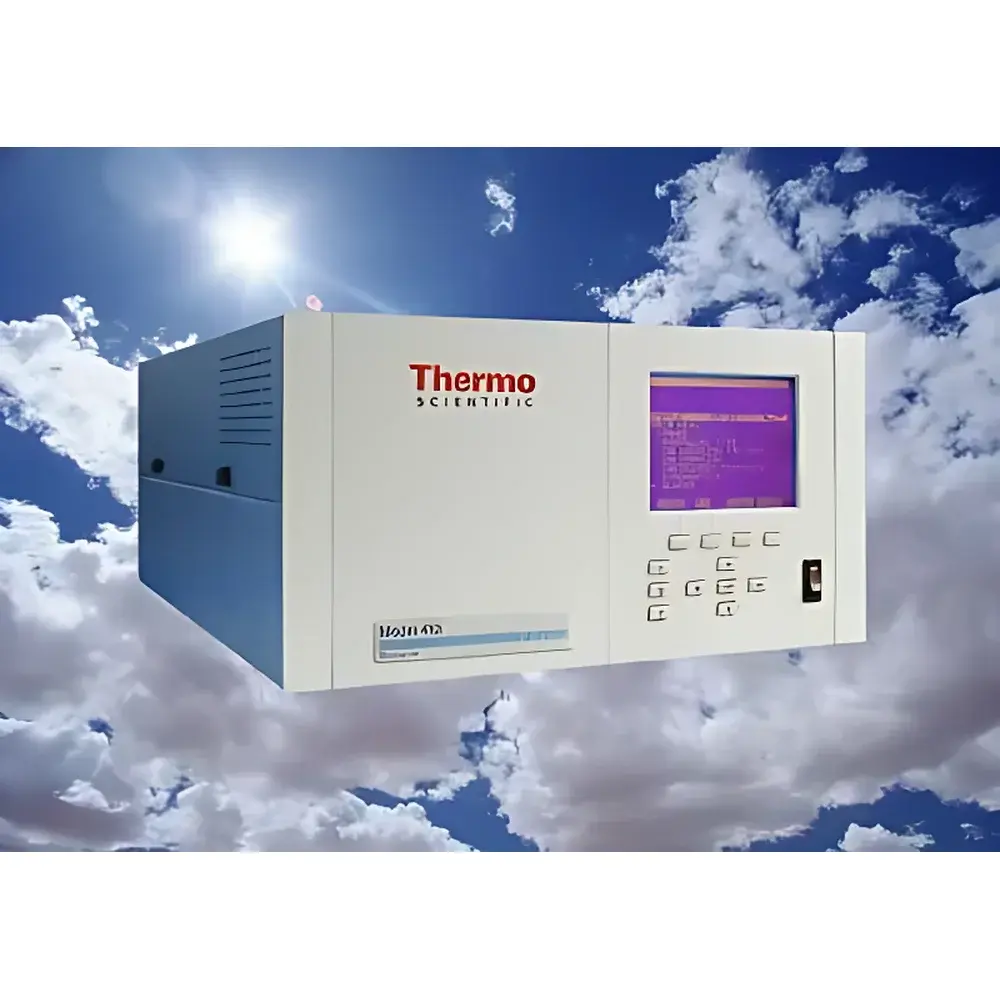
Thermo Scientific 410i Carbon Dioxide (CO₂) Analyzer
| Brand | Thermo Scientific |
|---|---|
| Origin | USA |
| Manufacturer | Thermo Fisher Scientific |
| Type | Online Analyzer |
| Detection Principle | Non-Dispersive Infrared (NDIR) with Fixed Bandpass Interference Filter and Quantum Detector |
| Model | 410i |
| Configuration Options | 410i-D (Standard Range), 410i-E (High Range) |
| Measurement Range (D) | 0–10,000 ppm |
| Measurement Range (E) | 0–25% vol |
| Zero Noise (D) | 0.1 ppm RMS (300 s avg) |
| LOD (D) | 0.2 ppm |
| Zero Drift (7 days, D) | <0.20 ppm |
| Span Drift (7 days, D) | <1% of reading |
| Zero Noise (E) | 10 ppm RMS (60 s avg) |
| LOD (E) | 20 ppm |
| Zero Drift (24 h, E) | <40 ppm |
| Span Drift (7 days, E) | <2% of reading |
| Operating Temperature Range | –20 to +50 °C |
| Data Output Options | Direct Extraction or Dilution Mode Reporting |
| Compliance | Designed for EPA Method 3A, ASTM D6522, ISO 12039, and EN 15267-3 environments |
| Software Interface | i-Series Menu-Driven Firmware with Audit Trail Support (21 CFR Part 11 ready) |
Overview
The Thermo Scientific™ 410i Carbon Dioxide (CO₂) Analyzer is an online, extractive gas monitoring system engineered for continuous, high-stability measurement of CO₂ concentration in industrial flue gas, combustion exhaust, and ambient air streams. It employs a refined non-dispersive infrared (NDIR) detection principle, utilizing a fixed bandpass interference filter centered at the characteristic CO₂ absorption wavelength (~4.26 µm) and a thermoelectrically cooled quantum detector. This optical architecture eliminates moving parts and spectral drift associated with grating-based systems, ensuring long-term baseline stability and minimal calibration frequency. The analyzer supports both direct extraction and dilution sampling configurations—enabling compliance with U.S. EPA Method 3A for stack gas analysis and harmonized European standards including EN 15267-3 and ISO 12039. Its extended operating temperature range (–20 to +50 °C) maintains metrological integrity across seasonal field deployments and unconditioned shelter installations.
Key Features
- Two calibrated configurations: 410i-D for trace-to-mid-range applications (0–10,000 ppm) and 410i-E for high-concentration monitoring (0–25% vol)
- Quantum-detector-based NDIR optics delivering sub-ppm zero noise (0.1 ppm RMS, 300 s averaging) in the D-model and robust low-drift performance in the E-model (zero drift <40 ppm over 24 h)
- Factory-installed, NIST-traceable calibration curves stored in flash memory—ensuring linearity across full span without user recalibration
- i-Series platform architecture featuring intuitive menu-driven firmware, programmable soft keys, and real-time diagnostic status reporting
- Rack-mountable 19-inch chassis with integrated Ethernet port (optional RS-232/485 and analog 4–20 mA outputs) for seamless integration into DCS, SCADA, or CEMS networks
- Onboard flash memory supporting ≥30 days of second-interval data logging (configurable), with timestamped event records for maintenance and audit review
Sample Compatibility & Compliance
The 410i is designed for use with conditioned or unconditioned sample gas streams from continuous emission monitoring systems (CEMS), boiler stacks, cement kilns, waste incinerators, and biogas upgrading facilities. Sample inlet compatibility includes standard ¼-inch stainless steel tubing and optional heated sample lines (up to 180 °C) for dew point control. The analyzer meets performance criteria specified in U.S. EPA Performance Specification 3 (PS-3) for CO₂ analyzers and supports QA/QC protocols aligned with 40 CFR Part 60 Appendix B and Part 75. Its firmware architecture supports audit trail generation—including operator login, parameter changes, calibration events, and fault logs—making it suitable for GLP/GMP environments requiring 21 CFR Part 11 compliance when deployed with validated network authentication and electronic signature workflows.
Software & Data Management
Control and configuration are managed via the embedded i-Series web interface accessible through any modern browser over Ethernet. The interface provides real-time concentration plots, alarm thresholds (with configurable hysteresis), calibration history, and diagnostic dashboards (e.g., detector voltage, optical path integrity, temperature compensation status). All logged data export in CSV format with ISO 8601 timestamps. Optional Thermo Scientific CEMPro™ software enables centralized fleet management, remote firmware updates, automated report generation (daily/weekly compliance summaries), and trend analysis against reference methods. Data security features include role-based access control, encrypted firmware updates, and tamper-evident log archiving.
Applications
- Regulatory-compliant CO₂ monitoring in fossil-fueled power plants per EPA MATS and EU ETS reporting requirements
- Process optimization and carbon balance calculations in cement, lime, and glass manufacturing
- Biogas quality control in anaerobic digestion facilities (CO₂ as proxy for CH₄ purity)
- Carbon capture and storage (CCS) verification—measuring CO₂ concentration pre- and post-absorption columns
- Indoor air quality (IAQ) assessment in large commercial buildings and laboratories where demand-controlled ventilation is implemented
- Research-grade emissions profiling in engine test cells and stationary combustion research platforms
FAQ
What sampling methods does the 410i support?
The 410i accommodates both direct extractive sampling (hot/wet or conditioned dry) and dilution extractive sampling, allowing users to configure output reports per EPA Method 3A or EN 15267-3 requirements.
Is the 410i compliant with 21 CFR Part 11?
Yes—the i-Series firmware includes audit trail logging, electronic signature capability, and user access controls. Full Part 11 compliance requires deployment within a validated IT infrastructure and documented procedural controls.
How often does the 410i require calibration?
Under typical operating conditions, quarterly zero/span verification is recommended. Factory calibration curves remain stable for ≥12 months; drift correction is supported via two-point calibration using certified NIST-traceable gases.
Can the 410i measure other gases besides CO₂?
No—the 410i is a dedicated CO₂ analyzer. Its optical filter and detector are optimized exclusively for CO₂ at 4.26 µm. Cross-sensitivity to water vapor and CO is minimized via internal compensation algorithms but not eliminated; co-location with moisture and CO analyzers is advised for multi-gas CEMS.
What is the difference between the 410i-D and 410i-E models?
The 410i-D is optimized for low-to-mid concentration ranges (0–10,000 ppm) with sub-ppm noise performance; the 410i-E covers 0–25% volume with enhanced thermal stability for high-CO₂ process streams such as syngas or fermentation off-gas.







