
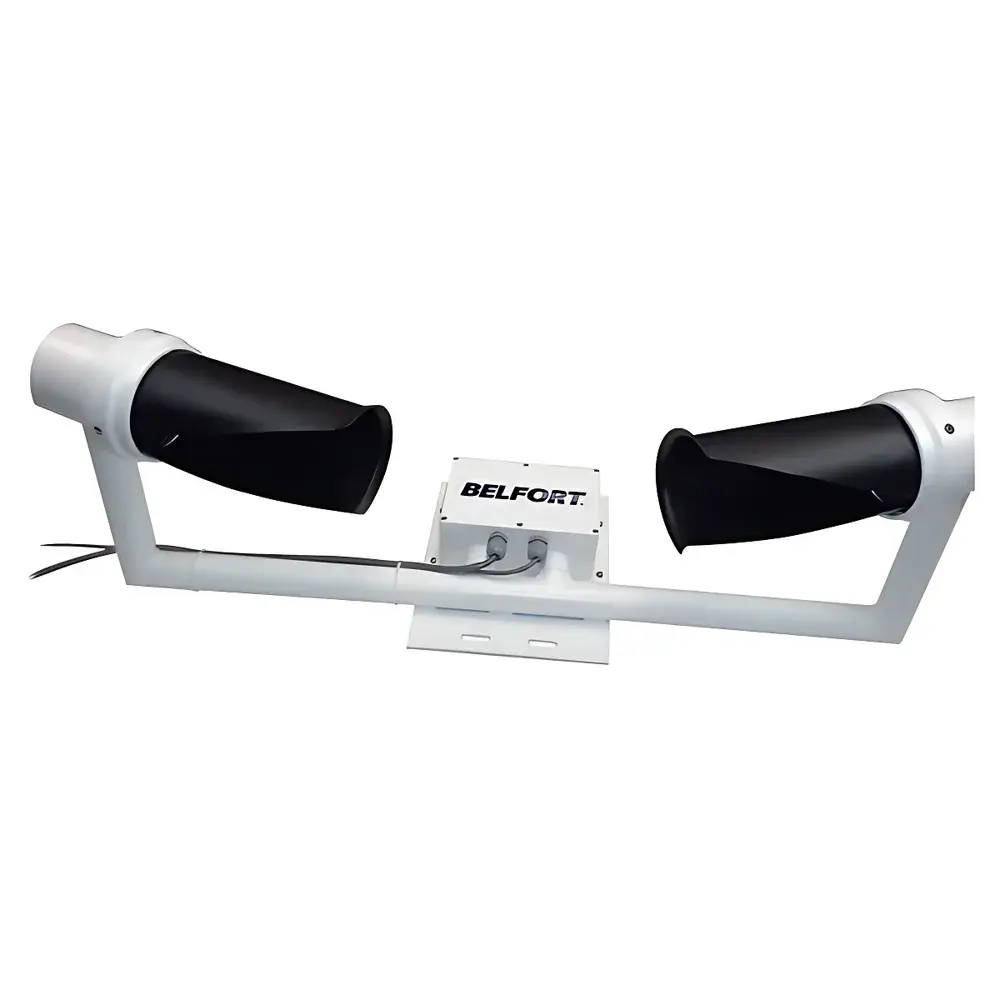
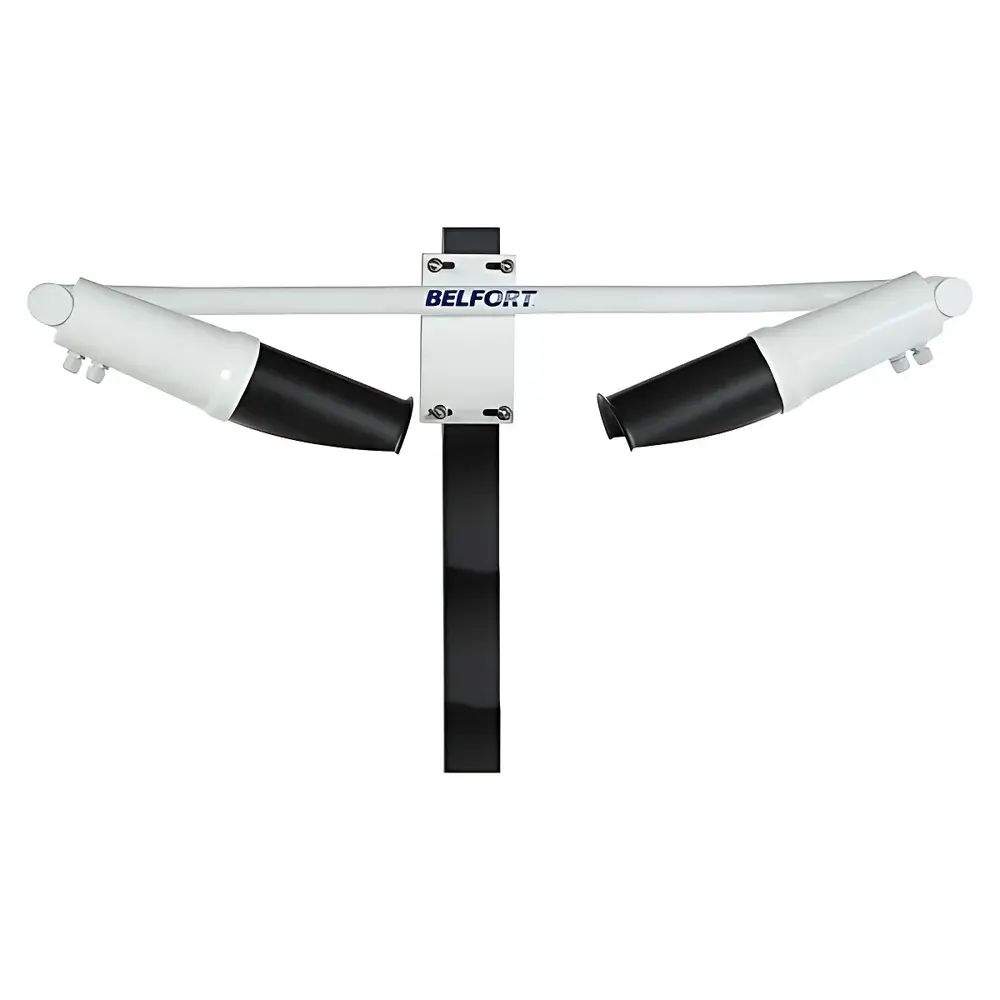
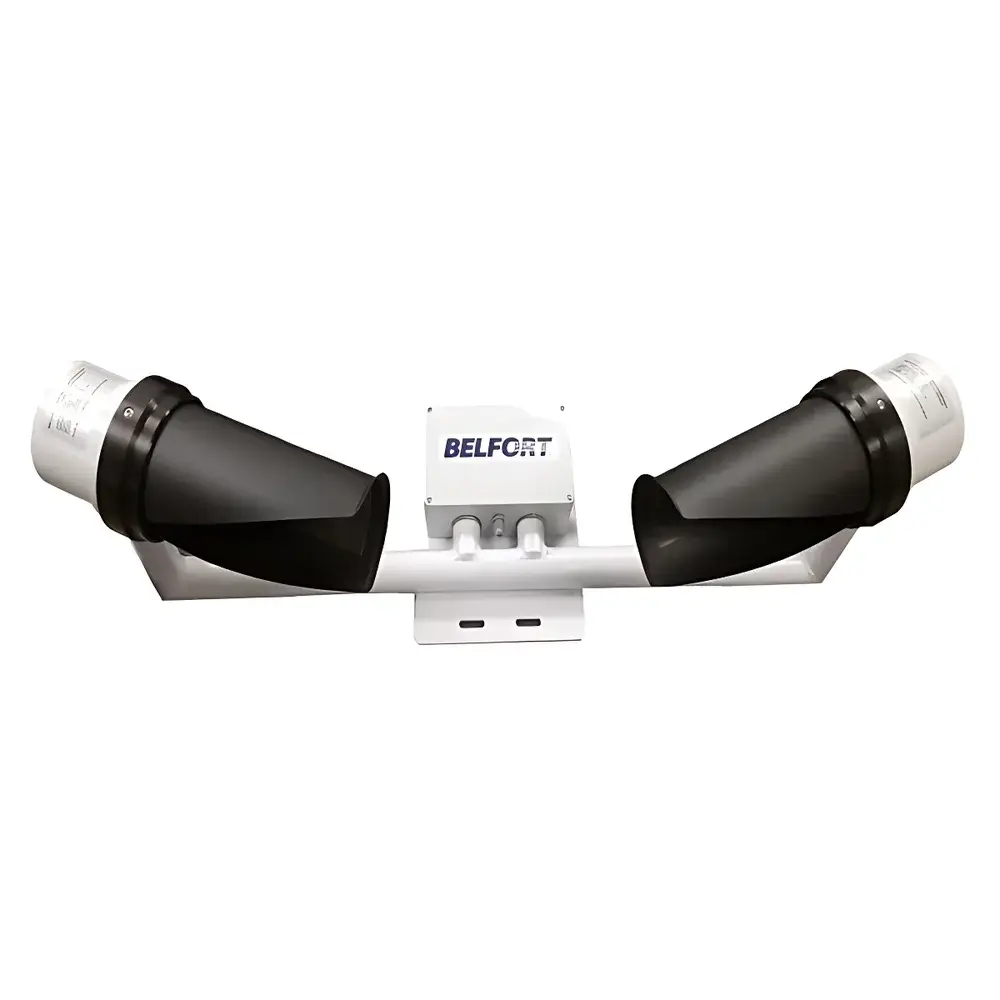
Belfort Model 6400 Forward-Scatter Visibility Sensor
| Brand | Belfort (USA) |
|---|---|
| Origin | USA |
| Model | Model 6400 |
| Measurement Range | 6 m to 80 km |
| Accuracy | ±10% MOR |
| Scattering Angle | 42° |
| Light Source | High-output infrared LED |
| Output | RS232 (300–38,400 bps), SPDT relay |
| Operating Temperature | −40 °C to +55 °C |
| Relative Humidity | 0–100% RH |
| Power | 6 W (standby), 30 W (heater active) |
| Supply Voltage | 12 VDC @ 500 mA |
| Dimensions | 97 × 33 × 41 cm |
| Weight | 7.9 kg |
| Ingress Protection | IP66 |
| Lens Heater | Integrated |
| Optional | Calibration Kit (P/N 93001), Shroud Heater, Analog Output |
Overview
The Belfort Model 6400 Forward-Scatter Visibility Sensor is an engineered solution for continuous, real-time measurement of Meteorological Optical Range (MOR) across a wide dynamic span—from 6 meters to 80 kilometers. It operates on the internationally standardized forward-scatter principle defined in WMO No. 8 and ICAO Annex 3, where a collimated infrared LED beam (typically 850 nm) is directed through a defined sample volume; light scattered at a nominal angle of 42° by suspended aerosols, fog droplets, or precipitation is captured by a matched photodetector. This optical geometry ensures high signal-to-noise ratio and robust immunity to ambient solar loading, achieved through spectral filtering, pulsed modulation, and adaptive background compensation algorithms. The sensor’s compact monolithic housing integrates transmitter and receiver optics within a single weatherproof enclosure—eliminating alignment drift and minimizing maintenance intervals. Designed for unattended operation in harsh environments, it meets the functional and environmental requirements of automated surface observing systems (ASOS), road weather information systems (RWIS), marine navigation aids, and aviation meteorological networks.
Key Features
- Forward-scatter optical architecture compliant with WMO/CIMO guidelines for MOR determination
- Dual-output interface: RS232 serial communication (configurable baud rate: 300–38,400 bps) and field-programmable SPDT relay for alarm triggering
- Integrated lens heater prevents dew, frost, and ice accumulation—critical for stable performance in sub-zero and high-humidity conditions
- Optional shroud heater available to mitigate snow/ice buildup on external housing surfaces
- IP66-rated enclosure constructed from marine-grade anodized aluminum and UV-stabilized polymers for long-term corrosion resistance
- Modular design enables rapid field servicing—no optical realignment required after lens cleaning or heater replacement
- Self-diagnostic firmware provides status reporting (e.g., signal strength, heater status, optical contamination index) via serial interface
Sample Compatibility & Compliance
The Model 6400 is validated for deployment in diverse atmospheric regimes—including maritime salt-laden air, alpine low-temperature fog banks, desert dust events, and urban particulate-laden boundary layers. Its scattering geometry and calibration traceability support compliance with multiple international observational standards: WMO Guide to Instruments and Methods of Observation (CIMO Guide, Chapter 12), FAA Advisory Circular 150/5220-19B (for airport visibility reporting), and EN 16702:2016 (road weather sensors). While not intrinsically certified for SIL or ATEX zones, its electrical isolation and low-power DC architecture allow integration into safety-critical infrastructure when deployed behind appropriately rated barriers. All factory calibrations are performed against NIST-traceable transmissometer reference standards, and on-site verification may be conducted using the optional Calibration Kit (P/N 93001), which includes calibrated neutral-density filters and documented uncertainty budgets per ISO/IEC 17025 practices.
Software & Data Management
Data output follows ASCII-based protocol with configurable transmission modes: timed interval (e.g., every 10 s, 1 min, or 5 min) or polled query response—minimizing network overhead in SCADA or IoT edge deployments. Each data frame includes MOR value (in meters or km), diagnostic flags, internal temperature, heater status, and checksum. Relay thresholds are programmable via serial command set, supporting up to two independent setpoints (e.g., “Low Visibility Alert” and “Ceiling Limit”). Firmware supports non-volatile storage of configuration parameters, enabling retention across power cycles. While no proprietary PC software is bundled, the open ASCII protocol ensures seamless integration with industry-standard platforms including Campbell Scientific LoggerNet, OSIsoft PI System, Ignition SCADA, and custom Python/Node-RED data ingestion pipelines. Audit trails for configuration changes and relay state transitions can be logged externally to satisfy GLP/GMP-aligned operational records requirements.
Applications
- Aviation: Runway Visual Range (RVR) augmentation, approach lighting control, and terminal area fog monitoring
- Transportation: Dynamic message signs (DMS) activation on highways and tunnels, intelligent transport system (ITS) decision support
- Maritime: Vessel traffic service (VTS) situational awareness, lighthouse automation, offshore platform safety monitoring
- Meteorology: Synoptic and climatological MOR time-series collection in national weather networks and research observatories
- Renewable Energy: Fog-induced turbine derating triggers at wind farms and solar irradiance forecasting correlation
FAQ
What is the recommended calibration interval for the Model 6400?
Annual calibration is advised under normal operating conditions; however, sites exposed to heavy dust, sea salt, or industrial particulates may require biannual verification using the P/N 93001 Calibration Kit.
Can the Model 6400 operate without the lens heater?
Yes—lens heating is optional for operation but strongly recommended below 0 °C or above 90% RH to prevent condensation-related measurement bias.
Is analog output available as standard?
No—analog output (4–20 mA or 0–10 V) is an optional module (P/N TBD) requiring factory installation and separate calibration.
Does the sensor meet FDA 21 CFR Part 11 requirements?
The device itself is not a regulated medical instrument; however, its ASCII data stream and relay logs may be incorporated into Part 11–compliant systems when paired with validated audit-trail software and electronic signature controls.
How is optical contamination detected and reported?
Firmware continuously monitors received signal amplitude relative to baseline and triggers a “Lens Contamination” flag when deviation exceeds ±15%—visible in serial diagnostics and usable to schedule preventive maintenance.







