
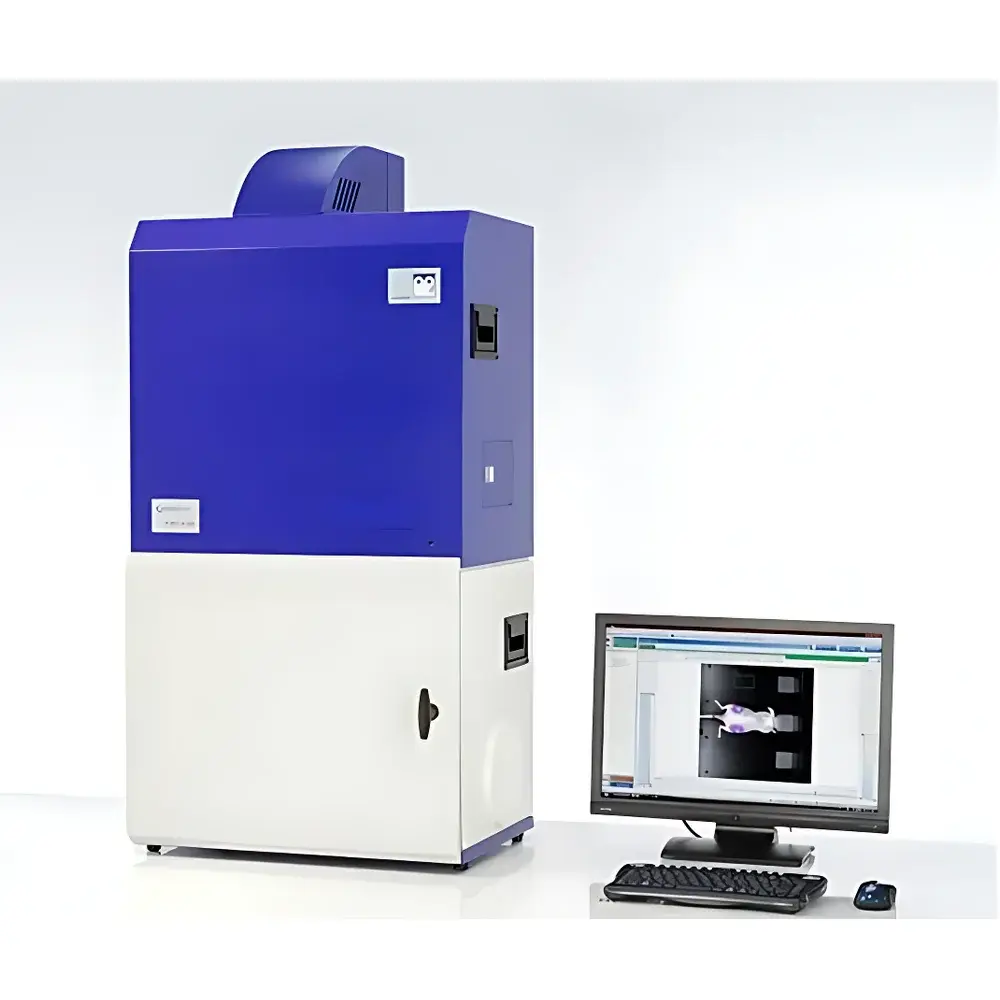
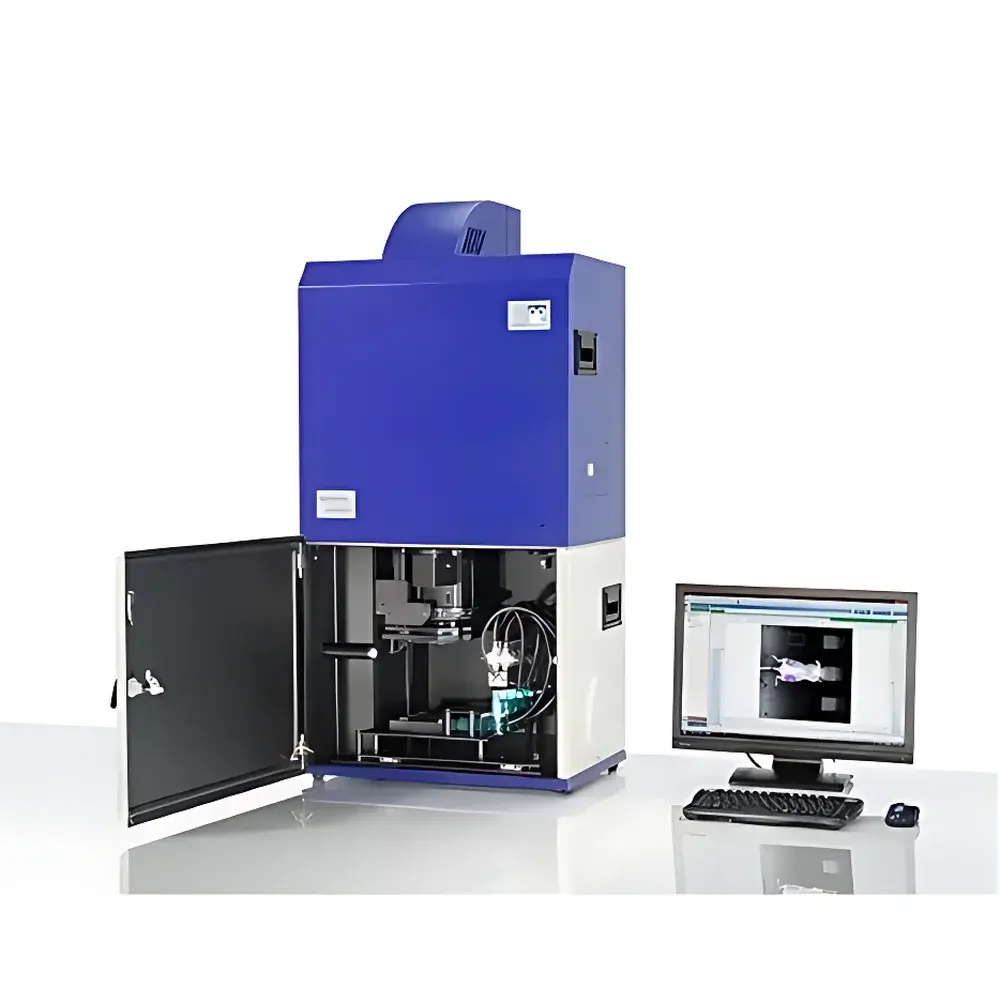
Berthold NightOwl II LB 983 In Vivo Imaging System
| Brand | Berthold |
|---|---|
| Origin | Germany |
| Model | NightOwl II LB 983 |
| CCD Sensor | Back-illuminated, deep-depletion CCD, 1 MP (13 × 13 µm pixels) |
| Cooling | −90 °C (Peltier) |
| Full Well Capacity | 100,000 e⁻ |
| Spectral Range | 350–1050 nm |
| Quantum Efficiency | >90% @ 500–700 nm |
| Lens | f/0.95, C-mount, 25 mm |
| Field of View | Adjustable 35–725 mm |
| Exposure Time | 30 ms to >120 h |
| Sample Height Capacity | 312 mm |
| Binning | 1×1 to 16×16 |
| Filter Wheel | 6-position, 340–1100 nm |
| Excitation Source | ≥75 W halogen lamp (340–750 nm) |
| X-ray Module | Optional integrated micro-radiography |
| Anesthesia Interface | 5-animal isoflurane chamber with flow control |
| Dimensions (H×W×D) | 122 × 60 × 40 cm |
| Weight | 85 kg |
| Compliance | CE-marked, GLP/GMP-ready architecture, FDA 21 CFR Part 11–compatible software audit trail |
Overview
The Berthold NightOwl II LB 983 In Vivo Imaging System is a high-sensitivity, multi-modal optical imaging platform engineered for preclinical research in small animal models. Based on photon detection principles—primarily bioluminescence (BLI) and fluorescence (FLI)—the system enables non-invasive, longitudinal monitoring of molecular and cellular processes in living subjects. Its core detection architecture employs a scientific-grade, back-illuminated, deep-depletion CCD sensor cooled to −90 °C via thermoelectric (Peltier) technology, ensuring ultra-low dark current and read noise—critical for quantifying low-flux bioluminescent signals from luciferase-expressing cells or tissues. The system operates across a broad spectral window (350–1050 nm), supporting conventional fluorescence, upconversion nanoparticle (UCNP) imaging, and Cherenkov luminescence imaging (CLI), while maintaining compatibility with external structural modalities such as micro-CT or micro-PET through synchronized data acquisition protocols.
Key Features
- Ultra-low-noise imaging engine: Back-thinned CCD with 90% quantum efficiency in the 500–700 nm range, 13 × 13 µm pixel pitch, and full-well capacity of 100,000 electrons ensures high dynamic range and signal fidelity across exposure durations from 30 ms to over 120 hours.
- Motion-controlled optical path: Motorized, precision-guided CCD movement (<±0.01 mm repeatability) enables auto-focus across variable sample heights (up to 312 mm) and seamless switching between wide-field (26 × 26 cm²) and microscopic-scale imaging when coupled to C-mount-compatible microscopes.
- Modular excitation architecture: Integrated 75 W halogen source (340–750 nm) with interchangeable illumination geometries—including ring, dual-line, and gooseneck configurations—optimizes uniform excitation for both large cohorts (e.g., 6 mice simultaneously) and localized targets (e.g., paw or brain region).
- Multi-modal expandability: Standard support for white-light reflectance imaging and optional add-ons including X-ray radiography (for anatomical co-registration), gas anesthesia integration (5-port isoflurane manifold), and 3D surface reconstruction modules.
- Electromagnetic isolation: Fully shielded, light-tight enclosure minimizes ambient and cosmic-ray-induced background—essential for detecting sub-femtowatt photon emissions typical in early-stage tumor or immune-cell trafficking studies.
Sample Compatibility & Compliance
The NightOwl II LB 983 accommodates diverse preclinical specimens—from neonatal mice and zebrafish larvae to explanted tissues and 3D organoids—within its vertically adjustable stage. Its 26 × 26 cm² maximum field supports high-throughput screening of multi-animal cohorts under standardized positioning. Regulatory compliance includes CE marking per Directive 2014/30/EU (EMC) and 2014/35/EU (LVD). The system’s hardware design and Indigo™ software architecture align with Good Laboratory Practice (GLP) and Good Manufacturing Practice (GMP) requirements, including electronic signature support, user-access tiering, and full 21 CFR Part 11–compliant audit trails for image acquisition parameters, filter selection, exposure settings, and post-processing steps.
Software & Data Management
Indigo™ acquisition and analysis software provides an integrated workflow—from real-time preview and automated exposure optimization to spectral unmixing, region-of-interest (ROI) quantification, and kinetic time-series normalization. It supports batch processing of longitudinal datasets, cross-modal registration (e.g., FLI + X-ray), and export of FAIR-compliant metadata (DICOM-ORB, NIfTI, TIFF+XML). All raw and processed images are stored with embedded EXIF-like headers containing instrument configuration, calibration coefficients, and environmental logs—enabling traceable reanalysis and regulatory submission readiness.
Applications
The system serves as a foundational tool across translational research domains: oncology (orthotopic tumor growth, metastasis, CAR-T trafficking, oncolytic virus spread), immunology (inflammatory cell recruitment, cytokine reporter dynamics), neurodegeneration (tau or α-synuclein propagation), cardiovascular biology (angiogenesis, myocardial infarction remodeling), stem cell therapy (engraftment, differentiation fate mapping), infectious disease (bacterial/viral load kinetics), nanomedicine (nanocarrier biodistribution, photothermal conversion efficiency), and nucleic acid therapeutics (mRNA vaccine expression kinetics, CRISPR-Cas9 editing persistence). Its quantitative rigor supports IND-enabling pharmacodynamic assessments and mechanistic biomarker validation.
FAQ
What is the minimum detectable photon flux for bioluminescence imaging?
The system achieves theoretical detection limits below 10 photons/sec/cm²/sr under optimal cooling and binning conditions—validated using NIST-traceable luminance standards.
Can the NightOwl II LB 983 perform spectral unmixing for multiple fluorescent probes?
Yes—when used with the 6-position filter wheel and Indigo™’s linear unmixing algorithm, it resolves spectrally overlapping fluorophores (e.g., GFP/mCherry, Cy5.5/Cy7) with <5% crosstalk error.
Is the X-ray module capable of dose-controlled imaging?
The optional micro-radiography unit includes programmable kV/mA settings and real-time dose monitoring compliant with ALARA principles for longitudinal skeletal or pulmonary studies.
How does the system ensure reproducibility across independent laboratories?
Each instrument undergoes factory calibration using certified photometric standards; Indigo™ enforces mandatory calibration file binding to acquired datasets, enabling inter-lab quantitative comparison.
Does Berthold provide validation documentation for GxP environments?
Yes—IQ/OQ/PQ protocols, 21 CFR Part 11 implementation guides, and raw data integrity verification reports are available upon request for regulated preclinical studies.



