
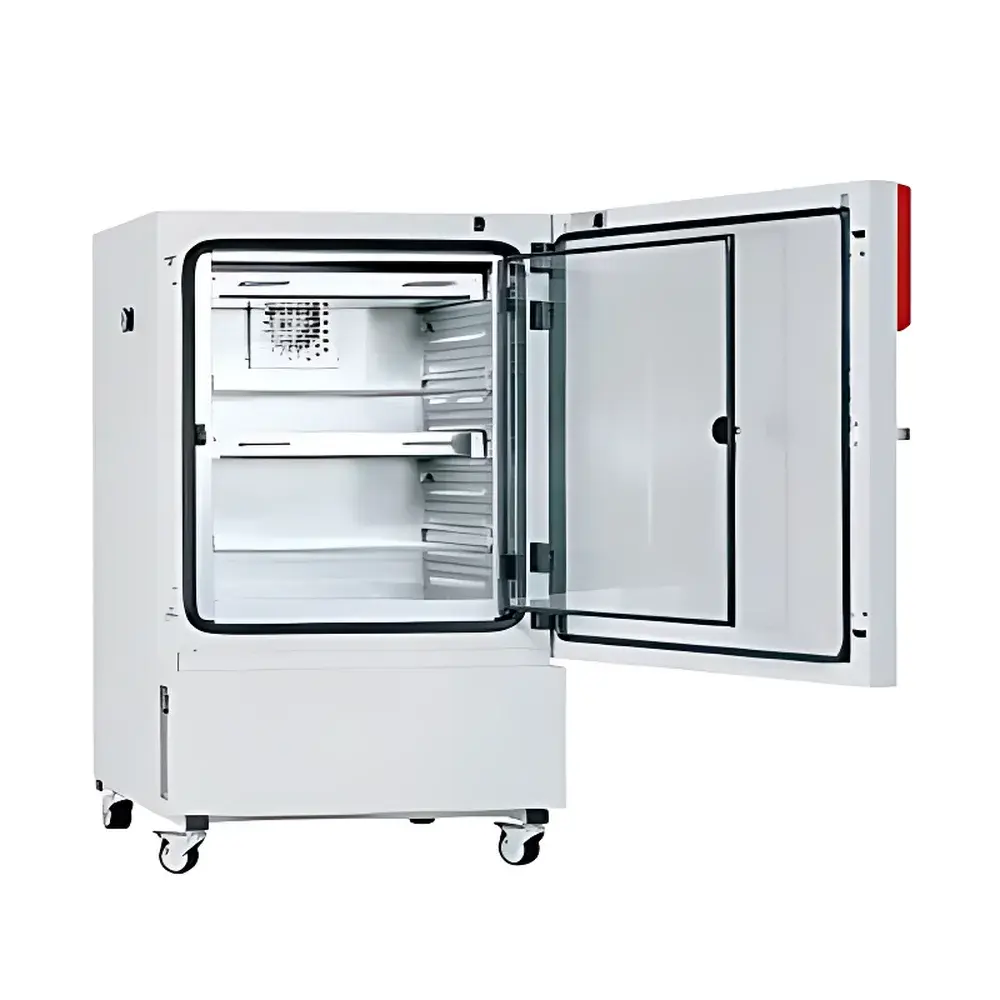
BINDER KBF, KBF ICH, KBF LQC & KMF Series Climate Chambers
| Brand | BINDER |
|---|---|
| Origin | Germany |
| Model Series | KBF, KBF ICH, KBF LQC, KMF |
| Temperature Range (dry) | 0–70 °C |
| Temperature Range (humidified) | 10–70 °C |
| Humidity Range | 10–80 % RH |
| Control System | MCS controller with 25 stored programs (up to 100 segments each, max. 500 total segments) |
| Humidity Sensor | Capacitive |
| Safety Class | DIN 12880 Class 3.1 |
| Connectivity | Ethernet interface for APT-COM™ software |
| Compliance | ICH Q1A, Q1B Option 2 (KBF LQC), ISO 17025-supportive validation documentation available |
| Accessories | 2 stainless-steel shelves, integrated water supply & drain kit (6 m total length), 30 mm port with silicone plug, double-glazed inner door with hermetic seal |
Overview
The BINDER KBF, KBF ICH, KBF LQC, and KMF Series climate chambers are precision-engineered environmental test systems designed for pharmaceutical stability testing, material aging studies, microbiological cultivation, and regulatory-compliant climatic simulation. These chambers operate on a dual-control principle—simultaneous and independent regulation of temperature and relative humidity—using high-stability Peltier-assisted cooling, resistive heating, and electronically modulated steam humidification combined with active desiccant-based dehumidification. The KBF series meets ICH Q1A(R3) requirements for long-term and accelerated stability storage conditions; the KBF ICH variant integrates calibrated daylight-spectrum LED lighting compliant with ICH Q1B Option 1; the KBF LQC model is specifically configured for photostability testing per ICH Q1B Option 2, incorporating a spherical irradiance sensor that measures both UV-A (315–400 nm) and visible light (400–800 nm) irradiance in real time. The KMF series extends operational range for broader climatic simulation, supporting extended temperature spans and dynamic cycling protocols required in automotive, aerospace, and polymer testing standards.
Key Features
- Microprocessor-controlled MCS system with intuitive LCD interface, multilingual menu navigation, and built-in real-time clock for timestamped event logging
- Capacitive humidity sensor with traceable calibration certificate (NIST-traceable reference), ensuring measurement accuracy within ±1.5 % RH across 10–80 % RH range
- Dual-stage humidity control: steam injection for humidification and cold-surface condensation + desiccant wheel for precise dehumidification
- Class 3.1 temperature safety cut-off per DIN 12880, featuring visual and audible alarm outputs plus automatic power interruption at user-defined thresholds
- Hermetically sealed double-glazed inner glass door with anti-fog coating, minimizing thermal bridging and internal condensation
- Ethernet-enabled communication via standardized TCP/IP protocol, fully compatible with BINDER’s APT-COM™ software for remote monitoring, data export (CSV/Excel), and audit-trail generation
- Integrated validation-ready architecture: preconfigured IQ/OQ templates, electronic signature support, and 21 CFR Part 11–compliant user access levels (admin/operator/auditor)
- Modular chamber interior with two adjustable stainless-steel shelves (load capacity: 25 kg/shelf), reinforced floor pan, and 30 mm process port with silicone gasket for external sensor feedthrough or gas purging
Sample Compatibility & Compliance
These chambers accommodate a wide range of sample formats—including vials, blister packs, syringes, petri dishes, and bulk containers—without compromising environmental uniformity. Internal air circulation employs tangential fan geometry with laminar flow optimization, achieving ≤±0.3 °C temperature uniformity and ≤±2 % RH homogeneity (measured per VDI/VDE 3511 Sheet 4.4 at 25 °C/60 % RH). All KBF-series units ship with a factory-issued BINDER Test Certificate verifying performance against EN 61000-6-3 (EMC) and EN 61000-6-2 (immunity), alongside optional IQ/OQ documentation packages aligned with ISO/IEC 17025 and EU GMP Annex 15. The KBF LQC configuration includes full photometric validation: spectral irradiance mapping per CIE S 023/E:2013, with integrated spherical detector calibrated to NIST SRM 2271a. This enables automated exposure dosimetry—calculating cumulative radiant exposure (J/m²) and terminating illumination upon reaching user-specified thresholds—ensuring strict adherence to ICH Q1B Option 2 pass/fail criteria.
Software & Data Management
APT-COM™ software provides comprehensive lifecycle data governance: real-time parameter visualization, configurable alarm notifications (email/SMS via SMTP gateway), and encrypted database logging with immutable audit trails. Data files comply with ALCOA+ principles (Attributable, Legible, Contemporaneous, Original, Accurate, Complete, Consistent, Enduring, Available) and support direct import into LIMS or ELN platforms via ODBC or REST API. Electronic signatures meet FDA 21 CFR Part 11 requirements, including role-based permissions, biometric or token-based authentication, and revision history with change justification fields. Trend analysis tools enable statistical process control (SPC) charting for temperature/humidity deviation tracking over time—critical for CAPA documentation during regulatory inspections.
Applications
- Pharmaceutical stability testing per ICH Q1A(R3), Q5C, and USP /
- Photostability assessment under ICH Q1B Options 1 (visible light) and 2 (UV + visible), including forced degradation studies
- Accelerated aging of medical device packaging (ISO 11607-1), adhesives, and polymer films
- Microbiological incubation requiring controlled humidity (e.g., fungal growth assays per EP 2.6.12)
- Food and beverage shelf-life modeling under tropical, temperate, and sub-arctic climatic profiles
- Electronics reliability testing per JEDEC JESD22-A119 (cold/hot/humidity bias)
- Cosmetic product challenge testing per ISO 11930 and CTFA guidelines
FAQ
What ICH guidelines do the KBF LQC chambers support?
The KBF LQC series is validated for ICH Q1B Option 2 photostability testing, providing real-time UV and visible irradiance measurement, automated exposure dosimetry, and termination logic based on cumulative radiant energy thresholds.
Can the chambers be qualified for GMP environments?
Yes—BINDER supplies IQ/OQ documentation packages, supports PQ execution with third-party vendors, and offers 21 CFR Part 11–compliant APT-COM™ software with full electronic audit trail and user access control.
Is remote monitoring supported out-of-the-box?
All models include Ethernet connectivity and are natively compatible with APT-COM™, enabling secure remote access, live parameter streaming, and alarm forwarding without additional hardware.
How is humidity accuracy maintained over time?
Capacitive sensors are factory-calibrated and field-verifiable using BINDER’s optional humidity calibration kit (Part No. 60-8000-001); drift compensation algorithms adjust for long-term sensor aging based on periodic reference checks.
What validation support is provided for laboratory accreditation?
BINDER delivers metrologically traceable certificates, uncertainty budgets per ISO/IEC 17025, and customizable validation protocols aligned with ASTM E2582, ISO 17025 Clause 6.4.6, and EU GMP Annex 15 Section 4.3.



