
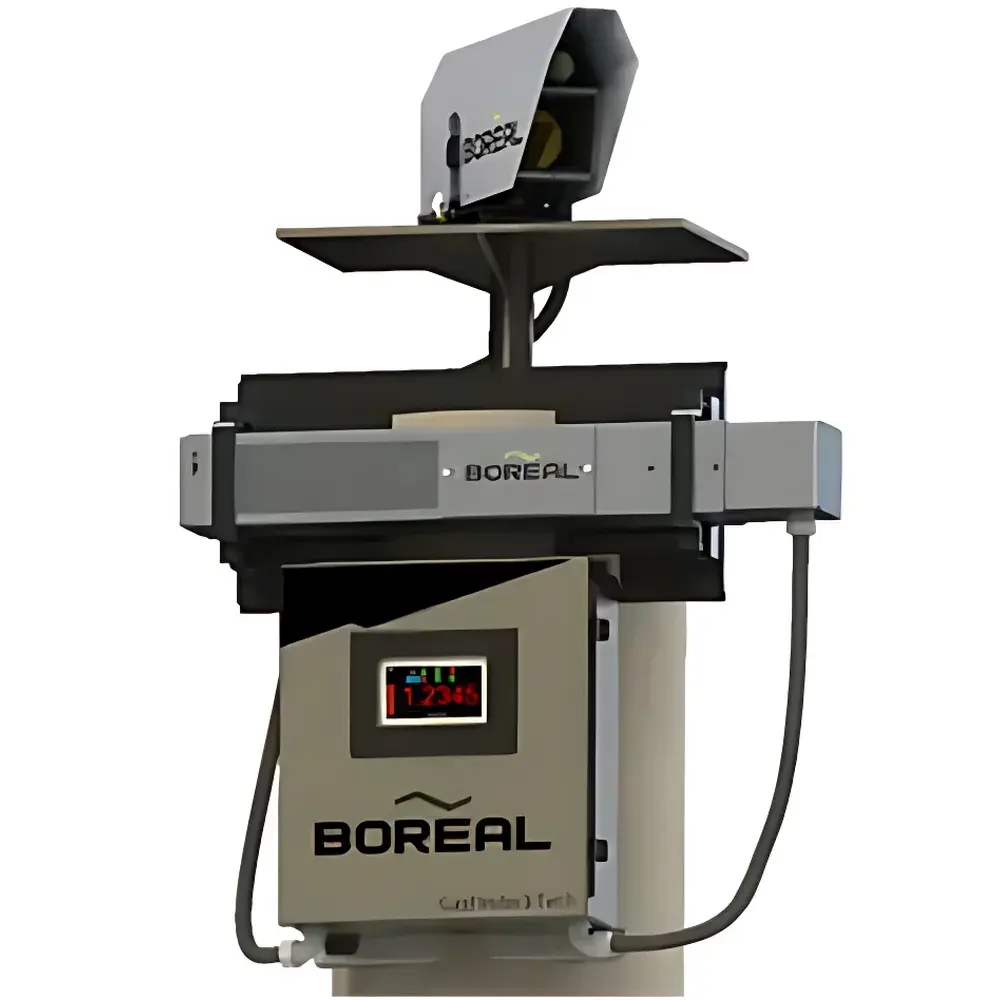
Boreal Laser GasFinder3-DC In-Situ Tunable Diode Laser Absorption Spectroscopy (TDLAS) Multicomponent Gas Analyzer
| Brand | Boreal Laser |
|---|---|
| Origin | Canada |
| Model | GasFinder3-DC |
| Type | Portable In-Situ Analyzer |
| Measurement Principle | TDLAS with Wavelength Modulation Spectroscopy (WMS) |
| Response Time | 1 s |
| Accuracy | ±2% FS |
| Repeatability | CH₄, CO₂, H₂S, NH₃, C₂H₂, O₂ |
| Output Options | Up to three 4–20 mA analog outputs and dry-contact relays per channel (enhanced configuration) |
| Communication Protocols | RS-232, RS-485 (Modbus RTU), Ethernet (TCP/IP, Telnet) |
| Display & Control | Integrated HMI touchscreen or remote GasView software |
| Operating Temperature | −40 °C to +50 °C |
| Enclosure Rating | IP66 / NEMA 4X |
| Laser Source | Semiconductor diode laser (~10 mW output) |
| Laser Safety Class | IEC 60825-1 Class 1 AEL |
| Hazardous Area Certification | NA Class I, Zone 2, IIC, T4 (analyzer) |
| Functional Safety | SIL2 compliant |
| Dimensions | 495 × 368 × 160 mm |
| Weight | 14.6 kg (32.2 lbs) |
| Power Supply | 24 VDC, 20 W (optional 120–220 VAC adapter) |
Overview
The Boreal Laser GasFinder3-DC is an in-situ, dual-channel tunable diode laser absorption spectroscopy (TDLAS) gas analyzer engineered for continuous, real-time multicomponent gas concentration measurement in demanding industrial and environmental applications. Unlike extractive sampling systems, the GasFinder3-DC performs direct optical path measurements across the process stream—eliminating sample conditioning, transport delays, and associated calibration drift. Its core measurement principle leverages wavelength modulation spectroscopy (WMS), a highly selective and noise-immune variant of TDLAS that enables parts-per-trillion (ppt) to percent-level detection sensitivity while rejecting broad-band interferences from particulates, water vapor, and background gases. The system is designed for permanent or semi-permanent installation at measurement points—including stack ducts, fenceline perimeters, landfill cover zones, biogas pipelines, and refinery flare stacks—where robustness, long-term stability, and minimal maintenance are critical.
Key Features
- Dual-channel architecture supports simultaneous, independent measurements at two distinct locations using a single analyzer unit—reducing footprint, power consumption, and total cost of ownership.
- In-situ probe configurations include insertion-type, open-path, point-sampling, and cross-duct variants—enabling flexible deployment across ducts, ambient air zones, and hazardous area boundaries.
- Integrated reference cell enables automatic zero and span verification without external gas cylinders or manual intervention—ensuring traceable calibration integrity between scheduled maintenance cycles.
- Class 1 laser safety certification (IEC 60825-1) ensures operational compliance in occupied spaces without additional engineering controls.
- SIL2-certified functional safety architecture meets IEC 61508 requirements for use in safety instrumented systems (SIS) where gas monitoring contributes to process shutdown logic.
- Wide operating temperature range (−40 °C to +50 °C) and IP66/NEMA 4X-rated enclosure guarantee reliable operation in arctic field sites, tropical refineries, and outdoor emission monitoring stations.
- Real-time data acquisition at 1 Hz native sampling rate—with no hysteresis, memory effect, or sensor poisoning—provides statistically independent readings for regulatory reporting and dynamic leak quantification.
Sample Compatibility & Compliance
The GasFinder3-DC is validated for quantitative detection of CH₄, CO₂, H₂S, NH₃, C₂H₂, O₂, CO, HCl, HF, HCN, C₂H₄, and other target species upon factory configuration. Its spectral selectivity—rooted in rovibrational absorption line targeting—ensures immunity to cross-sensitivity from common interferents such as H₂O, CO, NOₓ, and hydrocarbon mixtures. The system complies with international standards governing environmental monitoring and industrial safety, including EPA Method 21 (leak detection), ASTM D6522 (TDLAS-based emissions monitoring), ISO 14064-1 (GHG quantification), and EN 15267-3 (QAL1 certification framework). For regulated environments, the analyzer supports audit-ready data logging with time-stamped events, user access logs, and change history—fully compatible with FDA 21 CFR Part 11 electronic record requirements when deployed with GasView software and secure network infrastructure.
Software & Data Management
Local operation is managed via a high-brightness, sunlight-readable 7-inch resistive touchscreen HMI with intuitive menu navigation and real-time trend visualization. Remote monitoring and configuration are enabled through GasView—a Windows-based PC application supporting multi-analyzer fleet management, historical data export (CSV/Excel), alarm threshold definition, and automated report generation. All communication interfaces—including RS-232, RS-485 (Modbus RTU), and Ethernet (TCP/IP, Telnet)—are natively supported without protocol gateways. Data can be streamed directly into SCADA, DCS, or cloud-based IoT platforms (e.g., AWS IoT Core, Azure IoT Hub) via configurable MQTT or OPC UA adapters. Internal non-volatile memory stores >12 months of 1-second resolution data (compressed), with optional SD card expansion for extended archival.
Applications
- Leak Detection and Repair (LDAR): Quantifies fugitive emissions from valves, flanges, connectors, and compressors under EPA OOOO/OOOOa and EU IED mandates—supporting both survey-mode scanning and fixed-point continuous monitoring.
- Stack Emissions Monitoring: Measures CO₂, CH₄, NH₃, and HCl in combustion flue gas streams without extractive sampling—ideal for cement kilns, waste incinerators, and biomass boilers.
- Fenceline & Ambient Air Monitoring: Deployed as open-path or point-sampling nodes in perimeter networks to detect plume dispersion, verify dispersion modeling, and support community air quality reporting (e.g., U.S. EPA Community Right-to-Know).
- Biogas & Landfill Gas Optimization: Tracks CH₄/CO₂ ratio and H₂S concentration in real time to optimize upgrading efficiency, corrosion mitigation, and energy recovery control strategies.
- Process Safety & Combustible Gas Monitoring: Provides fail-safe O₂ deficiency or combustible gas buildup detection in confined spaces, LNG terminals, and hydrogen production facilities—leveraging SIL2-certified hardware and diagnostics.
FAQ
Does the GasFinder3-DC require periodic calibration with certified gas standards?
No—its built-in reference cell enables automatic zero and span validation. Manual calibration is only required annually or after major optical component replacement, per QAL2 procedures.
Can the analyzer operate in explosive atmospheres?
Yes—the analyzer housing is certified for Class I, Zone 2, IIC, T4 environments; probes are rated for Zone 1, intrinsic safety (ib), IIC, T4 Gb per CSA/UL standards.
Is the system compatible with existing plant DCS networks?
Yes—native Modbus RTU (RS-485), Modbus TCP, and 4–20 mA analog outputs ensure seamless integration with legacy and modern control systems.
What is the minimum detectable concentration for methane in open-path mode?
Detection limits depend on path length and optics configuration; typical values range from 0.1 ppm·m to 5 ppm·m (integrated concentration-path product) with sub-second response.
How is data integrity ensured during network outages?
All measurements are buffered locally in non-volatile memory. Upon network restoration, timestamps and sequence numbers ensure gap-free retransmission without data loss.
Related Products







