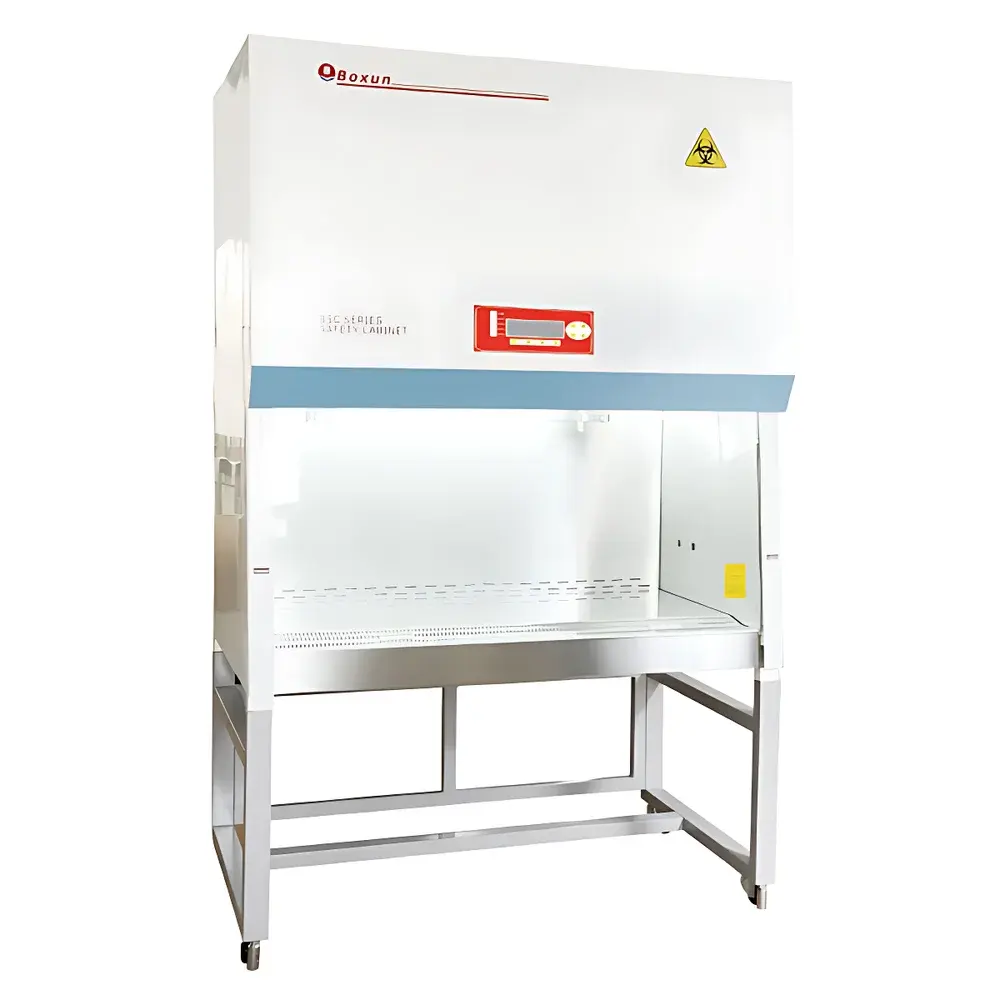
BOXUN BSC-1360B2 Class II Biological Safety Cabinet
| Brand | BOXUN |
|---|---|
| Origin | Shanghai, China |
| Manufacturer Type | Authorized Distributor |
| Origin Category | Domestic (China) |
| Model | BSC-1360B2 |
| Instrument Type | Class II Biological Safety Cabinet |
| External Dimensions (L×W×H) | 1420 × 895 × 2340 mm |
| Internal Work Area Dimensions (L×W×H) | 1300 × 500 × 640 mm |
| HEPA Filter Efficiency | ≥99.99% @ 0.3 µm |
| Inflow Velocity | 0.55 m/s |
| Downflow Velocity | 0.33 m/s |
| Downflow Control Accuracy | ±0.015 m/s |
| Pressure Differential Range | 0–500 Pa |
| Noise Level | ≤67 dB(A) |
| Vibration Half-Peak | ≤5 µm |
| Average Illuminance | ≥650 lx |
| Operating Ambient Temperature | 10–30 °C |
| Relative Humidity | ≤70% @ 25 °C |
| Atmospheric Pressure Range | 80–105 kPa |
| Power Supply | AC 220 V ±10%, 50/60 Hz |
| Total Power Consumption | 2.2 kW |
| Lighting | 2 × 40 W fluorescent lamps + 1 × 30 W UV lamp |
| Supply Filter Size | 1326 × 606 × 70 mm |
| Exhaust Filter Size | 782 × 515 × 90 mm |
| Work Surface | Removable SUS304 stainless steel with integrated liquid collection trough and drain valve |
| Airflow Sensors | Imported U.S.-made constant-velocity anemometers |
| Fan System | EBMPAPST (Germany) centrifugal blowers |
| Safety Interlocks | UV/light interlock, sash position alarm, fan shutdown at sash closure |
Overview
The BOXUN BSC-1360B2 is a certified Class II, Type A2 biological safety cabinet engineered for rigorous containment of low-to-moderate risk biological agents (BSL-2 and select BSL-3 applications under validated protocols). It operates on the principle of laminar downflow combined with inward-facing inflow—both streams conditioned through dual HEPA filtration—to simultaneously protect personnel, product, and environment. The cabinet complies with NSF/ANSI 49-2022, EN 12469:2000, and GB 50346-2011 standards for biosafety cabinet performance and classification. Its airflow architecture maintains a minimum inflow velocity of 0.55 m/s and a downward laminar flow of 0.33 m/s across the work surface, ensuring consistent particle removal and cross-contamination control. The negative-pressure chassis, sealed welds, and fully enclosed ductwork prevent unfiltered air leakage, while real-time differential pressure monitoring (0–500 Pa range) enables continuous verification of operational integrity.
Key Features
- Structural modularity: Bolt-together frame with leveling screws and heavy-duty casters for stable repositioning and site adaptation.
- Intuitive human-machine interface: Backlit LCD display showing real-time inflow/downflow velocities, static pressure differential, UV lamp status, and filter life indicators.
- Precision airflow regulation: Microprocessor-controlled blower system with auto-compensation for filter loading—maintaining ±0.015 m/s downflow stability over full filter service life.
- Dual HEPA filtration: Supply and exhaust filters certified to retain ≥99.99% of particles ≥0.3 µm; exhaust air recirculated (70%) after filtration, with 30% exhausted externally via dedicated ducting.
- Ergonomic sash design: 5° inclined tempered glass sash with UV-blocking coating, shatter-resistant construction, and position-sensing interlock triggering audible/visual alarms above safe height limits.
- Corrosion-resistant interior: Seamless, radius-curved SUS304 stainless steel chamber walls and removable work surface with integrated liquid collection trough and quick-drain valve.
- Integrated utility provisions: One splash-proof AC outlet (with cover), plus pre-punched ports for optional water/gas line integration.
- Acoustic and vibrational optimization: EBMPAPST (Germany) centrifugal fans mounted on vibration-dampening isolators; noise output ≤67 dB(A) at 1 m, vibration half-peak ≤5 µm.
Sample Compatibility & Compliance
The BSC-1360B2 supports routine aseptic handling of cell cultures, primary tissues, recombinant DNA constructs, and diagnostic specimens. Its 1300 × 500 × 640 mm work area accommodates standard tissue culture hoods, centrifuges (up to 20 cm diameter), and multi-channel pipettors without airflow disruption. All materials in contact with the work chamber—including gasketing, lighting diffusers, and UV reflectors—meet ISO 10993 biocompatibility requirements. The cabinet is validated for compliance with NSF/ANSI 49 Annex D (personnel protection), Annex E (product protection), and Annex F (environmental protection). Optional third-party certification reports (e.g., from CNAS-accredited labs) are available upon request to support GLP/GMP audit readiness and FDA 21 CFR Part 11–aligned documentation workflows.
Software & Data Management
While the BSC-1360B2 operates via embedded microcontroller logic (no external PC dependency), its firmware supports audit-trail-capable event logging—including sash position changes, UV activation cycles, filter saturation warnings, and airflow deviation alerts. Logged data is timestamped and stored in non-volatile memory for ≥12 months. Optional RS-485 or Modbus RTU interface enables integration into centralized laboratory infrastructure management systems (LIMS/BMS) for remote monitoring and automated calibration scheduling. All firmware updates follow secure signed-package protocols compliant with IEC 62443-3-3 SL2 requirements for industrial control system integrity.
Applications
- Aseptic preparation of mammalian and insect cell lines in academic and contract research laboratories.
- Handling of clinical specimens (blood, saliva, swabs) in diagnostic virology and microbiology units.
- Plasmid transfection, CRISPR-Cas9 editing, and lentiviral vector production under BSL-2 containment.
- Quality control testing of sterile pharmaceutical intermediates per USP and ISO 14644-1 Class 5 (ISO Class 5) environmental monitoring protocols.
- Support of GLP-compliant toxicology studies involving genetically modified organisms (GMOs) as defined in OECD Test Guideline 306.
FAQ
Does the BSC-1360B2 meet NSF/ANSI 49 certification requirements?
Yes—it is designed and tested to comply with NSF/ANSI 49-2022 for Class II, Type A2 cabinets, including smoke pattern visualization, microbial challenge testing, and airflow velocity validation.
Can it be connected to a building’s central exhaust system?
Yes—equipped with a 250 mm diameter exhaust collar compatible with standard rigid ducting; static pressure compensation ensures stable operation under variable building exhaust backpressure.
What maintenance intervals are recommended for HEPA filters?
Supply and exhaust filters require annual integrity testing (DOP/PAO scan); replacement is typically required every 3–5 years depending on usage intensity and ambient particulate load.
Is UV lamp irradiance validated and documented?
UV output is measured at installation using NIST-traceable radiometry; certificate of conformance includes irradiance (µW/cm²) at 15 cm distance and wavelength peak (253.7 nm).
How is user authentication managed for audit trail compliance?
The system logs operator-initiated actions (e.g., UV activation, sash adjustment) with device-generated timestamps; no user login is required, but external LIMS integration supports role-based access control.
Related Products