
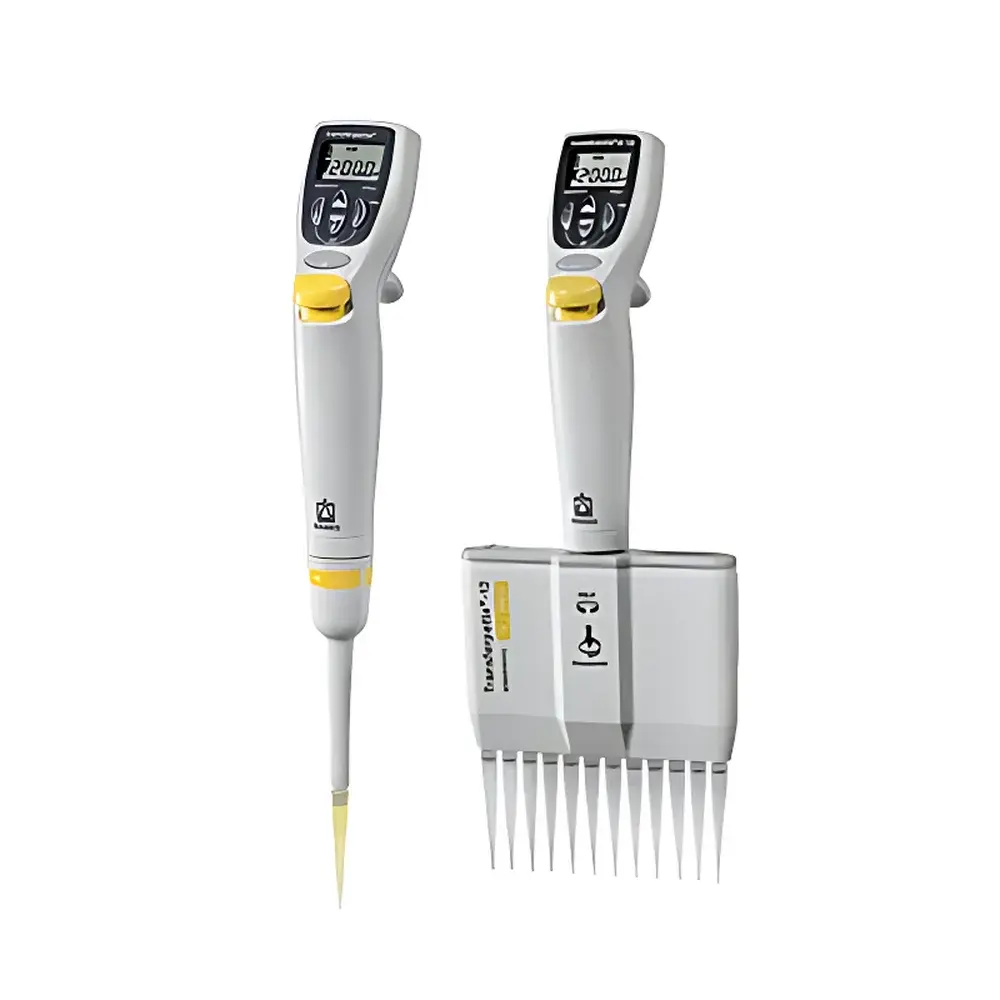
BRAND Transferpette® electronic Single-Channel and Multi-Channel Electronic Pipettes
| Brand | BRAND |
|---|---|
| Origin | Germany |
| Type | Air-displacement electronic pipette |
| Channel Configurations | Single-channel (1-channel), 8-channel, 12-channel |
| Volume Ranges (Single) | 0.5–10 µL, 2–20 µL, 20–200 µL, 100–1000 µL, 0.5–5 mL |
| Volume Ranges (Multi) | 0.5–10 µL, 1–20 µL, 5–100 µL, 10–200 µL, 15–300 µL |
| Certification | CE-IVD, TÜV Rheinland/Berlin-Brandenburg certified ergonomics |
| Battery Life | ~4,000 pipetting cycles per charge |
| Operation Modes | Pipetting, Reverse Pipetting, Mixing, Gel Electrophoresis, Continuous Dispensing |
| Corrosion Resistance | Chemically resistant piston and tip ejection mechanism |
| Compliance | Conforms to ISO 8655-2 (volumetric accuracy & precision), EN 61326-1 (EMC), IEC 61010-1 (safety) |
Overview
The BRAND Transferpette® electronic is a high-precision air-displacement electronic pipette engineered for reproducible liquid handling across research, clinical diagnostics, and quality control laboratories. Unlike traditional mechanical pipettes, it integrates programmable electronic actuation with the proven mechanical reliability of BRAND’s legacy Transferpette® platform. Its core operating principle relies on controlled motor-driven piston displacement within a sealed air chamber—enabling precise volume setting, consistent plunger travel, and minimized operator-induced variability. Designed specifically for environments requiring traceable, repeatable, and fatigue-reduced pipetting workflows—including ISO/IEC 17025-accredited testing labs and IVD-regulated settings—the Transferpette® electronic meets CE-IVD requirements and carries formal ergonomic certification from TÜV Rheinland/Berlin-Brandenburg, making it the world’s first electronically actuated pipette validated for comprehensive human factors compliance.
Key Features
- Ergonomic architecture: Balanced mass distribution, low center of gravity, and independently adjustable finger rest minimize wrist flexion and repetitive strain during extended use.
- Five pre-programmed pipetting modes: Standard pipetting, reverse pipetting (optimized for viscous or volatile liquids), mixing (with customizable cycle count and speed), gel electrophoresis (low-force aspiration/dispense for fragile gels), and continuous dispensing (for serial dilutions or plate filling).
- Chemical resistance: Stainless-steel piston coated with PTFE-compatible surface finish; tip ejector mechanism constructed from corrosion-resistant polymers suitable for exposure to alcohols, acids, and common laboratory solvents.
- Intuitive interface: Backlit monochrome LCD display with logical menu navigation, tactile feedback buttons, and multilingual on-device prompts (English, German, French, Spanish, Chinese).
- Power management system: Rechargeable Li-ion battery supports approximately 4,000 full pipetting cycles; battery regeneration protocol extends service life; pipette remains fully operational while charging via micro-USB port.
Sample Compatibility & Compliance
The Transferpette® electronic accommodates standard conical polypropylene tips (including low-retention and filtered variants) across all specified volume ranges. It is compatible with both universal-fit and BRAND-specific tip lines, ensuring optimal sealing and minimal carryover. All models comply with ISO 8655-2:2022 for volumetric accuracy (±0.6% at nominal volume) and precision (CV ≤ 0.3%), verified under controlled environmental conditions (20–25 °C, 40–60% RH). The CE-IVD marking confirms conformity with EU In Vitro Diagnostic Medical Devices Regulation (IVDR 2017/746) Annex I essential requirements. Full documentation—including Declaration of Conformity, test reports, and ergonomic validation dossier—is provided for audit readiness in GLP, GMP, and CLIA-regulated facilities.
Software & Data Management
While the Transferpette® electronic operates as a standalone instrument without mandatory software dependency, optional connectivity modules enable integration into laboratory information management systems (LIMS) via RS-232 or USB-C serial emulation. Firmware updates are performed using BRAND’s free PipetteManager™ desktop utility (Windows/macOS), which logs calibration history, user-defined protocols, and battery health metrics. Audit trails generated by the utility comply with FDA 21 CFR Part 11 requirements when deployed with appropriate organizational controls (e.g., role-based access, electronic signatures, and secure storage).
Applications
This pipette is routinely deployed in applications demanding high repeatability and operator safety: qPCR master mix preparation, ELISA plate setup, cell culture media aliquoting, nucleic acid normalization, and clinical sample dilution in molecular pathology labs. Its reverse pipetting mode improves accuracy when handling glycerol-rich buffers or serum samples; the gel electrophoresis mode reduces well distortion during loading of agarose or polyacrylamide gels. Multi-channel variants (Transferpette®-8/-12 electronic) significantly accelerate high-throughput workflows such as 96-well plate replication, CRISPR guide RNA complex assembly, and QC testing of pharmaceutical excipients.
FAQ
Is the Transferpette® electronic compatible with third-party pipette tips?
Yes—it accepts industry-standard conical tips meeting ISO 8655-3 dimensional tolerances, though optimal performance (e.g., leak-free operation at lowest volumes) is guaranteed with BRAND-certified tips.
What calibration standards does it support?
It adheres to ISO 8655-6 for routine verification and ISO 8655-5 for full calibration; certified reference weights and distilled water density tables are used per gravimetric method.
Can it be decontaminated with ethanol or bleach?
External surfaces may be wiped with 70% ethanol; avoid submersion or aggressive solvents. The piston and internal mechanisms are not user-serviceable and must not be exposed to chlorine-based disinfectants.
Does it require annual recalibration?
Calibration frequency depends on usage intensity and regulatory context; most accredited labs perform verification every 3–6 months and full calibration annually—or after impact, disassembly, or environmental shock.
How is user authentication managed?
The device itself does not store user identities; however, PipetteManager™ software supports multi-user profiles with password protection and activity logging for traceability in regulated environments.



