
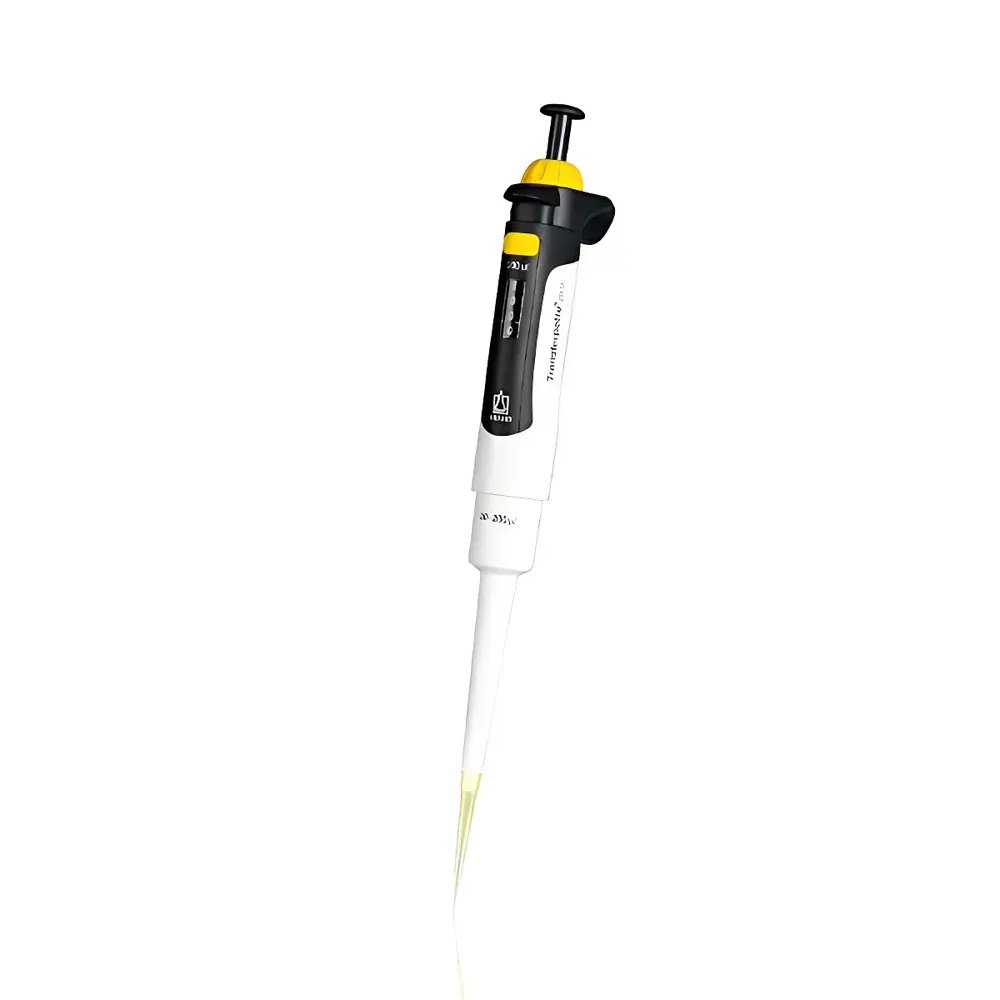
BRAND Transferpette® pro Manual Single-Channel Pipette
| Brand | BRAND |
|---|---|
| Origin | Germany |
| Model | Transferpette® pro |
| Pipette Type | Manual Single-Channel |
| Volume Range | 0.1 µL – 10 mL |
| Maximum Capacity | 10 mL |
| Ergonomic Design | Yes |
| Tool-Free Calibration | Yes |
| User-Adjustable Offset Function | Yes |
| Compliance | ISO 8655 Compliant |
| Channel Count | 1 |
| Import Status | Imported |
Overview
The BRAND Transferpette® pro is a precision-engineered manual single-channel pipette designed for high-reproducibility liquid handling across life science, clinical diagnostics, and quality control laboratories. Built upon the ISO 8655–compliant piston-driven air displacement principle, it delivers traceable accuracy and repeatability across its full volume range—from ultra-low volumes of 0.1 µL (critical for PCR setup, enzyme dilutions, and nucleic acid quantification) to macro-scale transfers up to 10 mL (common in environmental water analysis, buffer preparation, and bulk reagent dispensing). Unlike motorized or electronic pipettes, the Transferpette® pro maintains mechanical simplicity while integrating advanced ergonomic and functional refinements—ensuring consistent operator performance without reliance on batteries or firmware. Its German-manufactured construction reflects stringent adherence to DIN EN ISO 9001 quality management systems, with every unit individually tested and supplied with a factory calibration certificate traceable to national standards.
Key Features
- Ergonomic one-hand operation: Volume setting, volume lock, aspiration, dispensing, and tip ejection are all executable using a single hand—reducing wrist fatigue and improving workflow continuity during high-throughput tasks.
- Tool-free calibration system: Internal adjustment mechanism allows certified technicians or qualified lab personnel to recalibrate volume output without disassembly or specialized tools—supporting routine maintenance under GLP/GMP environments.
- User-adjustable offset function: A dedicated red slider located beneath a removable cover enables temporary volumetric compensation (±10% typical range) for non-ideal conditions—e.g., viscous liquids (glycerol, serum), temperature gradients between pipette and reagent, or non-standard tip geometries—without altering the factory-set baseline calibration.
- Low-force plunger action: Optimized spring mechanics reduce actuation force by up to 35% compared to prior-generation models, minimizing repetitive strain injury (RSI) risk during extended use sessions.
- Chemically resistant materials: Upper housing and tip cone constructed from autoclavable polypropylene and stainless-steel components; compatible with 70% ethanol, isopropanol, and common laboratory disinfectants.
- Modular design: Interchangeable lower parts facilitate rapid servicing and long-term reliability; O-rings and seals conform to USP Class VI biocompatibility requirements.
Sample Compatibility & Compliance
The Transferpette® pro is validated for use with standard conical polypropylene pipette tips meeting ISO 8655–4 dimensional specifications. It accommodates low-retention, filtered, and sterile-filtered tips across all volume ranges. For challenging fluids—including high-density (e.g., DMSO, glycerol solutions), high-viscosity (e.g., PEG, agarose gels), or high-vapor-pressure solvents (e.g., acetone, chloroform)—the user-adjustable offset feature provides empirically derived compensation without requiring recalibration. All models comply with ISO 8655 Parts 1–6 (volumetric performance, testing methods, and metrological traceability), and documentation supports audit readiness for FDA 21 CFR Part 11–aligned environments when paired with appropriate lab-specific SOPs and calibration logs.
Software & Data Management
As a fully manual instrument, the Transferpette® pro does not incorporate embedded electronics or digital connectivity. However, its design supports integration into digitally governed workflows: calibration records, usage logs, and maintenance histories can be managed via LIMS or ELN platforms using standardized templates aligned with ISO/IEC 17025 and GxP data integrity principles. Each pipette carries a unique serial number engraved on the barrel, enabling traceability across instrument lifecycle events—including calibration due dates, service interventions, and user assignment tracking.
Applications
- Molecular biology: Accurate dispensing of restriction enzymes, Taq polymerase, dNTPs, and cDNA templates at sub-microliter levels.
- Clinical microbiology: Serial dilution of bacterial cultures and antimicrobial susceptibility testing (AST) preparations.
- Environmental testing: Transfer of large-volume aqueous samples (e.g., wastewater, soil extracts) into digestion vessels or ICP-MS autosampler vials.
- Pharmaceutical QC: Preparation of reference standards and placebo formulations where volumetric consistency directly impacts assay validity.
- Cell culture: Gentle handling of sensitive media supplements (e.g., growth factors, FBS) without foaming or aerosol generation.
FAQ
Is the Transferpette® pro suitable for positive displacement applications?
No. It operates on the air displacement principle and is not designed for positive displacement pipetting. For volatile, viscous, or temperature-sensitive liquids requiring direct piston contact, BRAND’s Dispensette® or Transferpette® S Positive Displacement models are recommended.
Can the user-adjustable offset be locked to prevent accidental changes?
Yes. The red slider is secured under a snap-fit cover plate; removal requires deliberate action, ensuring unintentional adjustments are avoided during routine handling.
What is the recommended recalibration interval?
Per ISO 8655 and internal BRAND guidelines, recalibration is advised every 3–6 months for daily-use instruments, or after 10,000 cycles—whichever occurs first—and must follow documented procedures compliant with ISO/IEC 17025.
Are replacement parts available globally?
Yes. All consumables—including tip cones, seals, springs, and calibration tools—are distributed through authorized BRAND partners and carry CE marking and RoHS compliance documentation.
Does the pipette meet requirements for ISO 13485-certified medical device manufacturing?
While the pipette itself is not a medical device, its ISO 8655 compliance, traceable calibration, and material biocompatibility support its use in ISO 13485–regulated environments for device-related testing and process validation activities.



