
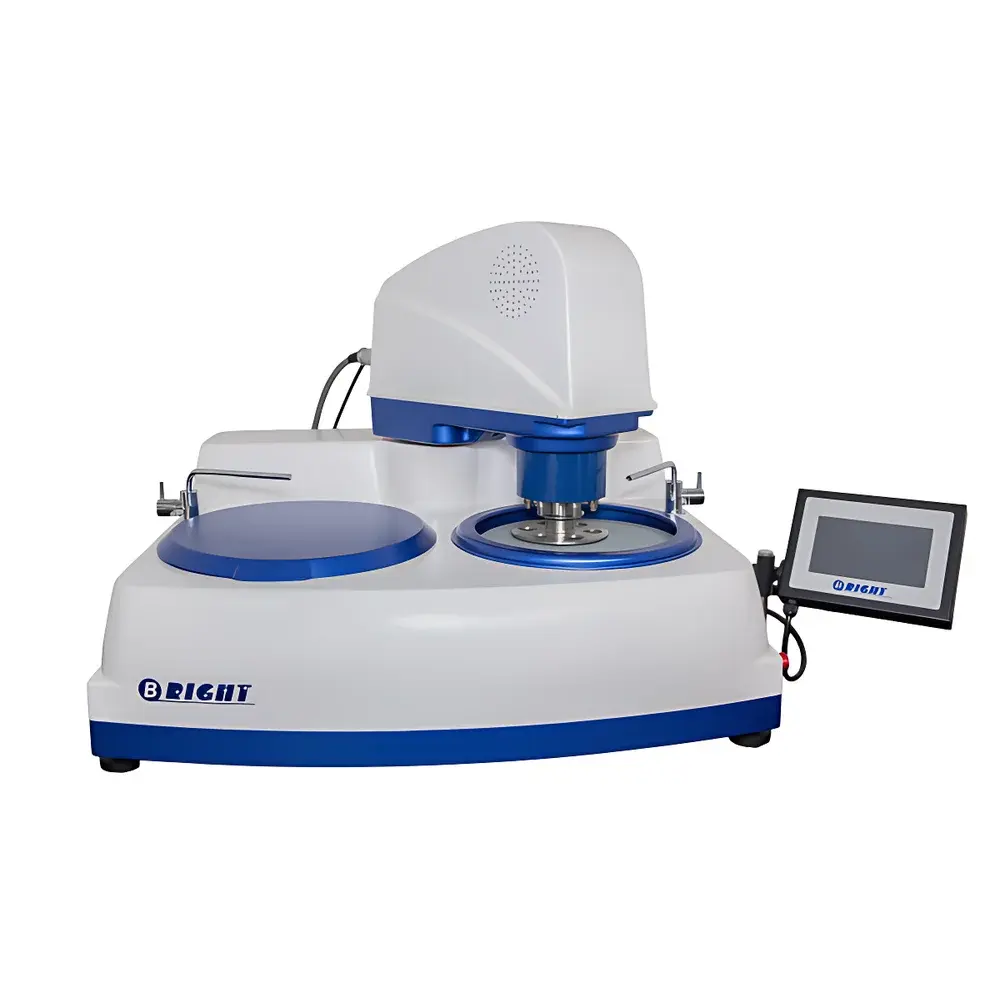
BRIGHT Chiron 250DA Intelligent Fully Automatic Metallographic Grinding and Polishing System
| Brand | BRIGHT |
|---|---|
| Origin | United Kingdom |
| Model | Chiron 250DA |
| Disc Diameter | 254 mm |
| Disc Quantity | 2 |
| Speed Range (Main Disc) | 100–1000 rpm, infinitely variable |
| Speed Range (Grinding Head) | 20–120 rpm, infinitely variable |
| Sample Holders | 6 positions |
| Holder Sizes | Φ22 mm / Φ30 mm / Φ45 mm |
| Z-Axis Grinding Depth | 0.1 mm per step, adjustable from 0 to 5 mm |
| Pressure Modes | Single-point pneumatic (0–50 N) and central pneumatic (0–160 N) |
| Motor Type | Brushless DC motor (220 V, 1.1 kW) + Stepper motor for grinding head (26 V, 200 W) |
| Timer Range | 0–99 minutes |
| Dimensions (L×W×D) | 725 × 1200 × 760 mm |
| Net Weight | 134 kg |
| Compliance | CE, RoHS, ISO 15510 (Metallographic Sample Preparation), ASTM E3, ISO 643, EN 10365 |
Overview
The BRIGHT Chiron 250DA is an intelligent, fully automated metallographic grinding and polishing system engineered for precision, repeatability, and compliance in metallurgical laboratories. It operates on a dual-disc architecture with independent control of main platen rotation and vertically actuated grinding head motion—enabling true sequential, multi-step preparation under programmable force, speed, time, and depth parameters. The system implements controlled material removal via abrasive contact mechanics governed by standardized metallographic principles (per ASTM E3 and ISO 643), where consistent surface planarity, minimal deformation layer, and artifact-free edge retention are critical for subsequent microstructural analysis by optical microscopy, SEM, or EBSD. Its brushless DC drive architecture ensures torque stability across the full 100–1000 rpm range, while the stepper-driven grinding head delivers precise 0.1 mm Z-axis increments—essential for reproducible thin-sectioning, cross-sectioning, or serial sectioning protocols.
Key Features
- Two independently driven 254 mm diameter grinding/polishing platens with infinitely variable rotational speed (100–1000 rpm) and reversible directionality for optimized abrasive action.
- Motorized grinding head with 20–120 rpm infinitely variable speed control, integrated Z-axis linear actuator (0.1 mm resolution), and dual-mode pneumatic loading: single-point (0–50 N) for localized pressure control and central loading (0–160 N) for uniform specimen support.
- High-resolution 7-inch LCD touchscreen interface with intuitive menu navigation, real-time parameter feedback, and embedded program storage for ≥12 user-defined preparation methods—including preconfigured workflows for ferrous alloys, non-ferrous metals, ceramics, and composites.
- Quick-change disc mounting system compatible with standard 250 mm abrasive papers, cloths, and diamond-impregnated pads; ABS-molded contamination tray and transparent safety shield meet EN 61000-6-2 EMC and EN 61000-6-4 emission standards.
- Brushless DC main motor (220 V, 1.1 kW) eliminates brush wear and commutation noise; reinforced cast-aluminum baseplate ensures mechanical rigidity and rotational stability (≤±0.02 mm runout at 1000 rpm).
- Integrated LED task lighting above the working zone improves visual inspection during intermediate stages; acoustic enclosure reduces operational noise to ≤62 dB(A) at 1 m distance.
Sample Compatibility & Compliance
The Chiron 250DA accommodates up to six specimens simultaneously using interchangeable holder inserts (Φ22 mm, Φ30 mm, Φ45 mm), supporting both mounted and unmounted samples per ISO 15510 guidelines. Its programmable Z-axis displacement enables precise thickness control in applications such as TEM lamella preparation, coating cross-sectioning, and failure analysis of multilayered components. All operational firmware and hardware configurations conform to CE Machinery Directive 2006/42/EC, RoHS 2011/65/EU, and electromagnetic compatibility requirements per EN 61326-1. For regulated environments, audit-trail-capable logging (timestamped parameter changes, operator ID, cycle completion status) supports GLP/GMP alignment and FDA 21 CFR Part 11 readiness when paired with validated networked data export.
Software & Data Management
The embedded control firmware provides local method storage, execution logging, and parameter traceability without external PC dependency. Each stored protocol retains complete configuration metadata: disc speed, head speed, applied load, dwell time, Z-step count, and directional sequence. Optional Ethernet or USB-C connectivity enables secure transfer of preparation logs to LIMS or ELN platforms. Firmware updates are delivered via signed binary packages with SHA-256 verification; no cloud dependency or third-party telemetry is implemented. All timestamped records include UTC synchronization and support CSV export for statistical process control (SPC) analysis in accordance with ISO/IEC 17025 Clause 7.7.
Applications
- Routine metallographic preparation of steels, aluminum alloys, titanium, copper, and superalloys per ASTM E3 and ISO 643.
- Cross-sectional analysis of thermal spray coatings, PVD/CVD layers, solder joints, and PCB laminates.
- Failure analysis workflows requiring controlled subsurface exposure—e.g., corrosion pit profiling, fatigue crack tip characterization, and interfacial delamination studies.
- Preparation of ceramic matrix composites (CMCs), refractory metals, and brittle intermetallics where low-stress, high-planarity finishing is mandatory.
- Quality control labs performing incoming material verification, heat treatment validation, and weld integrity assessment in aerospace, power generation, and automotive supply chains.
FAQ
Does the Chiron 250DA support automatic disc更换 without manual recalibration?
Yes—the quick-change disc system maintains repeatable centering and runout tolerance (<0.03 mm) across all compatible 250 mm consumables, eliminating need for post-installation calibration.
Can pressure profiles be ramped during a single cycle?
No—pressure is held constant per step, but multi-step programs allow discrete transitions between predefined load values within one automated sequence.
Is the system compatible with diamond suspension dosing systems?
Yes—standardized 1/8″ NPT ports on the platen housing support integration with OEM or third-party timed dispensers (e.g., Buehler DuraMet-compatible modules).
What maintenance intervals are recommended for pneumatic components?
Pneumatic regulator filters require replacement every 12 months or 2000 operating hours; cylinder seals are rated for ≥50,000 cycles under nominal load conditions.
How is software validation performed for regulated environments?
BRIGHT provides IQ/OQ documentation templates aligned with ASTM E2500 and GAMP5; full validation support—including URS, risk assessment, and test scripts—is available under separate service agreement.



