
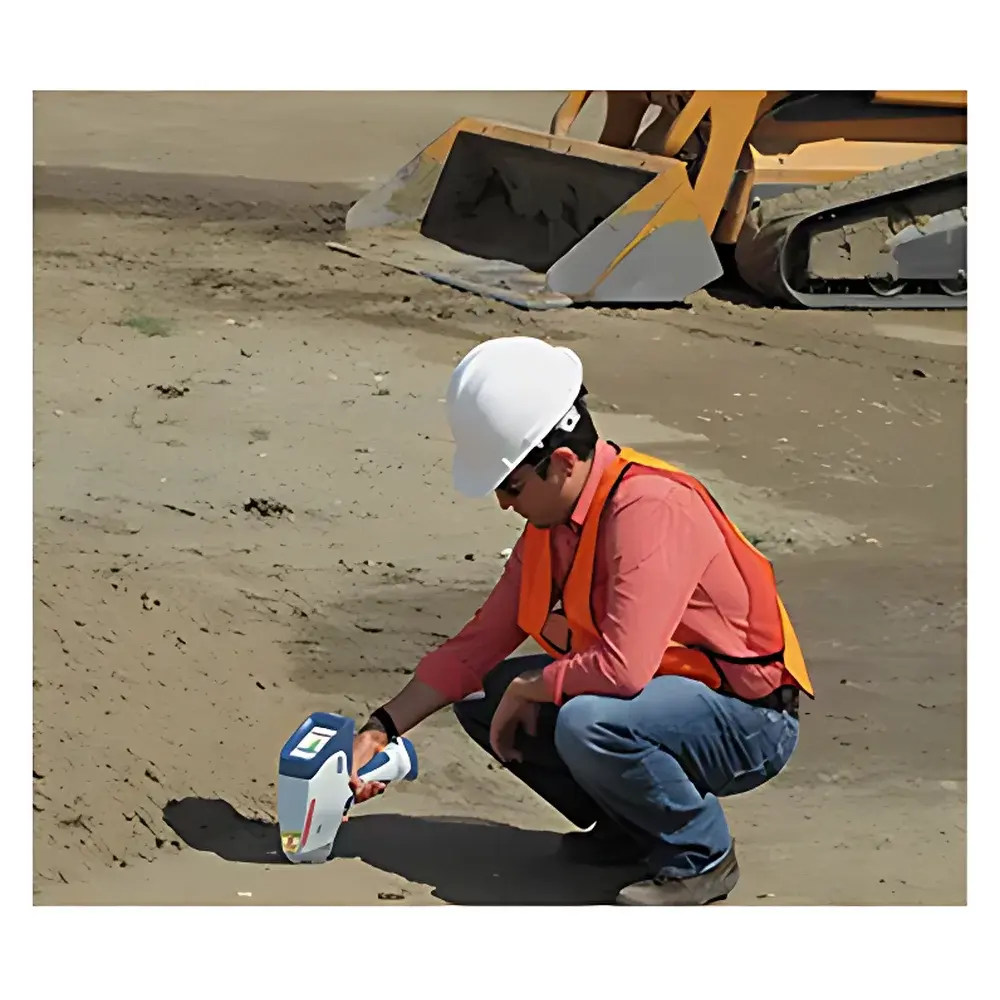
Bruker S1 TITAN Handheld Energy Dispersive X-Ray Fluorescence (ED-XRF) Spectrometer for Soil Heavy Metal Analysis
| Brand | Bruker |
|---|---|
| Origin | Germany |
| Model | S1 TITAN |
| Application | Field-Portable Soil & Environmental Analysis |
| Elemental Range | Mg to U |
| Detection Limit | 1 ppm (typical for heavy metals in soil matrices) |
| Energy Resolution | <140 eV (Mn Kα) |
| Repeatability | RSD ≤ 0.1% (for major elements under optimized conditions) |
| Detector | Silicon Drift Detector (SDD) |
Overview
The Bruker S1 TITAN is a field-deployable, battery-powered energy dispersive X-ray fluorescence (ED-XRF) spectrometer engineered for rapid, non-destructive elemental analysis of soils, sediments, sludges, dusts, and solid environmental matrices. Operating on the fundamental principle of X-ray fluorescence—where primary X-rays excite atoms in the sample, causing emission of characteristic secondary X-rays—the instrument delivers quantitative and semi-quantitative data for elements from magnesium (Mg, Z = 12) to uranium (U, Z = 92). Its compact ergonomic design, integrated GPS, and ruggedized housing meet IP54 environmental protection standards, enabling reliable operation in outdoor environments including mining sites, industrial perimeters, agricultural fields, and contaminated brownfield locations. Unlike benchtop ED-XRF systems, the S1 TITAN employs a miniature high-power X-ray tube (up to 50 kV, 20 µA) coupled with a large-area silicon drift detector (SDD), ensuring high photon throughput and excellent peak-to-background ratios essential for low-concentration heavy metal detection in complex soil matrices.
Key Features
- Ruggedized handheld platform certified to MIL-STD-810G for shock, vibration, and thermal stability—suitable for extended field deployment without external power or climate control.
- Real-time spectrum acquisition and on-device quantification using Bruker’s proprietary FP (Fundamental Parameters) and empirical calibration algorithms, supporting both factory-loaded and user-customizable soil-specific calibrations.
- Integrated high-resolution color touchscreen with intuitive workflow navigation, offline data storage (≥32 GB internal), and Bluetooth/Wi-Fi connectivity for secure data synchronization.
- Automated beam filtration and voltage/current optimization for each measurement—maximizing sensitivity for light elements (e.g., Mg, Al, Si) and trace heavy metals (e.g., As, Cd, Pb, Hg) simultaneously.
- Onboard spectral deconvolution engine resolves overlapping peaks (e.g., As Kα/Pb Lα, Cr Kα/V Kα), critical for accurate quantification in heterogeneous soil samples containing iron oxides or clay minerals.
Sample Compatibility & Compliance
The S1 TITAN is validated for direct analysis of unprepared or minimally prepared environmental solids—including air-dried soil cores, sieved sediments ( 0.92 vs. reference methods for Pb, As, Cd, Cr, Cu, Zn, Ni in NIST SRM 2710a and 2711a) and accepted for Tier 1 risk screening, hotspot delineation, and remediation progress monitoring under EPA Region 10 and EU Soil Thematic Strategy guidelines.
Software & Data Management
Data acquisition and reporting are managed through Bruker’s proprietary MSA (Mobile Spectral Analysis) software suite, compatible with Windows and Android platforms. The software enables full spectral review, matrix correction, limit-of-detection calculation, and generation of PDF reports compliant with GLP documentation requirements. Audit trail functionality records operator ID, GPS coordinates, time stamps, instrument settings, and calibration history—fully traceable and exportable for 21 CFR Part 11–compliant environments. Cloud-based data aggregation via Bruker’s ECO-Cloud platform allows centralized dashboard visualization across multi-site monitoring programs, with role-based access control and encrypted TLS 1.2 transmission.
Applications
- Environmental site assessments: Rapid mapping of As, Pb, Cd, Cr, and Hg contamination at former smelters, battery recycling facilities, and pesticide manufacturing sites.
- Agricultural land monitoring: Screening for bioavailable heavy metals in topsoil and irrigation-affected zones, supporting EU Regulation (EC) No 1881/2006 and China’s GB 15618–2018 soil quality standards.
- Regulatory compliance support: Pre-screening prior to lab submission, reducing analytical costs by up to 70% in large-scale surveys.
- Emergency response: On-scene triage during chemical spills or illegal dumping incidents, delivering actionable data within 60 seconds per measurement.
- Research applications: Geochemical profiling of mine tailings, sediment core stratigraphy, and atmospheric deposition studies using sequential depth-resolved measurements.
FAQ
Does the S1 TITAN require sample digestion or pelletization before analysis?
No—direct solid analysis is standard practice; however, for highest precision in regulatory contexts, users may optionally employ pressed pellets or fused beads when matrix effects are severe.
How does the instrument handle moisture or organic content in field-collected soils?
Moisture reduces X-ray penetration and increases scattering; air-drying to ≤15% water content is recommended. Organic carbon content is accounted for via matrix-matched calibrations or Compton normalization.
Is spectral interference from iron or calcium corrected automatically?
Yes—Bruker’s proprietary deconvolution algorithm applies iterative least-squares fitting with physical models of absorption and enhancement effects, minimizing inter-element corrections for Fe, Ca, and Si-rich matrices.
Can the S1 TITAN be used for regulatory reporting under ISO 12847 or EPA SW-846?
It satisfies screening-level requirements per EPA Method 6200 and ISO 12847 Annex A, but final compliance reporting typically requires confirmatory lab analysis per ISO/IEC 17025-accredited methods.
What maintenance is required for long-term field reliability?
Annual detector vacuum integrity check and X-ray tube output verification are recommended; no routine consumables are required beyond periodic cleaning of the X-ray window and detector collimator.
Related Products






