
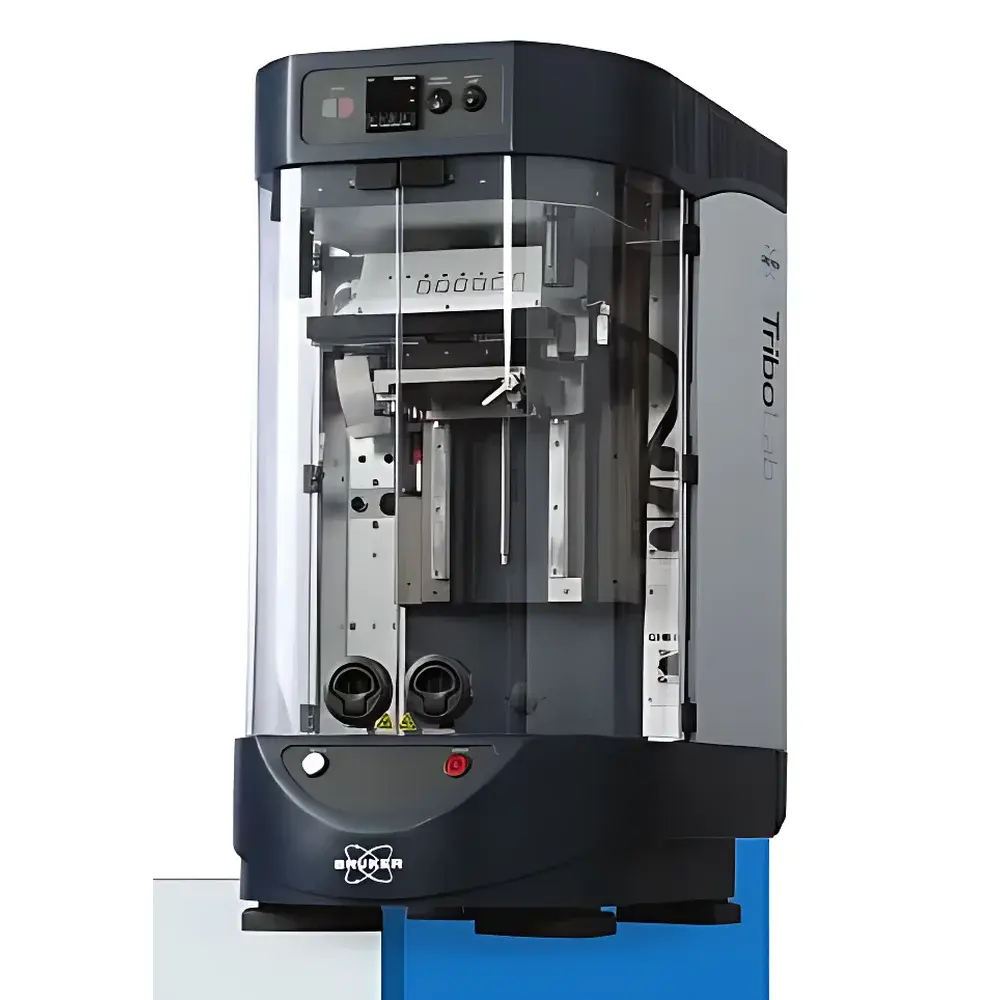
Bruker UMT TriboLab Modular Tribological Testing System
| Brand | Bruker |
|---|---|
| Origin | USA |
| Model | TriboLab |
| Instrument Type | Multi-Function Tribological Tester |
| Maximum Friction Force | 2000 N |
| Force Resolution | 10 mN |
| Maximum Temperature | 1000 °C |
| Vertical Travel | 150 mm (0.5 µm resolution) |
| Horizontal Travel | 75 mm (0.25 µm resolution) |
| Linear Drive Speed | 0.002–10 mm/s |
| Rotational Drive Speed | 0.1–5000 rpm |
| Reciprocating Frequency | 0.1–60 Hz |
| Stroke Range | 0.1–25 mm |
| Torque Capacity | 5 N·m @ 100 rpm / 2.5 N·m @ 5000 rpm |
| Data Acquisition | 16-bit, up to 200 kHz (8 standard channels, expandable to 16) |
| Environmental Control Options | −30 °C to 1000 °C temperature chamber, 5–85% RH humidity control, liquid immersion cell, cryogenic cooling, programmable fluid pump (2.2–480 mL/min) |
Overview
The Bruker UMT TriboLab is a fully modular, high-precision tribological testing system engineered for quantitative measurement of friction, wear, adhesion, and interfacial mechanical behavior under controlled mechanical, thermal, and environmental conditions. Based on the proven Couette–type contact mechanics architecture and servo-controlled multi-axis actuation, the TriboLab employs a central high-torque motor mounted on a proprietary vibration-damping column to deliver calibrated linear, rotational, reciprocating, and oscillatory motion across a unified platform. Unlike single-purpose tribometers, the TriboLab implements a hardware-agnostic, sensor-integrated design where mechanical drives—including rotary, reciprocating, ring-on-block, and linear scratch modules—are mechanically and electrically auto-recognized via embedded TriboID chips. This enables seamless reconfiguration between test modes—e.g., transitioning from ASTM G99 pin-on-disk to ASTM G119 reciprocating wear—in under two minutes without tools, cable reconnections, or manual calibration. The system’s core architecture supports full-spectrum tribological analysis from micro-Newton-scale nanotribology (e.g., MEMS interface stability) to kilo-Newton-level industrial component validation (e.g., gear tooth contact fatigue), all within a single instrument footprint.
Key Features
- Modular drive interchangeability: Four mechanically distinct, tool-free interchangeable drives—rotary, reciprocating, ring-on-block, and linear—share one motor and control backbone.
- TriboID automatic component recognition: Each sensor, drive, and environmental module contains an embedded chip; software auto-detects configuration, loads calibration files, and dynamically updates UI menus.
- Ultra-low-noise force sensing: “Gold Series” load cells with 0.02% full-scale noise floor, spanning 1 mN to 2000 N, enabling high-fidelity static and dynamic friction coefficient calculation.
- Multi-channel synchronized acquisition: 8 standard analog input channels (expandable to 16), 16-bit resolution, up to 200 kHz sampling—capturing simultaneous force, torque, displacement, temperature, acoustic emission, and contact resistance signals.
- Integrated environmental control: Programmable temperature chambers (−30 °C to 1000 °C), humidity modules (5–85% RH), liquid immersion cells with natural convection flow, and cryogenic cooling—all fully scriptable via TriboScript.
- High-fidelity motion control: Vertical Z-axis resolution of 0.5 µm over 150 mm travel; horizontal X/Y resolution of 0.25 µm over 75 mm; linear drive speed range 0.002–10 mm/s with ±1 µm positioning accuracy.
Sample Compatibility & Compliance
The TriboLab accommodates solid specimens ranging from polished wafers (10 mm × 10 mm) to large industrial components (diameter ≤ 100 mm, height ≤ 50 mm), including metallic alloys, ceramics, polymers, thin-film coatings, and biological tissues. Its open-stage architecture permits custom fixturing and in situ optical access. All standard test configurations comply with internationally recognized tribological standards, including ASTM G99 (pin-on-disk wear), ASTM G119 (wear map development), ASTM G77 (ring-on-block abrasion), ASTM G174 (scratch adhesion), ASTM G133 (linearly varying load scratch), ISO 20808 (tribological testing of biomedical materials), and DIN 50324 (wear testing of hard coatings). Environmental modules are validated per ASTM E145 (gravity-convection ovens) and IEC 60068-2-1/2 (cold/heat testing). For regulated environments, TriboScript supports audit trails, electronic signatures, and data integrity features aligned with FDA 21 CFR Part 11 and GLP/GMP documentation requirements.
Software & Data Management
TriboScript is a graphical, drag-and-drop scripting environment designed specifically for tribological workflows—not general-purpose programming. Users construct test sequences by assembling pre-validated action modules (e.g., “Apply Normal Load”, “Ramp Speed”, “Trigger AE Capture”) into hierarchical workflows. The software auto-generates error-checked scripts, enforces hardware compatibility constraints, and prompts for required parameters (e.g., target load, dwell time, ramp rate). Built-in templates cover >30 standardized methods (ASTM, ISO, DIN, JIS), allowing rapid protocol deployment. Post-test, the Viewer module provides synchronized multi-channel visualization, statistical overlay, derivative analysis (e.g., dF/dt for stick-slip detection), and automated report generation in PDF or Excel format. All raw data are stored in HDF5 format with embedded metadata (sensor IDs, calibration dates, environmental setpoints), ensuring FAIR (Findable, Accessible, Interoperable, Reusable) data management principles.
Applications
- Coating adhesion and failure mechanics: Quantifying critical load in scratch tests (ASTM G174), correlating acoustic emission bursts with delamination onset.
- Lubricant performance screening: Generating Stribeck curves (ASTM D3702), evaluating boundary film formation via real-time contact resistance monitoring (5 MΩ–1 MΩ range).
- High-temperature tribology: Assessing oxidation-driven wear mechanisms in turbine blade coatings at 800–1000 °C under sliding contact.
- Biomedical material evaluation: Measuring wear rates of UHMWPE acetabular liners against CoCr femoral heads under simulated synovial fluid immersion (ISO 14242-1).
- Nanotribology and MEMS reliability: Sub-mN force mapping of surface energy heterogeneity using diamond-coated AFM tips in ambient or controlled humidity.
- Electrified contact systems: Simultaneous measurement of friction coefficient, contact voltage drop, and current leakage during sliding electrification (e.g., EV battery busbar interfaces).
FAQ
What ASTM standards does the TriboLab support out-of-the-box?
TriboScript includes native templates for ASTM G99, G119, G77, G132, G133, G174, G203, G204, D2981, D3702, D3704, and D3705—with configurable parameters for load, speed, stroke, temperature ramp, and environmental hold steps.
Can the system operate unattended for extended wear tests?
Yes—TriboLab supports scheduled, script-driven operation for durations exceeding 1000 hours. Integrated thermal monitoring, emergency stop logic, and hardware watchdog timers ensure safe long-term execution.
Is calibration traceable to NIST or equivalent national metrology institutes?
All force, torque, displacement, and temperature sensors ship with individual calibration certificates traceable to NIST or PTB (Physikalisch-Technische Bundesanstalt), valid for 12 months under standard lab conditions.
How is data security and user access managed in regulated labs?
TriboScript implements role-based access control (RBAC), encrypted audit logs, electronic signature capture, and 21 CFR Part 11-compliant electronic records—including immutable timestamps, operator ID, and change history for every parameter modification.
What third-party instrumentation can be integrated?
Via analog voltage inputs (±10 V) and TTL triggers, the system synchronizes with external tools including Raman spectrometers, white-light interferometers, high-speed cameras (up to 100 kHz), and electrochemical workstations—enabling correlative tribology–spectroscopy–topography studies.



