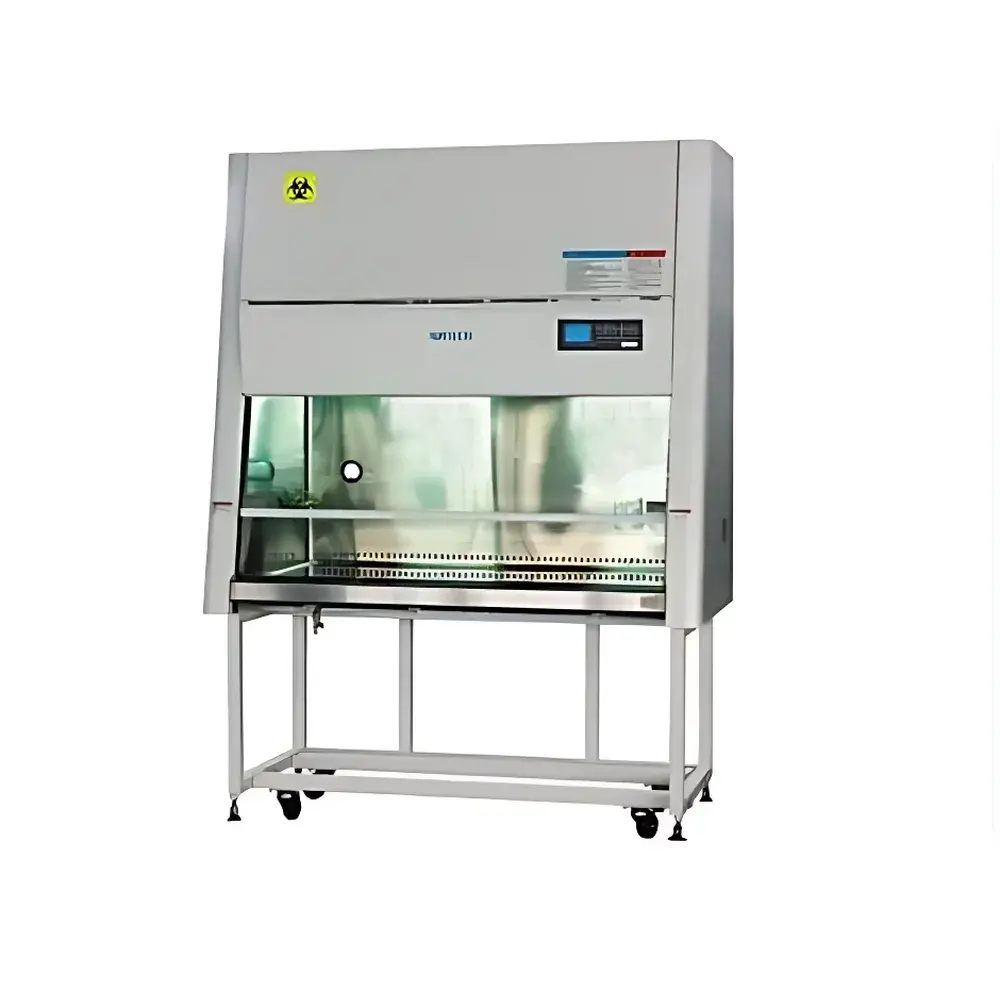
BSC-1300IIB2 Biological Safety Cabinet (Class II, Type B2, Total Exhaust)
| Origin | Jiangsu, China |
|---|---|
| Cabinet Type | Class II, Type B2 (Total Exhaust) |
| External Dimensions (L×W×H) | 1500 × 790 × 2050 mm |
| Internal Work Area (L×W×H) | 1300 × 600 × 620 mm |
| Filter Efficiency | HEPA ≥99.995% @ 0.3 µm |
| Downflow Velocity | 0.35 m/s |
| Inflow Velocity | 0.35 m/s |
| Noise Level | ≤58 dB(A) |
| Power Supply | AC 220 V, 1Φ, 50 Hz |
| Max. Rated Power | 2.1 kVA |
| Weight | 300 kg |
| Lighting | 36 W × 2 fluorescent lamps |
| UV Lamp | 20 W × 1 |
| Illuminance | ≥800 lx |
| Biological Protection Performance | ≤10 CFU/plate (impact sampler), ≤5 CFU/plate (slit sampler) |
| Product Protection | ≤5 CFU/plate |
| Cross-contamination Protection | ≤2 CFU/plate |
Overview
The BSC-1300IIB2 Biological Safety Cabinet is a certified Class II, Type B2 total-exhaust biosafety cabinet engineered for high-risk microbiological and biomedical applications requiring absolute containment of hazardous aerosols and vapors. Unlike recirculating Class II A2 cabinets, the BSC-1300IIB2 directs 100% of the air—both inflow and downflow—through dual-stage filtration (pre-filter + HEPA or ULPA) and exhausts it externally via dedicated ductwork, eliminating any internal recirculation. This configuration complies with NSF/ANSI 49–2022 and EN 12469:2000 standards for personnel, product, and environmental protection. The cabinet operates under sustained negative pressure across all critical zones—including the work area, rear plenum, and front access plane—ensuring unidirectional airflow integrity and preventing cross-contamination. Its structural design features a double-walled stainless steel chassis with continuous welded seams and helium-leak-tested joints, validated to meet ≤10⁻⁶ mbar·L/s leakage rate per IEC 61010-1.
Key Features
- Vertically laminar, negative-pressure work environment with ISO Class 5 (100) or ISO Class 4 (10) cleanroom performance, selectable via HEPA or ULPA final filtration
- Electropolished SUS304 stainless steel interior chamber with seamless, radius-formed corners for enhanced decontamination efficacy and reduced microbial retention
- Dual independent centrifugal blowers with intelligent airflow compensation: automatically maintain nominal inflow (0.35 m/s) and downflow (0.35 m/s) velocities across filter loading and static pressure variations
- Integrated “zero-leakage” front airfoil design eliminates turbulence at the sash opening, ensuring stable inflow profile and minimizing operator exposure during routine manipulation
- Detachable ergonomic forearm rest with rounded contour reduces musculoskeletal fatigue during extended procedures
- Full-color LCD interface with real-time monitoring of airflow velocity, filter service life estimation, motor status, sash height, UV lamp operation, and predictive clogging alerts
- Interlocked safety systems: UV irradiation disabled when sash exceeds safe operating height; lighting and sterilization circuits mutually inhibited; power outlets and gas valves located within the work area conform to IP54 ingress protection
- Stainless steel liquid collection trough (≥4 L capacity) with removable drain plug for safe disposal of biohazardous spills
Sample Compatibility & Compliance
The BSC-1300IIB2 supports a broad range of biological agents classified under BSL-2 and BSL-3 containment requirements, including but not limited to recombinant DNA constructs, viral vectors, mycobacterial cultures, and low-volatility chemical toxins. It is validated for use with open-flame devices (e.g., Bunsen burners) only when integrated with supplemental local exhaust ventilation, as permitted under NSF/ANSI 49 Annex D. All materials in contact with the work surface—including gasketing, seals, and electrical components—meet USP and cytotoxicity and systemic injection testing criteria. Cabinet certification includes third-party verification of personnel protection (using potassium iodide or Bacillus atrophaeus spore challenge), product protection (via settle plate assay per ISO 14644-1), and environmental protection (duct exhaust integrity test). Documentation supports GLP and GMP audit readiness, including full traceability of filter lot numbers, airflow calibration certificates, and leak-test reports.
Software & Data Management
The embedded control system logs operational parameters—including cumulative runtime, sash position history, airflow deviations, alarm events, and maintenance timestamps—with timestamped, non-erasable records stored onboard for ≥12 months. Optional RS485 or Ethernet connectivity enables integration into laboratory infrastructure management platforms (LIMS/LabVantage) and supports configurable export of CSV-formatted logs. Audit trail functionality complies with FDA 21 CFR Part 11 requirements for electronic records and signatures, featuring user-level access controls, role-based permissions, and immutable event logging. Firmware updates are performed via secure USB authentication, with version rollback capability and cryptographic signature validation.
Applications
This cabinet is routinely deployed in academic research laboratories conducting lentiviral transduction, CRISPR-Cas9 genome editing, and primary cell line expansion; pharmaceutical QC labs performing sterility testing of parenteral formulations; clinical diagnostics facilities handling respiratory pathogen specimens (e.g., SARS-CoV-2, influenza A/B); and biomanufacturing cleanrooms supporting aseptic filling of monoclonal antibody intermediates. Its total-exhaust architecture makes it especially suitable for workflows involving volatile organic solvents (e.g., chloroform, ethanol), radioisotope-labeled compounds, and nanomaterial suspensions where recirculation poses unacceptable risk.
FAQ
Does the BSC-1300IIB2 require external ducting?
Yes. As a Type B2 cabinet, it mandates hard-ducted connection to a dedicated exhaust system capable of sustaining ≥150 Pa static pressure loss at rated airflow.
Can it be used with flammable solvents?
Only under strict engineering controls: solvent use must be confined to sealed vessels, and the exhaust ductwork must be grounded and constructed of non-sparking material per NFPA 30 and NFPA 45.
What filter replacement interval is recommended?
HEPA/ULPA filters should be replaced every 5–7 years or after 10,000 hours of operation, whichever occurs first—subject to annual integrity testing per ISO 14644-3.
Is the cabinet compliant with international regulatory frameworks?
Yes. It carries CE marking under the EU Medical Device Regulation (MDR 2017/745) Annex II, conforms to IEC 61010-1:2010 for laboratory equipment safety, and meets the performance verification requirements of ISO 15189-accredited medical laboratories.
How is decontamination validated post-maintenance?
Formaldehyde or vaporized hydrogen peroxide (VHP) decon protocols must be followed by quantitative biological indicator testing using Geobacillus stearothermophilus spores placed at five defined challenge locations, with log₁₀ reduction ≥6 required for release.
Related Products