
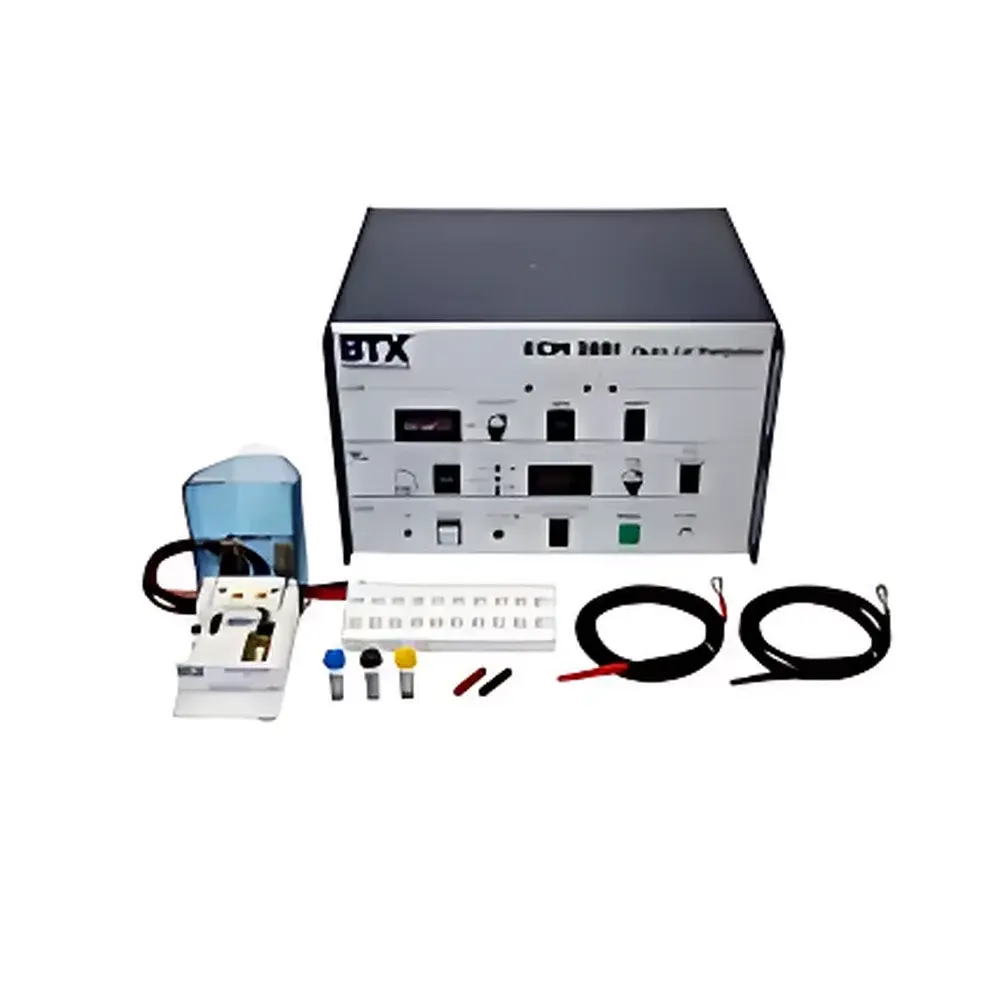
BTX ECM2001 Electroporation and Cell Fusion System
| Origin | USA |
|---|---|
| Manufacturer Type | Authorized Distributor |
| Import Status | Imported |
| Model | ECM2001 |
| Price Range | USD 14,000 – 43,000 |
| Product Category | Cell Analysis System |
| AC Parameters | Non-sinusoidal waveform, 1 MHz frequency, 0–75 V amplitude, 0–99 s duration, AC/DC inter-pulse interval 50 µs |
| DC Parameters (High-Voltage Mode) | 10–3000 V (10 V step), pulse width 1–99 µs (1 µs step) |
| DC Parameters (Low-Voltage Mode) | 10–500 V (10 V step), pulse width 1–99 ms (1 ms step) or 10–990 µs (10 µs step) |
| Pulse Count | 1–9 pulses per train |
| Inter-Pulse Interval | 1 s |
| Cycle Count | 0–9 cycles |
| Minimum Load Impedance | 20 Ω |
| Electrode Compatibility | All BTX electrodes except 35 mm dish electrodes |
Overview
The BTX ECM2001 Electroporation and Cell Fusion System is a precision-engineered benchtop instrument designed for controlled, reproducible delivery of electrical stimuli to biological cells—enabling both transient membrane permeabilization (electroporation) and reversible membrane destabilization for somatic cell fusion. Operating on the principles of pulsed electric field (PEF) biophysics, the ECM2001 delivers programmable DC square-wave and AC field waveforms with nanosecond-to-second temporal resolution. Its dual-mode architecture supports high-voltage microsecond pulses for nuclear envelope breaching in transfection protocols, and low-voltage millisecond pulses optimized for cytoplasmic membrane alignment and fusion pore formation. The system’s ability to operate down to 20 Ω load impedance ensures stable performance across heterogeneous cell suspensions and adherent monolayers—critical for applications requiring real-time microscopic observation during fusion events.
Key Features
- Dual-mode waveform generation: Independent AC (1 MHz, 0–75 V, up to 99 s) and DC (10–3000 V / 10–500 V, adjustable pulse width from 1 µs to 99 ms) output channels with sub-microsecond timing resolution
- Full parameter programmability: User-defined pulse count (1–9), inter-pulse interval (1 s fixed), cycle repetition (0–9), and AC/DC sequencing—enabling precise replication of published fusion or transfection protocols
- Real-time microscopy compatibility: Designed for integration with inverted microscopes using BTX fusion chambers (e.g., fusion cuvettes and chamber slides), permitting live visualization of membrane blebbing, cell alignment, and syncytium formation
- Robust electrical architecture: Solid-state switching, optical isolation, and active impedance compensation ensure waveform fidelity across variable sample conductivities and electrode geometries
- Regulatory-ready operation: Supports audit-trail-capable software logging (via optional BTX Manager Suite), compliant with GLP documentation requirements for preclinical cell engineering workflows
Sample Compatibility & Compliance
The ECM2001 is validated for use with mammalian, avian, amphibian, and plant protoplast systems—including primary isolates, immortalized lines, oocytes, and tissue explants. It interfaces seamlessly with BTX’s full electrode portfolio (e.g., LF500, CUY21EDIT II, and fusion-specific chamber slides), excluding only standard 35 mm culture dish electrodes. The system meets IEC 61010-1 safety standards for laboratory electrical equipment and supports traceable calibration via external oscilloscope verification of voltage and pulse width. When operated with VIP 3000 detection modules, it satisfies ASTM F2813-19 criteria for electroporation-based viability assessment in cell therapy manufacturing environments.
Software & Data Management
While the ECM2001 operates via intuitive front-panel controls, optional BTX Manager Software (v4.2+) enables protocol library management, remote triggering via TTL/USB, and time-stamped export of pulse logs (CSV/Excel). All parameter sets are stored with user ID, date/time stamp, and hardware serial number—facilitating 21 CFR Part 11-compliant electronic records when deployed with validated Windows OS configurations. Audit trails include operator login history, parameter change timestamps, and session start/stop metadata—supporting GMP-aligned QC documentation for regulatory submissions.
Applications
- Somatic cell fusion: Generation of hybridomas (e.g., murine myeloma + spleen B-cells), dendritic-tumor hybrids for cancer immunotherapy, and interspecies cytoplasmic hybrids for mitochondrial functional studies
- Nuclear transfer & cloning: Enucleation synchronization and donor nucleus fusion in oocyte reconstitution—validated in landmark studies including Dolly the sheep (1996) and subsequent transgenic livestock models (cattle, pigs, goats) at institutions including Cold Spring Harbor Laboratory, China Agricultural University, and the Institute of Zoology, CAS
- In vivo and ex vivo electroporation: Delivery of plasmid DNA, siRNA, CRISPR ribonucleoproteins, or small molecules into embryonic tissues, skin, muscle, and neural structures using needle or paddle-type electrodes
- Protoplast fusion: Interspecific plant hybridization (e.g., Solanum spp., Brassica spp.) under osmotic stabilization, enabling trait introgression without sexual barriers
FAQ
Is the ECM2001 suitable for GMP-compliant cell therapy process development?
Yes—when paired with BTX Manager Software and configured on a validated computing platform, it supports electronic signature, audit trail, and parameter lockout features required for FDA-regulated workflows.
Can I replicate the exact pulse parameters used in the Dolly cloning protocol?
Yes—the ECM2001’s high-voltage mode (1500 V, 20 µs, 1 pulse) and low-voltage mode (30 V, 50 ms, 2 pulses) match the original Roslin Institute specifications for oocyte electrofusion.
Does the system support impedance monitoring during pulsing?
No real-time impedance feedback is built-in; however, the 20 Ω minimum load rating ensures stable output even with high-conductivity buffers (e.g., mannitol-based fusion media), and external oscilloscope validation is recommended for critical applications.
What documentation is provided for regulatory submissions?
BTX supplies a Factory Acceptance Test (FAT) report, electrical safety certification (IEC 61010-1), and software validation package (IQ/OQ templates) upon request for qualified customers.
Is training available for protocol optimization?
Yes—BTX offers application-specific workshops covering hybridoma development, zygote electroporation, and protoplast fusion, including access to peer-reviewed protocol libraries and troubleshooting guides.



