
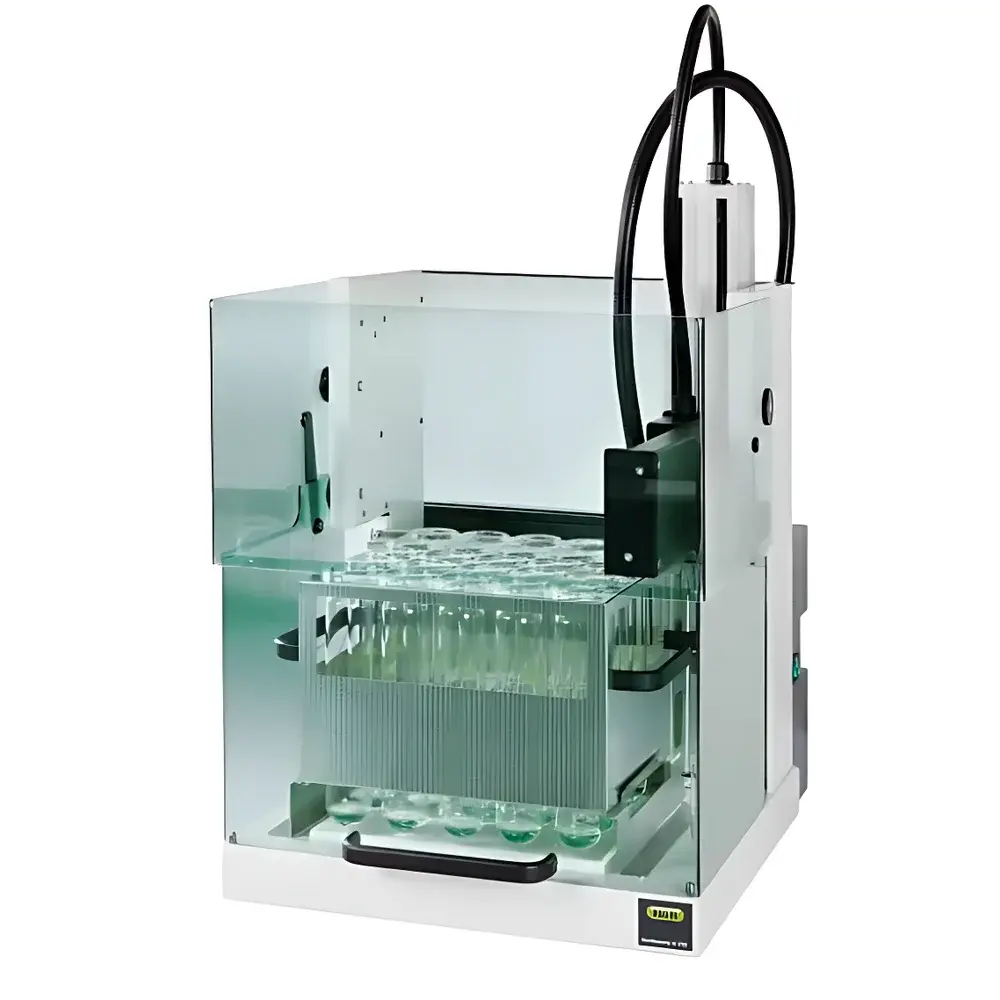
BUCHI K-376/K-377 Automated Sample Handler for KjelMaster K-375 Kjeldahl Nitrogen Determination System
| Brand | BUCHI |
|---|---|
| Origin | Switzerland |
| Manufacturer | BUCHI AG |
| Product Type | Automated Sample Handler (KjelSampler) |
| Model | K-376 / K-377 |
| Instrument Category | Kjeldahl Nitrogen Analyzer Accessory |
| Nitrogen Determination Range | 0.02 – 200 mg N |
| Distillation Time per Sample | ≤240 s |
| Repeatability | RSD < 1 % |
| Sample Weight Capacity | Solids ≤ 5 g, Liquids ≤ 200 mL |
| Nitrogen Recovery Rate | >99.5 % (for 1–200 mg N) |
| Power Consumption | 150 W |
| Dimensions (L×W×H) | 505 × 750 × 655 mm |
Overview
The BUCHI K-376 and K-377 are fully automated sample handling modules designed exclusively for integration with the BUCHI KjelMaster K-375 — a fully automated Kjeldahl nitrogen determination system. These units implement synchronized robotic sample transport, precise positioning, and intelligent batch management to eliminate manual intervention during the post-digestion phase of classical Kjeldahl analysis. Based on gravimetric and volumetric dosing principles, the K-376/K-377 ensures reproducible transfer of digested samples into distillation units while maintaining strict adherence to ISO 8968, AOAC 984.27, and ASTM D1122 protocols. Unlike semi-automated alternatives, the K-376/K-377 operates as a closed-loop subsystem — coordinating digestion cooling, sample rack indexing, reagent addition sequencing, and distillation initiation without operator input. This architecture supports unattended operation for up to 40 samples per run and enables true 24/7 laboratory throughput in regulated QC environments.
Key Features
- Two independent sample tray stations (K-377 model) enabling continuous batch processing — one tray loads while the other undergoes analysis
- Universal compatibility with all BUCHI sample tubes (100 mL, 300 mL, and 500 mL formats), supporting diverse matrix types including dairy, feed, soil, and pharmaceutical excipients
- Integrated tube washing module eliminating manual glassware handling; rinses occur automatically between cycles using programmable water or dilute acid flush sequences
- No direct operator contact with hazardous reagents (e.g., concentrated NaOH, boric acid, or H2SO4) — all liquid handling is performed via sealed peristaltic pumps and solenoid valves compliant with IEC 61000-6-4 EMC standards
- Modular mechanical design with tool-free access to critical components (e.g., gripper arms, tube clamps, and sensor arrays) for rapid maintenance under GLP audit conditions
- Real-time positional feedback via optical encoders and Hall-effect sensors ensuring sub-millimeter repeatability in sample tube alignment relative to distillation heads
Sample Compatibility & Compliance
The K-376/K-377 accommodates heterogeneous sample forms across food, agriculture, environmental, and life science applications — from homogenized solids (≤5 g) to clarified liquids (≤200 mL). Its mechanical handling system maintains sample integrity by avoiding glass-to-glass transfer, thereby minimizing cross-contamination risk and preserving analyte stability during transit. All fluid pathways meet USP material compatibility requirements for Class VI plastics, and the unit’s firmware supports 21 CFR Part 11-compliant electronic signatures when paired with BUCHI’s LabX software. Validation documentation includes IQ/OQ protocols aligned with ISO/IEC 17025:2017 and supports GMP traceability through configurable audit trails capturing timestamped events such as tray insertion, reagent dispense volume, and distillation start/stop.
Software & Data Management
Controlled via BUCHI LabX LIMS-integrated software, the K-376/K-377 supports method-based scheduling, priority queueing, and dynamic rerouting of high-priority samples mid-run. Raw data — including individual sample IDs, digestion batch numbers, distillation duration, condensate volume, and titration endpoints — are stored in encrypted SQLite databases with SHA-256 hashing. Audit logs record all user actions (login/logout, parameter changes, emergency stops) with immutable timestamps. Optional cloud synchronization enables remote monitoring via secure TLS 1.3 connections, and raw output files export in ASTM E1382-compliant CSV format for third-party statistical analysis (e.g., JMP, Minitab).
Applications
- High-throughput protein quantification in dairy product certification (ISO 8968-1:2014)
- Crude protein determination in animal feed formulations per AOAC Official Method 984.13
- Nitrogen content verification in fertilizer quality control (ISO 5315:2022)
- Pharmaceutical raw material testing where nitrogen serves as a surrogate for active ingredient concentration
- Environmental soil analysis requiring compliance with EPA Method 350.1 for total Kjeldahl nitrogen (TKN)
FAQ
Can the K-376/K-377 operate independently of the KjelMaster K-375?
No — these units are not standalone instruments; they require hardware-level synchronization with the KjelMaster K-375 controller via CAN bus communication.
What maintenance intervals are recommended for the gripper mechanism?
BUCHI specifies lubrication of linear guide rails every 6 months and visual inspection of vacuum cup seals after every 500 sample cycles.
Is method validation support available for regulatory submissions?
Yes — BUCHI provides prequalified IQ/OQ documentation packages and assists with PQ protocol development in accordance with ICH Q2(R2) guidelines.
Does the system support variable distillation times based on sample type?
Yes — LabX allows user-defined distillation duration profiles mapped to sample ID prefixes or barcode metadata.
How is carryover prevented between high-nitrogen and low-nitrogen samples?
Automated triple-rinse cycles (water → dilute HCl → water) are triggered before each new sample introduction, with conductivity-based endpoint detection confirming rinse completion.




