
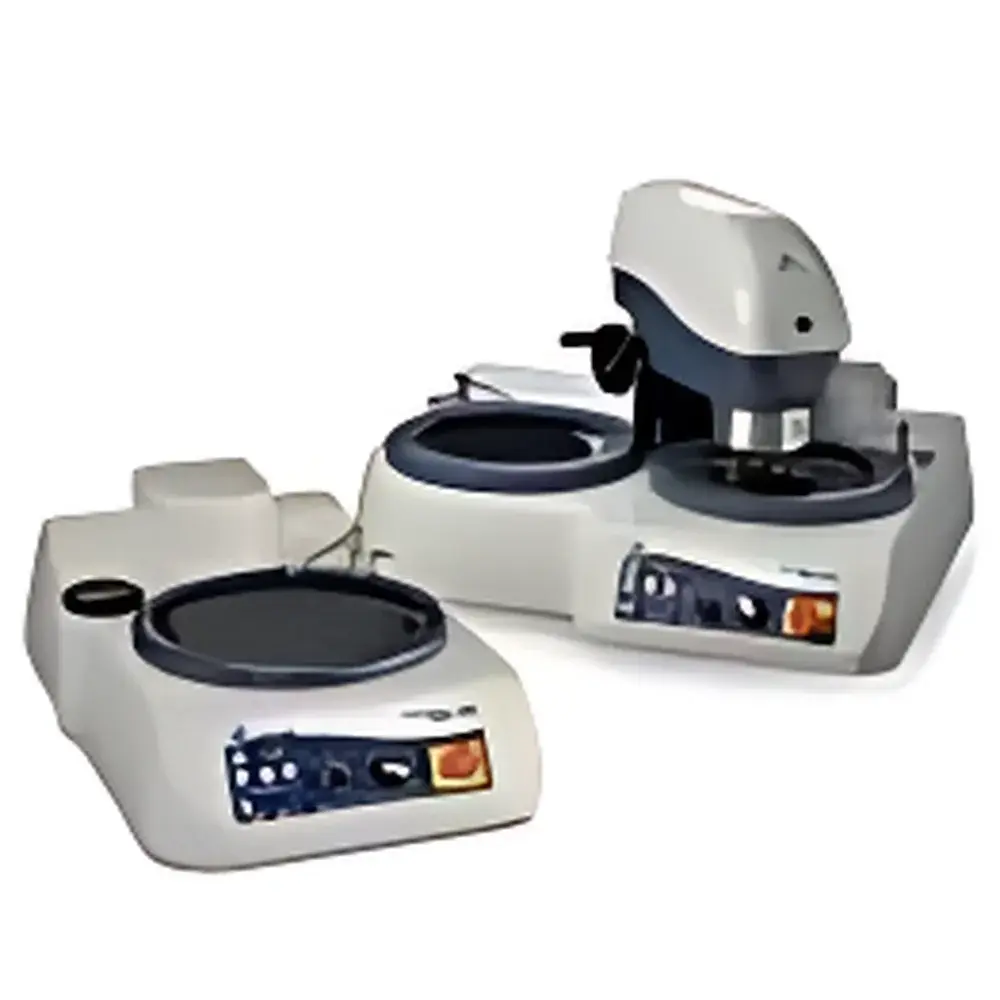
Buehler AutoMet™ 250 Precision Grinding and Polishing System
| Brand | Buehler |
|---|---|
| Origin | USA |
| Model | AutoMet 250 |
| Motor Power (Base) | 750 W |
| Motor Power (Head) | 116 W |
| Platen Diameter | 203 mm (8 in) or 254 mm (10 in) |
| Platen Speed | 10–500 rpm (10 rpm increments) |
| Head Speed | 30–60 rpm (10 rpm increments) |
| Central Load Range | 20–260 N (5–60 lbf) |
| Single-Point Load Range | 5–45 N (1–10 lbf) |
| Sample Size Compatibility (Central Mode) | up to 40 mm diameter or irregular shapes |
| Water Supply | 6 mm OD tubing, 275–690 kPa (40–100 psi) |
| Compressed Air | 6 mm OD tubing, 240 kPa (35 psi) |
| Dimensions (L×W×H) | 780 × 740 × 1040 mm |
| Weight | 77 kg (base), 32 kg (head) |
| Electrical Input | 100–240 VAC, 50/60 Hz, single-phase |
| Noise Level | ≤61.5 dB(A) at 0.5 m (unloaded) |
| Compliance | CE-marked per EU Machinery Directive 2006/42/EC and Low Voltage Directive 2014/35/EU |
| Enclosure Rating (Touchscreen Panel) | IP65 / NEMA 4 |
Overview
The Buehler AutoMet™ 250 Precision Grinding and Polishing System is an engineered solution for reproducible, high-throughput metallographic sample preparation in quality control laboratories, failure analysis centers, and R&D facilities. Built on Buehler’s decades of expertise in materials science instrumentation, the AutoMet 250 employs a dual-motor architecture—separate base platen and precision force-controlled head motors—to deliver consistent material removal rates, planar surface integrity, and edge retention across diverse sample geometries and hardnesses. Its design adheres to fundamental principles of abrasive wear mechanics and controlled mechanical polishing, where rotational velocity, applied load, slurry delivery kinetics, and dwell time are independently regulated to minimize artifact generation (e.g., smearing, pull-out, relief, or phase distortion). The system is purpose-built for compliance-critical environments requiring traceable, auditable, and repeatable preparation protocols—particularly where downstream analysis includes optical microscopy, SEM, EBSD, or microhardness testing.
Key Features
- Dual-mode force application: programmable central loading (20–260 N) and single-point loading (5–45 N), enabling standardized preparation of both standard discs (25–40 mm) and irregular or oversized specimens.
- Intuitive user interface: Pro version features a 7-inch full-color, waterproof (IP65/NEMA 4) touchscreen with graphical workflow navigation, real-time parameter feedback, and multilingual support.
- Z-axis quantitative material removal: integrated encoder-based head displacement monitoring allows precise control over total stock removal depth per step—critical for serial sectioning and cross-sectional metrology.
- Rapid clean cycle: motorized 360° platen rotation combined with retractable 6 mm OD water hose and disposable bowl liner minimizes manual intervention and cross-contamination risk between sample batches.
- Modular platen compatibility: interchangeable 203 mm (8 in) and 254 mm (10 in) platens optimize consumable utilization—reducing abrasive paper and diamond suspension costs without compromising flatness or edge definition.
- Automated process sequencing: store and recall up to 99 multi-step preparation methods, each with independent speed, load, time, and coolant activation parameters—supporting ASTM E3, ISO 13005, and USP alignment.
Sample Compatibility & Compliance
The AutoMet 250 accommodates a broad spectrum of metallic, ceramic, composite, and geological specimens—including cast iron, titanium alloys, sintered carbides, PCB laminates, and additively manufactured parts. Its adjustable head geometry supports flat, convex, concave, and asymmetric samples up to 40 mm in diameter under central loading, or custom fixtures for non-standard geometries. All operational parameters—including force profiles, rotational speeds, and dwell durations—are logged with timestamped metadata, satisfying GLP/GMP documentation requirements and FDA 21 CFR Part 11 electronic record integrity standards when paired with Buehler’s optional LabManager™ software. The system carries CE marking per Machinery Directive 2006/42/EC and Low Voltage Directive 2014/35/EU, and its electrical architecture meets IEC 61000-6-2/6-4 immunity and emission specifications.
Software & Data Management
LabManager™ software (optional) provides centralized method deployment, remote monitoring, audit trail generation, and exportable preparation reports compliant with ISO/IEC 17025 clause 7.7. Each preparation run records head position, applied load, platen RPM, elapsed time, coolant status, and error flags—stored locally or synchronized to networked servers via Ethernet. Role-based access control ensures SOP adherence; electronic signatures validate method execution and operator identity. Data exports support CSV, PDF, and XML formats for integration into LIMS or QMS platforms. Firmware updates are delivered via secure HTTPS, with version history and rollback capability maintained in-system.
Applications
- Quality assurance of heat-treated steels and aluminum extrusions per ASTM E384 and ISO 6507.
- Failure analysis of turbine blades, weld joints, and bearing races using serial sectioning workflows.
- Preparation of battery electrode cross-sections for porosity and particle distribution analysis.
- Standardized polishing of dental alloys and orthopedic implant materials for biocompatibility evaluation.
- High-volume incoming inspection in automotive and aerospace Tier-1 supplier labs operating under AS9100 or IATF 16949.
- Research-grade specimen prep for TEM lamella site selection and FIB lift-out targeting.
FAQ
Does the AutoMet 250 support automated slurry dispensing?
Yes—when equipped with the optional AutoDispense™ module, the system delivers precise, programmable volumes of colloidal silica, alumina, or diamond suspensions synchronized with rotation and load profiles.
Can existing Buehler consumables be used with this system?
All standard Buehler grinding papers (e.g., MetaDi®), polishing cloths (e.g., MicroCloth®), and diamond suspensions (e.g., MetaDi® Diamond) are fully compatible.
Is remote diagnostics supported?
The AutoMet 250 includes embedded Ethernet connectivity and supports Buehler Remote Assist for secure, technician-guided troubleshooting and firmware updates.
What safety certifications does the system hold?
It complies with EN ISO 12100:2010 (risk assessment), EN 60204-1:2018 (electrical safety), and carries CE, UKCA, and cULus marks for North American and European markets.
How is calibration verified?
Force transducers are factory-calibrated per ISO 376 Class 0.5; annual verification kits and traceable calibration certificates are available through Buehler Service Centers.



