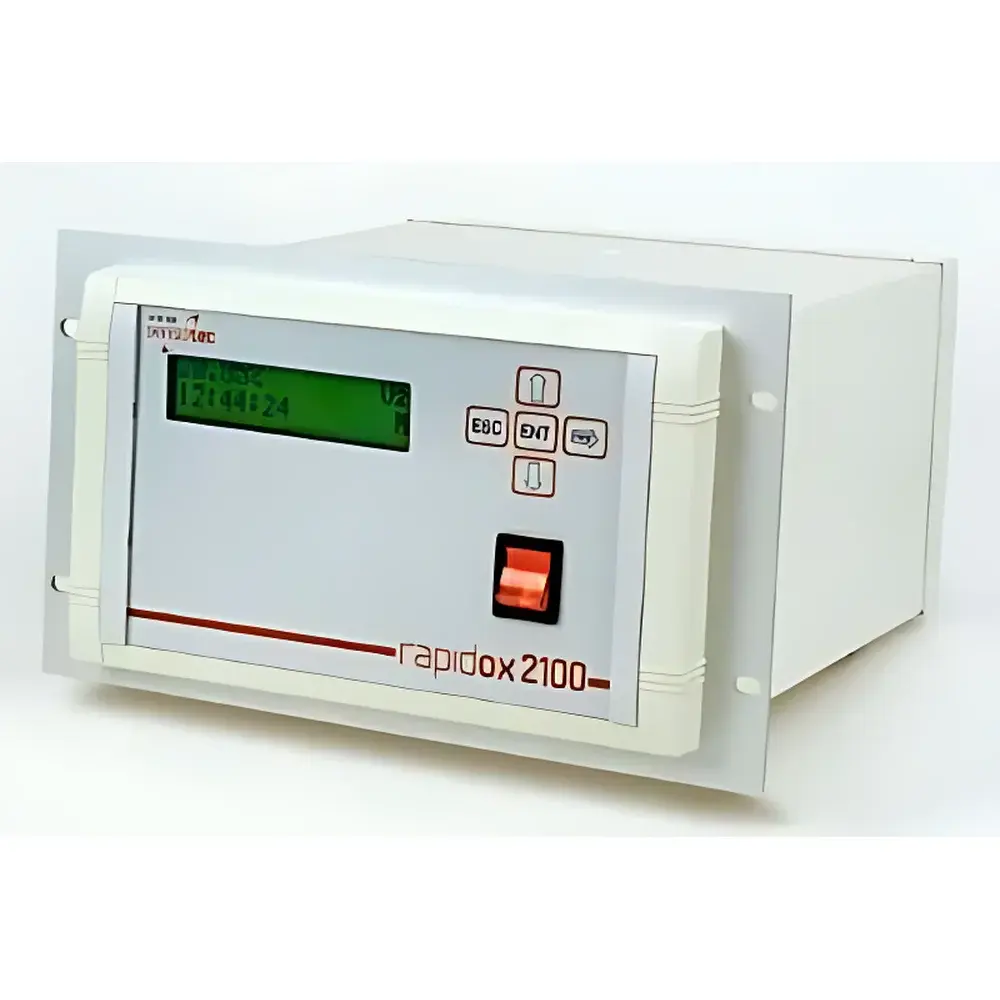
Cambridge Sensotec Rapidox 1100 Oxygen Analyzer
| Brand | Cambridge Sensotec |
|---|---|
| Origin | United Kingdom |
| Model | 1100 |
| Measurement Range | 1 ppm to 100% O₂ |
| Response Time (T₉₀) | < 5 s (at 1 L/min flow) |
| Accuracy | ±2% of actual O₂ concentration |
| Precision | ±0.5% of reading |
| Operating Temperature | 5–35 °C |
| Power Supply | 110/220 V AC, 50/60 Hz |
| Dimensions | 205 × 160 × 150 mm |
| Weight | 4 kg |
| Display | 16 × 2-character backlit LCD (9 mm height) |
| Warm-up Time | 3–4 min at 20 °C |
| Pump Type | AC-driven linear piston pump |
| Max Free Air Displacement | 4 L/min (0.28 bar typical) |
| Noise Level | ≤40 dB(A) at 1 m |
| Max Inlet Gas Temperature | 55 °C |
| Sensor Lifetime | >35,000 h |
| Analog Outputs | 0–5 V DC and 4–20 mA (user-programmable) |
| Digital Interface | RS232, data stream at 10 Hz |
| Calibration | Two-point, user-selectable gases (e.g., ambient air + zero or span gas) |
| Internal Pressure Compensation | Yes |
| Built-in Diaphragm Pump | Yes |
| Auto-Cleaning Function | Yes |
Overview
The Cambridge Sensotec Rapidox 1100 Oxygen Analyzer is a high-stability, zirconia-based electrochemical analyzer engineered for continuous, real-time oxygen monitoring across an exceptionally wide dynamic range—from trace-level detection at 1 ppm up to full-scale 100% O₂. Its core sensing element is a heated yttria-stabilized zirconium dioxide (YSZ) ceramic tube, operated at a precisely controlled temperature of 650 °C. At this temperature, molecular oxygen dissociates into oxide ions, generating a Nernst potential proportional to the partial pressure of oxygen in the sample gas. This fundamental principle—based on solid electrolyte potentiometry—ensures high selectivity for O₂ without cross-sensitivity to CO₂, CO, H₂O vapor, or hydrocarbons under normal operating conditions. The instrument integrates active thermal regulation via embedded thermistors and a stabilized power supply, minimizing drift and enabling repeatable measurements in fluctuating ambient environments. With a T₉₀ response time of less than 5 seconds at 1 L/min sample flow, the Rapidox 1100 meets stringent requirements for rapid process feedback in safety-critical and quality-controlled industrial applications.
Key Features
- Zirconia sensor with integrated heater and closed-loop thermal control (650 °C ±2 °C), ensuring long-term stability and minimal calibration drift
- High-efficiency linear piston sampling pump delivering consistent 1 L/min flow; maximum free-air displacement of 4 L/min supports bypass and low-resistance sampling lines
- Onboard pressure sensor for real-time compensation of minor inlet pressure variations—critical for maintaining measurement integrity during transient system conditions
- User-programmable dual alarm setpoints (high/low) with visual LED indicators and relay outputs compliant with IEC 61000-4 immunity standards
- Dual analog outputs (0–5 V DC and 4–20 mA), independently configurable for linear or logarithmic scaling across any sub-range of the full 1 ppm–100% span
- RS232 serial interface supporting 10 Hz data streaming; compatible with Modbus RTU protocol via optional firmware upgrade
- Automatic sensor cleaning cycle triggered by user-defined intervals or accumulated runtime—reducing fouling-related maintenance in dusty or condensing gas streams
- Backlit 16×2 character LCD display with intuitive menu navigation; all configuration parameters stored in non-volatile memory
Sample Compatibility & Compliance
The Rapidox 1100 is designed for dry, non-corrosive, particle-free gas streams. It accommodates inlet temperatures up to 55 °C and tolerates short-term exposure to condensate when used with optional hydrophobic inline filters. While not rated for explosive atmospheres (ATEX/IECEx), it complies with CE marking directives (EMC 2014/30/EU, LVD 2014/35/EU) and meets RoHS 2011/65/EU material restrictions. Its measurement methodology aligns with ISO 7504 (gas analysis — vocabulary) and supports traceability per ISO/IEC 17025 when deployed with documented calibration procedures using NIST-traceable standard gases. For regulated industries—including food packaging, pharmaceutical inerting, and medical gas production—the device supports audit-ready calibration logs and timestamped event records, facilitating adherence to GMP and FDA 21 CFR Part 11 requirements when paired with validated software.
Software & Data Management
The included Windows-compatible Rapidox Data Logger software provides full configuration, real-time visualization, and automated data archiving. It supports direct export to CSV and native MS Excel (.xlsx) formats, enabling integration into LIMS or MES platforms. Each logged record includes O₂ concentration, timestamp, analog output status, alarm flags, internal temperature, and pressure-compensated values. The software implements local user authentication, change history logging, and electronic signature capability—features essential for GLP-compliant laboratories. Firmware updates are delivered via secure HTTPS download and applied through the RS232 interface, preserving configuration integrity during upgrades.
Applications
- Monitoring headspace O₂ in modified-atmosphere food packaging lines to verify nitrogen flush efficacy and extend shelf life
- Controlling inert gas blanketing in semiconductor fabrication tools and vacuum metallurgy furnaces
- Verifying purge completeness prior to welding in ASME B31.3-compliant piping systems (e.g., nitrogen purging before TIG welding)
- Continuous O₂ surveillance in confined-space entry programs—alerting personnel to hypoxic (23.5%) conditions
- Performance validation of pressure-swing adsorption (PSA) and membrane nitrogen generators
- Combustion optimization in low-excess-air burners, where sub-stoichiometric O₂ levels must be maintained within ±0.1% tolerance
- Quality assurance testing of high-purity argon, helium, and nitrogen used in analytical instrumentation carrier gas supplies
FAQ
What calibration gases are required for initial setup?
Two-point calibration is mandatory: one at or near ambient air (20.9% O₂) and a second at either zero O₂ (e.g., certified nitrogen) or a known span gas (e.g., 100 ppm O₂ in N₂). Certified reference materials from ISO 6141-accredited suppliers are recommended.
Can the analyzer operate unattended for extended periods?
Yes—its solid-state zirconia sensor exhibits >35,000 hours of operational life under continuous duty, and the auto-cleaning function mitigates performance degradation in stable process streams. Scheduled verification every 3–6 months is advised per ISO 17025 guidelines.
Is external signal conditioning required for the 4–20 mA output?
No. The output is loop-powered and isolated, compliant with NAMUR NE43 standards. It drives loads up to 600 Ω at 24 V DC supply and requires no additional shunt resistors or isolators.
How does pressure compensation affect accuracy at varying altitudes?
The integrated pressure sensor corrects for deviations ±15 kPa around atmospheric pressure (typically 85–115 kPa). For installations above 2,000 m elevation, factory recalibration against local barometric pressure is recommended to maintain ±0.5% reading accuracy.
Related Products