
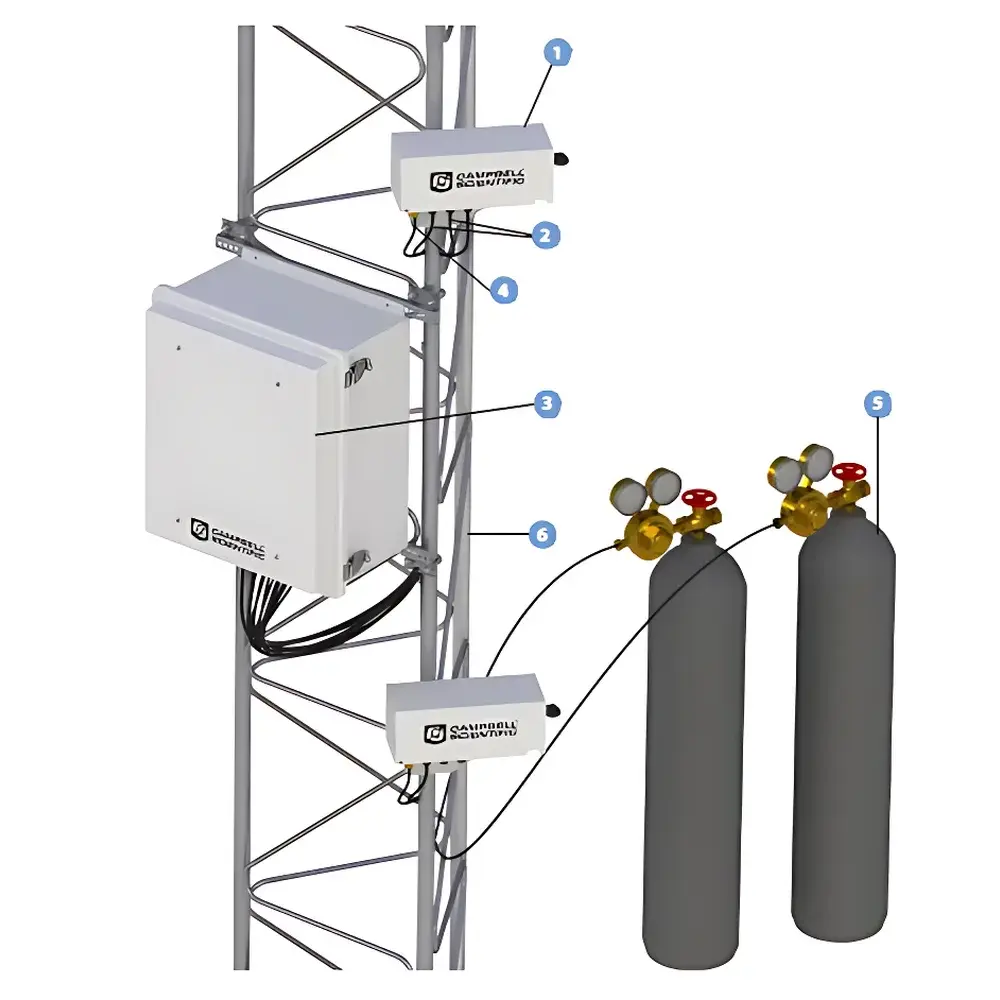
Campbell Scientific AP200 CO₂/H₂O Atmospheric Profile Measurement System
| Brand | Campbell Scientific |
|---|---|
| Origin | USA |
| Manufacturer Type | Authorized Distributor |
| Origin Category | Imported |
| Model | AP200 |
| Pricing | Upon Request |
Overview
The Campbell Scientific AP200 CO₂/H₂O Atmospheric Profile Measurement System is an engineered solution for high-temporal-resolution vertical profiling of carbon dioxide (CO₂) and water vapor (H₂O) concentrations in the atmospheric boundary layer. Based on multipoint, time-multiplexed sampling via a centralized, temperature- and pressure-controlled gas analyzer (typically the LI-840A dual-gas infrared analyzer), the AP200 implements a sequential draw-and-measure architecture across up to eight discrete intake levels—enabling quantification of vertical gradients, flux divergence, and storage terms essential for eddy covariance (EC) and budget-based ecosystem-atmosphere exchange studies. Its design adheres to the physical principles of non-dispersive infrared (NDIR) absorption spectroscopy for CO₂ and H₂O detection, with integrated thermobarometric compensation to minimize drift induced by ambient pressure and thermal fluctuations. The system operates autonomously in remote field deployments—supporting long-term ecological monitoring, AmeriFlux and ICOS network compliance, and process-level validation of land surface models.
Key Features
- Multi-level vertical profiling capability: Configurable for 4-, 6-, or 8-intake-height configurations using heated, stainless-steel sampling manifolds (e.g., 27693 series)
- Low-power operation: Average power consumption of 13 W at 12 VDC and 25°C; peak cold-start draw ≤45 W (3.75 A)
- Integrated environmental control: Onboard heater (8 W) activates automatically below 2°C; full heating cycle from –30°C to +2°C takes ~50 minutes
- Automated calibration protocol: CR1000 data logger executes scheduled zero/span calibrations using certified standard gases, with programmable frequency and alarm-triggered validation
- Real-time thermobarometric compensation: Internal pressure sensor (15–115 kPa range) and temperature stabilization maintain measurement stability across –30°C to +45°C operating envelope
- Robust mechanical architecture: Enclosed NEMA-4X-rated enclosure (52.1 × 44.5 × 29.7 cm); total system mass ≈15.9 kg (excluding ancillary components)
Sample Compatibility & Compliance
The AP200 is compatible with both open-path and closed-path CO₂/H₂O analyzers, with factory integration validated for the LI-840A (dual NDIR, ±0.1% of reading for CO₂, ±0.5% for H₂O). Sampling lines meet ASTM D6196-21 specifications for inert gas transport, and heated manifold sections prevent condensation-induced bias—critical for sub-zero or high-humidity environments. All firmware and data acquisition logic comply with GLP-aligned traceability requirements: CR1000KD keyboard/display enables on-site verification of calibration logs, while timestamped metadata (including pump status, pressure, and internal temperature) are embedded in every data record. The system supports audit-ready deployment under ISO 14064-1 (greenhouse gas inventories) and aligns with USDA ARS and NOAA GML protocols for atmospheric composition monitoring.
Software & Data Management
Data acquisition is managed through Campbell Scientific’s LoggerNet v5.x software suite, enabling remote configuration, script-based scheduling, and automated FTP/SFTP upload to central repositories. The CR1000’s onboard OS includes preloaded, modifiable programs for flow control, valve sequencing, and diagnostic self-checks—including pump duty-cycle logging and pressure-drop anomaly detection. Raw output conforms to CF-1.6 NetCDF conventions, with ancillary variables (e.g., manifold temperature, sample residence time, calibration gas concentration) stored as coordinate variables. Optional NL115 Ethernet interface and CFM100 microSD adapter support real-time streaming to cloud platforms (e.g., AWS IoT Core) and local archival exceeding 1 GB per month at 1 Hz sampling across 8 levels.
Applications
- Eddy covariance tower networks requiring concurrent storage term estimation (e.g., AmeriFlux Tier-1 sites)
- Urban canopy layer studies assessing CO₂ accumulation and ventilation efficiency
- Permafrost thaw monitoring where shallow-layer H₂O vapor gradients indicate subsurface phase change
- Validation of satellite-derived column CO₂ (XCO₂) products via ground-truth vertical profile anchoring
- Controlled-environment agriculture research tracking diurnal stomatal conductance proxies via H₂O gradient inversion
- Integration with LGR FGGA analyzers for ppm-level CH₄/CO₂ co-profiling in methane hotspot characterization
FAQ
Can the AP200 operate unattended for extended periods?
Yes—the system is designed for year-round,无人值守 operation with battery- or solar-powered configurations; CR1000’s low-power sleep mode extends autonomy when paired with deep-cycle batteries.
Is the LI-840A the only supported analyzer?
No—while optimized for LI-840A, the AP200’s analog/digital I/O and RS-232 interface allow integration with other NDIR or laser-based analyzers (e.g., LGR FGGA, Picarro G2301), subject to voltage, signal range, and protocol compatibility verification.
How is cross-sensitivity between CO₂ and H₂O corrected?
The LI-840A employs proprietary H₂O interference correction algorithms based on spectral fitting; AP200’s pressure/temperature compensation further reduces residual cross-talk, achieving <±0.5 ppm CO₂ error at 20,000 ppm H₂O.
What maintenance intervals are recommended?
Filter replacement every 3 months in dusty environments; annual calibration verification with traceable NIST-standard gases; quarterly inspection of heater continuity and manifold seal integrity.
Does the system support FDA 21 CFR Part 11 compliance?
While not inherently Part 11–certified, the CR1000’s password-protected program editing, electronic signature-capable LoggerNet, and immutable audit trail generation enable implementation within validated workflows meeting Part 11 Annex 11 requirements.
Related Products







