
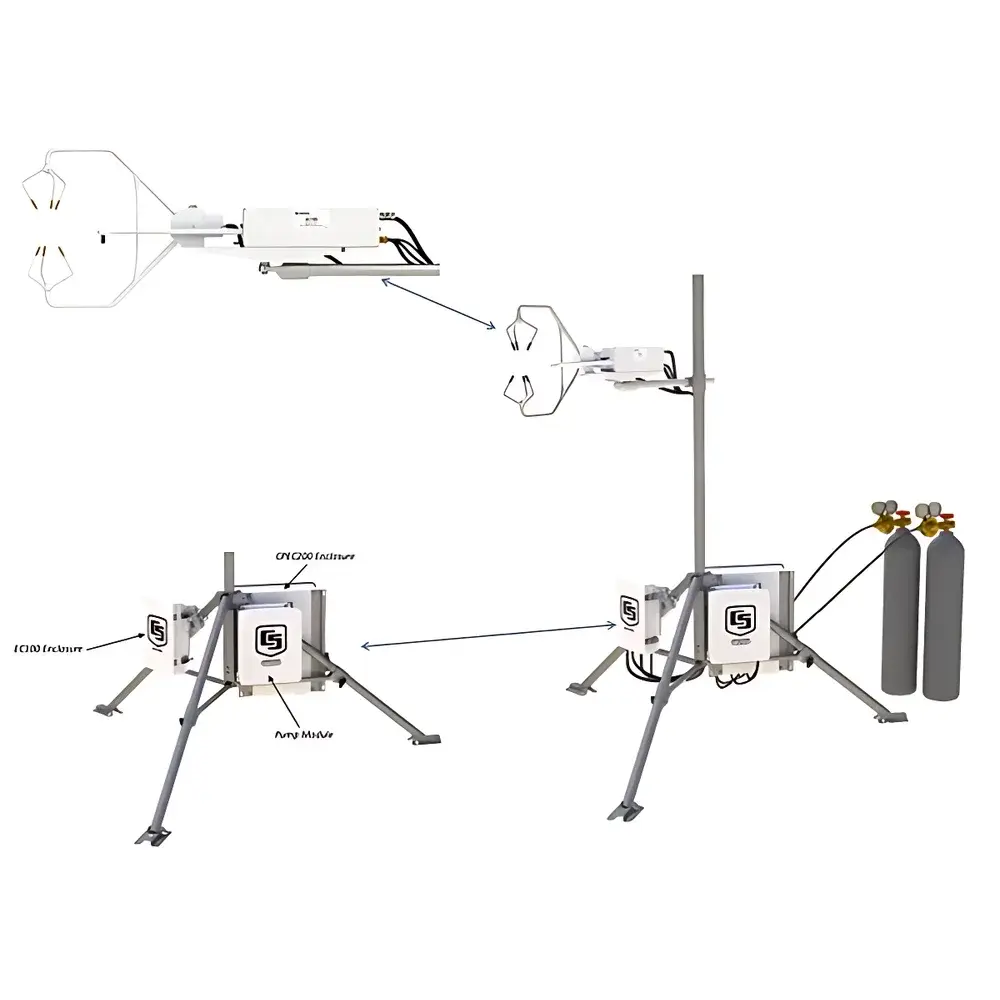
Campbell Scientific CPEC200 Closed-Path Eddy Covariance System
| Brand | Campbell Scientific |
|---|---|
| Origin | USA |
| Model | CPEC200 |
| Operating Temperature | −30 °C to +50 °C |
| Input Voltage | 10.5–16.0 Vdc |
| Typical Power Consumption | 12 W (max 35 W cold start) |
| System Dimensions | 52.1 × 44.5 × 29.7 cm |
| System Weight | 11.6 kg |
| Pump Module Flow Rate | 3–9 LPM (typ. 7 LPM) |
| Pump Pressure Range | 15–115 kPa |
| Valve Modules | 3-valve (zero, CO₂ span, H₂O span) or 6-valve (zero, four CO₂ spans, one H₂O span) |
| Data Storage | 2 GB CompactFlash card (≥60 days at 10 Hz) |
| Communication Interfaces | Ethernet, RS-232, short-haul modem, cellular, radio, satellite |
Overview
The Campbell Scientific CPEC200 Closed-Path Eddy Covariance System is a rigorously engineered field-deployable platform for high-temporal-resolution measurement of vertical turbulent fluxes of carbon dioxide (CO₂), water vapor (H₂O), sensible heat, and latent heat between the Earth’s surface and the atmospheric boundary layer. It operates on the eddy covariance principle—quantifying covariance between high-frequency (10 Hz) orthogonal wind velocity components (measured by the CSAT3A ultrasonic anemometer) and simultaneously sampled gas concentrations (measured by the EC155 closed-path infrared gas analyzer). Unlike open-path systems, the CPEC200 draws air through heated, temperature-controlled tubing into the EC155’s optical cell, eliminating path-length variability and enabling precise control over sample conditioning—including pressure, temperature, and dew point—critical for trace gas quantification under variable ambient conditions. The system is architected for long-term unattended operation in remote, climatically extreme environments—from arctic tundra to tropical forests—and meets foundational requirements for FLUXNET, ICOS, and AmeriFlux network compliance.
Key Features
- Integrated hardware architecture: CSAT3A 3D ultrasonic anemometer synchronized with EC155 dual-channel CO₂/H₂O analyzer via precision timing signals from the CR3000 datalogger.
- Active sample conditioning: Heated inlet lines (up to 50 °C), thermoelectrically cooled detector, and pressure-regulated sample flow ensure stable optical path transmission and minimize condensation-induced signal drift.
- Automated calibration infrastructure: Onboard 3-valve or 6-valve manifold enables scheduled zero-air injection and multi-point CO₂/H₂O span calibration without manual intervention—supporting GLP-aligned calibration traceability.
- Low-power, robust power management: Operates continuously at ≤12 W nominal; cold-start surge limited to 35 W for <60 s; compatible with solar-charged battery systems for multi-month deployments.
- Embedded firmware intelligence: CR3000 executes pre-compiled eddy covariance processing routines—including coordinate rotation, spectral correction, WPL density corrections, and flux partitioning—reducing post-processing burden.
- Multi-protocol telemetry: Native support for Ethernet, RS-232, cellular (LTE-M/NB-IoT), UHF radio, Iridium satellite, and legacy landline modems enables flexible remote diagnostics and data retrieval.
Sample Compatibility & Compliance
The CPEC200 is validated for continuous measurement of CO₂ (0–2000 ppm) and H₂O (0–30 mmol mol⁻¹) across diverse biomes, including croplands, wetlands, boreal forests, and alpine meadows. Its closed-path design eliminates cross-sensitivity to rain, dust, and aerosol scattering—key advantages over open-path alternatives in high-humidity or particulate-laden environments. All analog and digital signal paths comply with IEC 61000-6-2 (EMC immunity) and IEC 61000-6-4 (EMC emissions). Data provenance adheres to FAIR principles: time stamps are GPS-synchronized (±10 µs), raw sensor outputs are stored with full metadata (temperature, pressure, flow rate, valve state), and audit logs record all calibration events. The system supports 21 CFR Part 11–compliant electronic signatures when configured with Campbell’s LoggerNet software and secure authentication protocols.
Software & Data Management
Data acquisition, real-time quality control, and basic flux computation are handled onboard the CR3000 using Campbell’s Edlog and PakBus protocols. Raw 10 Hz time series are stored on industrial-grade CompactFlash (2 GB standard, expandable) with cyclic overwrite protection. Post-acquisition processing leverages EddyPro® (Li-Cor) or TK3 (University of Reading) for advanced spectral filtering, planar-fit coordinate rotation, and uncertainty propagation. Campbell’s PC-based LoggerNet software provides secure remote configuration, firmware updates, and automated data export to CSV, NetCDF, or SQL databases. All calibration sequences, pump status, and valve actuation events are logged with ISO 8601 timestamps and retained for regulatory review.
Applications
- Long-term carbon budget assessment in managed and natural ecosystems per IPCC Tier 2/3 reporting guidelines.
- Validation of satellite-derived evapotranspiration (ET) products (e.g., MOD16, SSEBop) and land surface models (CLM, Noah-MP).
- Soil–plant–atmosphere continuum studies requiring concurrent CO₂ assimilation and transpiration fluxes.
- Urban flux tower networks evaluating anthropogenic CO₂ emissions and building energy exchange.
- Climate change impact studies monitoring phenological shifts in net ecosystem exchange (NEE) across elevation gradients.
- Regulatory air quality monitoring where trace gas flux attribution supports emission inventory refinement (e.g., EPA GHG Reporting Program).
FAQ
What is the minimum recommended sampling height for CPEC200 deployment?
Typical installation requires mounting the CSAT3A and EC155 inlet at least 2 m above vegetation canopy or roughness elements to satisfy Monin–Obukhov similarity theory assumptions.
Can the CPEC200 measure methane (CH₄) or other trace gases?
No—the EC155 is optimized exclusively for CO₂ and H₂O. For CH₄, users must integrate a tunable diode laser (TDL) or cavity ring-down spectrometer (CRDS) with compatible analog/digital I/O and synchronization capability.
Is the CR3000 datalogger replaceable with newer Campbell models?
Yes—CR6 and CR1000X are backward-compatible with CPEC200 sensor wiring and Edlog programs; firmware updates and expanded memory improve long-term stability and processing depth.
How often should zero/span calibration be performed?
Field best practice recommends daily zero checks and weekly multi-point spans under stable ambient conditions; frequency increases in high-dust or high-humidity settings per QA/QC protocols in AmeriFlux Manual v7.
Does the system meet ISO 17025 requirements for accredited laboratories?
While the CPEC200 itself is not ISO/IEC 17025-certified as a test instrument, its metrological traceability (NIST-traceable calibration gases, documented uncertainty budgets, and full audit trails) satisfies Clause 6.5.2 for measurement equipment used within accredited environmental testing labs.
Related Products







