
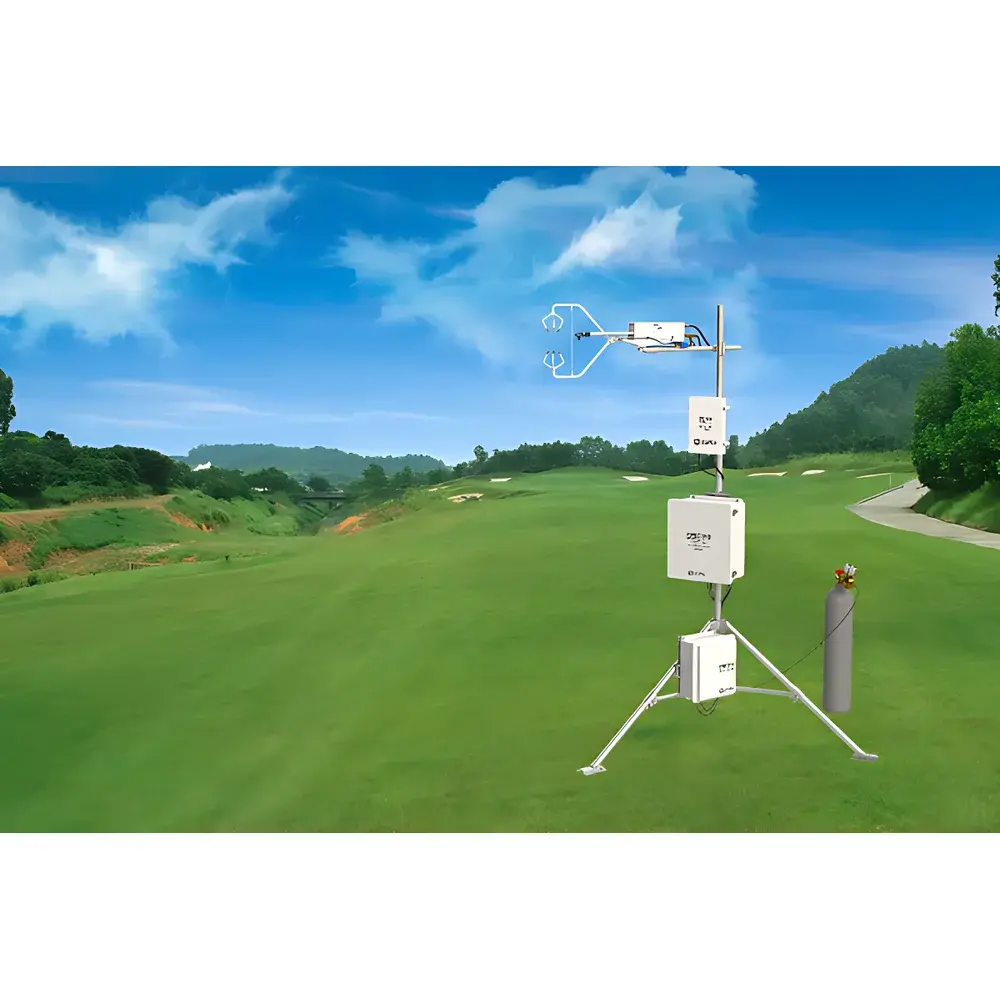
Campbell Scientific CPEC310 Closed-Path Eddy Covariance Flux System
| Brand | Campbell Scientific |
|---|---|
| Origin | USA |
| Model | CPEC310 |
| Operating Temperature Range | −30 °C to +50 °C |
| Input Voltage | 10.5–16.0 V DC |
| Typical Power Consumption | 12 W |
| Max Power (Cold Start) | 35 W |
| Sample Cell Volume | 5.9 mL |
| Sample Residence Time | 50 ms @ 7 L/min |
| Frequency Response (−3 dB) | 5.8 Hz (CO₂/H₂O) |
| Cut-off Frequency (System) | 4.3 Hz |
| Pump Flow Rate | 3–9 L/min (Auto-Controlled, Default: 7 L/min) |
| Pressure Sensor Range | 15–115 kPa |
| Enclosure Dimensions (Control Box) | 54 × 44.5 × 29.7 cm |
| Weight (Control Box) | 15.36 kg (16.24 kg w/ CDM-A116) |
| Pump Module Dimensions | 35.6 × 29.2 × 13.5 cm |
| Weight (Pump Module) | 5.4 kg |
| Three-Valve Module Dimensions | 14.0 × 12.7 × 14.0 cm |
| Weight | 1.5 kg |
| Scrubber Module Heater Power | 8 W |
| Molecular Sieve Bead Size | 1.6–2.5 mm |
| Scrubber Cylinder Volume | 480 cm³ |
Overview
The Campbell Scientific CPEC310 is a fully integrated, closed-path eddy covariance (EC) flux measurement system engineered for long-term, unattended monitoring of turbulent exchange of carbon dioxide (CO₂), water vapor (H₂O), sensible heat, and momentum across the atmospheric boundary layer. It operates on the fundamental principle of high-frequency covariance computation between vertical wind velocity (measured via ultrasonic anemometry) and scalar gas concentrations (measured via infrared absorption spectroscopy). Unlike open-path systems, the CPEC310 draws air through a heated, temperature-controlled sample line into a compact, thermostatically stabilized EC155 closed-path CO₂/H₂O analyzer—enabling precise quantification under variable ambient humidity and aerosol loading conditions. Its design prioritizes measurement fidelity, operational robustness, and energy efficiency, with a total system power draw of only 12 W under typical field conditions—a critical advantage for remote, solar-powered deployments.
Key Features
- Integrated hardware architecture comprising the EC155 closed-path CO₂/H₂O analyzer, CSAT3A 3D sonic anemometer, CR6 data logger, precision three-valve calibration module, dual-head diaphragm pump module, and optional CDM-A116 analog input expansion module.
- Patented vortex inlet (U.S. Patent No. 9,217,692) eliminating inline particulate filters while preserving high-frequency response—reducing maintenance intervals and minimizing flow-induced phase lag.
- Ultra-small 5.9 mL sample cell volume enabling 50 ms residence time at 7 L/min, yielding a system bandwidth of 5.8 Hz (−3 dB) for CO₂ and H₂O—sufficient for accurate flux computation up to 20 Hz sampling rates.
- Automated zero and span calibration capability for CO₂ via the three-valve module; manual H₂O span adjustment supported with optional scrubber module for automated zeroing of both gases.
- CR6-based control logic with embedded EasyFlux™ DL firmware performing real-time flux processing—including Webb-Pearman-Leuning (WPL) correction, coordinate rotation, spectral correction, and high-frequency loss compensation per standard EC protocols (e.g., ICOS, AmeriFlux).
- Modular enclosure design: fiberglass weatherproof control box houses CR6, pump, valves, and optional CDM-A116; separate EC100 processor unit handles advanced post-processing and QA/QC flagging.
Sample Compatibility & Compliance
The CPEC310 is designed for deployment in diverse terrestrial ecosystems—from forest canopies and agricultural fields to tundra and urban boundary layers—and conforms to internationally recognized flux measurement standards. Its closed-path configuration ensures compliance with ISO 17025-accredited laboratory traceability requirements when paired with NIST-traceable span gases and certified zero air. The system supports full audit trails for calibration events, sensor diagnostics, and environmental metadata logging—aligning with GLP and GMP principles where applicable. Data provenance meets requirements for submission to global networks including FLUXNET, ICOS, and AmeriFlux. All firmware and EasyFlux™ DL software are validated against USDA-ARS and NOAA benchmark datasets, and raw high-speed time series (20 Hz) are stored in netCDF-4 format with CF-1.8 metadata conventions.
Software & Data Management
EasyFlux™ DL runs natively on the CR6 data logger, executing flux calculations, quality control (QC) flagging (e.g., spike detection, stationarity tests), and gap-filling using marginal distribution sampling (MDS) or neural network interpolation. Processed fluxes (CO₂, H₂O, heat, momentum) are output as hourly and daily aggregates with uncertainty estimates derived from block bootstrapping. Raw 20 Hz time series are archived locally on microSD card and optionally transmitted via cellular or satellite telemetry using Campbell’s PakBus or MQTT protocols. Post-deployment analysis is supported by PC-based LoggerNet and Python-compatible libraries (e.g., pyflux, ec_tools) that ingest Level 1 (raw) and Level 2 (QC’d) netCDF files. Full compliance with FDA 21 CFR Part 11 is achievable through optional electronic signature modules and audit-log-enabled firmware configurations.
Applications
- Long-term carbon and water budget quantification in eddy covariance flux towers (ICOS Tier 1–3 sites).
- Evaluation of land-use change impacts on ecosystem-scale gas exchange (e.g., afforestation, bioenergy cropping, peatland restoration).
- Model validation for regional climate simulations and Earth system models (e.g., CESM, CLM5).
- Urban meteorology studies assessing anthropogenic CO₂ emissions and latent heat partitioning.
- Controlled-environment agriculture research requiring high-temporal-resolution evapotranspiration monitoring.
- Calibration reference systems for airborne or drone-based flux mapping campaigns.
FAQ
Does the CPEC310 support automatic H₂O span calibration?
No—H₂O span calibration is performed manually using certified humidity standards. However, the optional scrubber module enables fully automated zeroing of both CO₂ and H₂O.
What is the minimum recommended sampling height for tower deployment?
The system is height-agnostic; optimal placement follows Monin–Obukhov similarity theory guidelines—typically ≥2× canopy height for vegetated surfaces, or ≥10 m above ground level in open terrain.
Can the CPEC310 operate continuously in sub-zero environments?
Yes—the EC155 analyzer, CSAT3A anemometer, and CR6 logger are all rated for operation down to −30 °C, with active heating of sample lines and valves maintaining thermal stability.
Is the three-valve module required for basic operation?
It is integral to the CPEC310’s core functionality: without it, automated zero/span correction is not possible, compromising long-term data continuity and reducing compliance with FLUXNET QA/QC protocols.
How does the vortex inlet improve frequency response compared to traditional filter-based inlets?
By eliminating mechanical filtration, the vortex inlet avoids pressure drop-induced damping and inertial lag—preserving signal coherence up to 5.8 Hz and reducing low-pass filtering artifacts inherent in conventional designs.
Related Products







