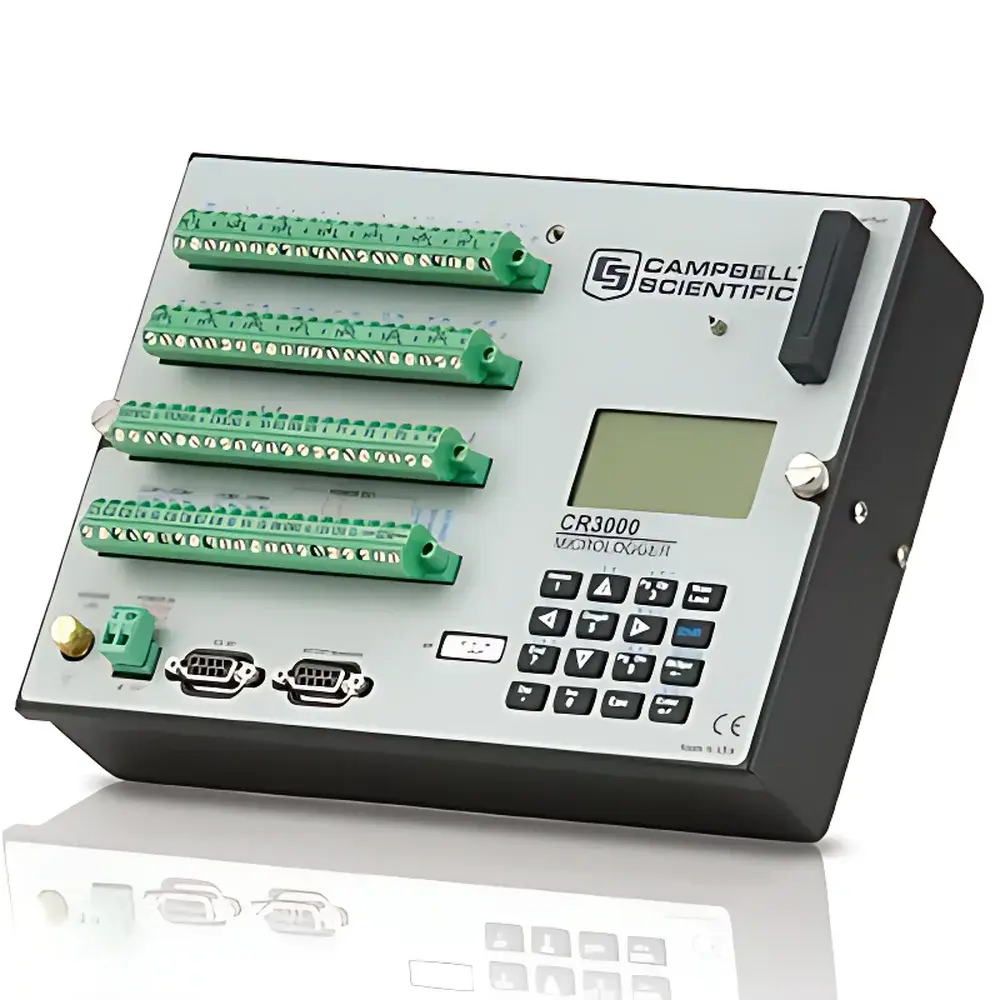
Campbell Scientific CR3000 Data Acquisition System
| Brand | Campbell Scientific |
|---|---|
| Origin | USA |
| Model | CR3000 |
| Analog Input Channels | 28 single-ended (14 differential) |
| Analog Voltage Range | ±5000 mV |
| Analog Resolution | 0.33 µV |
| A/D Resolution | 16-bit |
| Maximum Scan Rate | 100 Hz |
| Pulse Count Channels | 4 |
| Switched Excitation Outputs | 4 voltage, 3 current |
| Control Ports | 3 SDM, 8 I/O |
| Communication Interfaces | CS I/O, RS-232, Ethernet (optional), RF radio (optional), CDMA/GPRS (optional), satellite (optional) |
| Supported Protocols | PakBus, Modbus RTU/ASCII/TCP, DNP3, FTP, HTTP, XML, POP3, SMTP, Telnet, NTP, NTCIP, SDI-12, SDM |
| Memory | 4 MB internal |
| Power Consumption | 2 mA (sleep), 3 mA (1 Hz), 10 mA (100 Hz) |
| Environmental Compliance | CE, EMC, GDT input protection |
| Real-Time Clock | Temperature-compensated, battery-backed |
| Data Storage Format | Tabular (timestamp + record number) |
| Operating Temperature | 0–40 °C |
| Software Compatibility | LoggerNet 3.4/4.0, PC400 1.2, ShortCut 2.2 |
Overview
The Campbell Scientific CR3000 Data Acquisition System is a field-deployable, microcontroller-based measurement and control platform engineered for high-reliability environmental and industrial monitoring applications. Built around a 16-bit microcontroller with a 32-bit internal CPU architecture, the CR3000 executes measurement sequences, performs on-board calculations, and manages data storage and communications autonomously. Its core measurement principle relies on precision analog-to-digital conversion (16-bit resolution) with programmable gain, offset compensation, and temperature-stabilized reference circuitry—ensuring traceable accuracy across extended deployment periods and variable ambient conditions. Designed for unattended operation in remote or harsh environments, the CR3000 integrates a built-in LCD display and membrane keyboard for local configuration and diagnostics, eliminating dependency on external computers during initial setup or field troubleshooting. The system’s embedded real-time clock features temperature compensation and battery-backed SRAM, maintaining time integrity and preserving program logic and stored data—even during complete power loss.
Key Features
- Integrated human-machine interface: Backlit monochrome LCD and tactile keypad enable direct field programming, status verification, and real-time data review without auxiliary hardware.
- Robust signal conditioning architecture: Supports 28 single-ended or 14 differential analog inputs with ±5000 mV range, 0.33 µV effective resolution, and accuracy specified as ±(0.04% of reading + offset) over 0–40 °C.
- Flexible excitation capability: Four voltage-switched and three current-switched excitation outputs accommodate a wide range of sensors—including bridge-based transducers, thermistors, and 4–20 mA loop devices.
- High-speed timing and counting: Four pulse-counting channels support frequency, period, and event accumulation measurements up to 100 Hz scan rate, suitable for anemometers, flow meters, and rotational speed sensors.
- Multi-layer communication stack: Native support for PakBus (Campbell’s peer-to-peer mesh protocol), Modbus RTU/ASCII/TCP, DNP3, FTP, HTTP, NTP, and SDI-12 ensures interoperability with SCADA systems, cloud platforms, and third-party telemetry infrastructure.
- Field-hardened electrical protection: Gas Discharge Tube (GDT)-based transient suppression on all analog and digital inputs complies with EN 61000-4-5 surge immunity requirements and meets CE/EMC directives for electromagnetic compatibility.
- Non-volatile data integrity: 4 MB of internal memory stores tabular datasets indexed by timestamp and sequential record number; battery-backed SRAM retains firmware, configuration, and clock state during main power interruption.
Sample Compatibility & Compliance
The CR3000 interfaces with industry-standard analog, digital, and serial sensors used in micrometeorology, eddy covariance flux towers, agricultural phenotyping, transportation dynamics testing, and aerospace ground instrumentation. It natively supports SDI-12 sensors (e.g., soil moisture probes, water level transducers), SDM peripherals (multiplexers, GPS receivers), and Modbus slave devices without protocol translation gateways. From a regulatory standpoint, the CR3000 conforms to CE marking requirements under the EMC Directive 2014/30/EU and Low Voltage Directive 2014/35/EU. Its design incorporates galvanic isolation on critical I/O lines and adheres to IEC 61000-6-2 (immunity) and IEC 61000-6-4 (emissions) standards. While not certified for SIL or ATEX environments, its robust construction and fail-safe watchdog timer make it suitable for Class I, Division 2 installations when deployed with appropriate barriers.
Software & Data Management
Data acquisition and system management are performed using Campbell Scientific’s validated software suite: LoggerNet (v3.4/4.0) for centralized networked deployments, PC400 (v1.2) for single-station configuration and live data viewing, and ShortCut (v2.2) for rapid sensor-specific program generation. All software packages enforce structured project files, version-controlled program uploads, and audit-trail-capable operational logging. LoggerNet supports automated data retrieval via scheduled PakBus or FTP transfers, with optional encryption (TLS/SSL) and metadata tagging compliant with ISO 19115 geospatial standards. Raw binary data files are converted into ASCII-tab-delimited tables containing timestamps (UTC or local), record numbers, and calibrated engineering units—facilitating direct import into MATLAB, Python (Pandas), R, or commercial statistical analysis tools. Firmware updates are delivered as signed binaries to ensure integrity and traceability.
Applications
The CR3000 serves as the central data hub in long-term environmental observatories, including AmeriFlux and ICOS eddy covariance networks, where synchronization accuracy, low-power operation, and deterministic timing are critical for turbulent flux computation. In precision agriculture, it logs multi-sensor arrays measuring canopy temperature, soil water potential, and photosynthetically active radiation (PAR) at sub-minute intervals. Transportation engineers deploy it for vehicle dynamics testing—acquiring synchronized strain, acceleration, and thermal data from instrumented test tracks. Within aerospace ground support, the CR3000 monitors structural health metrics (e.g., vibration spectra, thermal gradients) during static engine tests and wind tunnel campaigns. Its modular expansion via SDM peripherals also enables scalable integration into smart infrastructure projects, such as bridge deflection monitoring or landslide early-warning systems.
FAQ
What is the maximum sampling rate achievable per analog channel?
The CR3000 supports a global scan rate of up to 100 Hz; individual channel sampling rates depend on the total number of active measurements per scan and the selected settling time—typically ranging from 10 ms to 1 s per channel.
Can the CR3000 operate independently without a host computer?
Yes. Once programmed and deployed, the CR3000 runs autonomously—executing measurement routines, storing data locally, and initiating scheduled communications without continuous PC connectivity.
Is the CR3000 compatible with modern IT security policies (e.g., firewall traversal, TLS)?
While native Ethernet support requires optional add-on modules, LoggerNet 4.0 enables TLS-secured FTPS and HTTPS data uploads. PakBus over TCP/IP can be tunneled through standard firewalls using port forwarding or reverse proxy configurations.
How is calibration traceability maintained over multi-year deployments?
The CR3000 supports scheduled background calibration routines that compensate for thermal drift and aging effects. Users may log raw ADC counts alongside calibrated values, enabling retrospective reprocessing using updated coefficients per NIST-traceable sensor documentation.
Does the CR3000 meet FDA 21 CFR Part 11 requirements for electronic records?
The CR3000 itself is not Part 11–certified; however, when integrated with LoggerNet in a validated environment—including user access controls, electronic signatures, and audit trail configuration—it forms part of a compliant data acquisition system for regulated life science or pharmaceutical applications.