
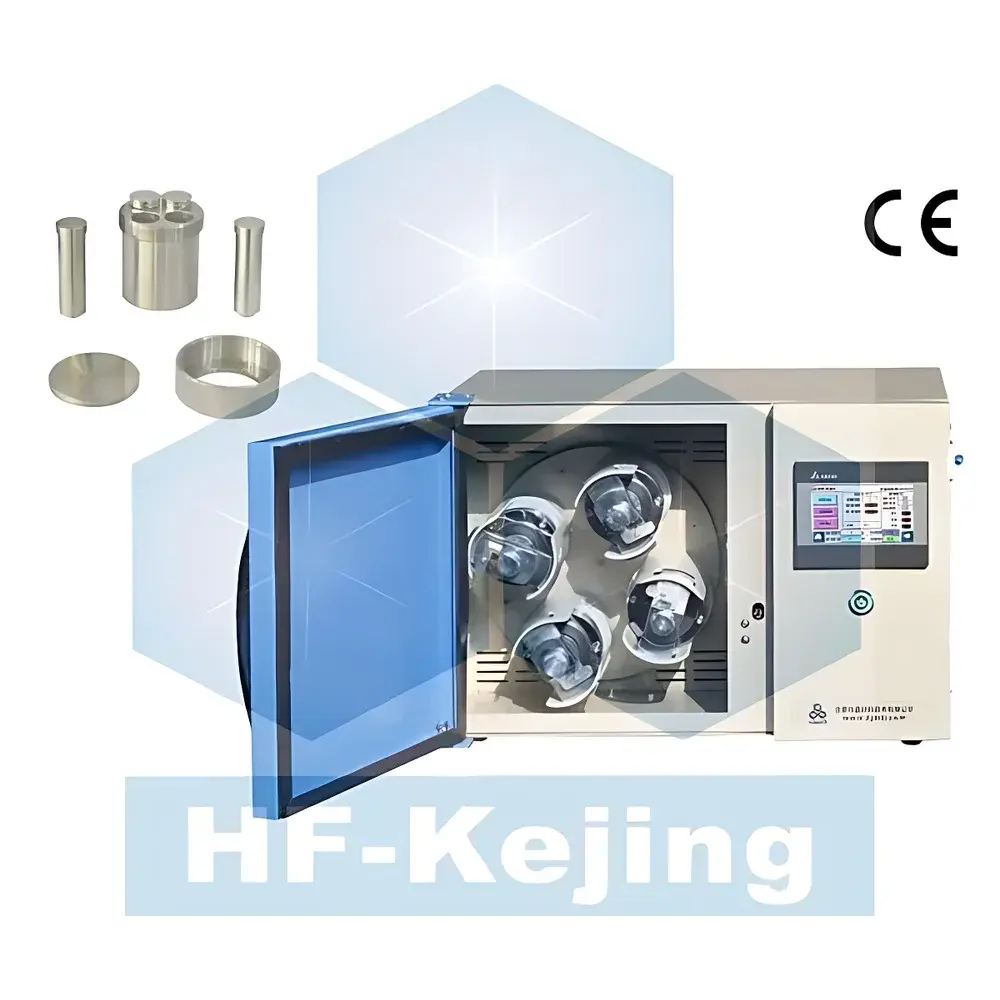
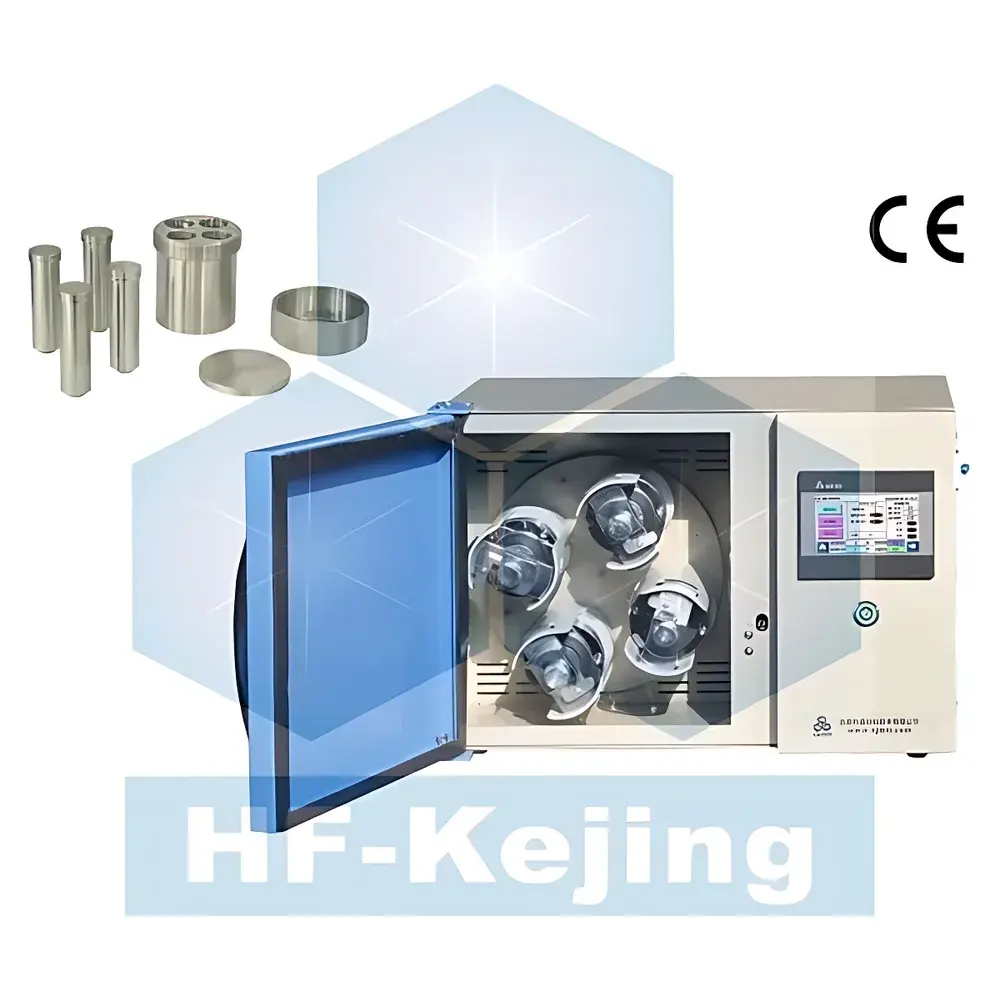
KJ GROUP MSK-SFM-13S High-Throughput Desktop Planetary Ball Mill
| Brand | KJ GROUP |
|---|---|
| Origin | Liaoning, China |
| Model | MSK-SFM-13S |
| Instrument Type | Planetary Ball Mill |
| Sample Applicability | Hard and brittle materials |
| Feed Size | <10 mm (brittle), <3 mm (other materials) |
| Output Particle Size | Wet grinding: avg. particle size <1 µm |
| Dry grinding | avg. particle size <20 µm |
| Batch Capacity | 160 mL |
| Operating Voltage | 208–240 V AC, single-phase, 50/60 Hz |
| Power Consumption | ≤550 W |
| Revolution Speed | 50–400 rpm (adjustable) |
| Rotation Speed | 100–800 rpm (adjustable) |
| Speed Ratio | Revolution : Rotation = 1 : 2 |
| Programmable Stages | 10 stored programs |
| Speed Control | 5-step digital speed regulation |
| Direction Control | Clockwise / Counterclockwise selectable |
| Dimensions (L×W×H) | 500 × 350 × 330 mm |
| Net Weight | 60 kg |
| Transport Dimensions | 762 × 711 × 660 mm (30″ × 28″ × 26″) |
| Shipping Weight | 90 kg |
Overview
The KJ GROUP MSK-SFM-13S High-Throughput Desktop Planetary Ball Mill is an engineered solution for rapid, reproducible mechanical alloying, homogenization, size reduction, and powder synthesis in research and development laboratories. Based on the planetary motion principle—where grinding jars rotate around a central axis while simultaneously rotating on their own axes—the instrument generates high centrifugal acceleration (up to 40 g) and intense impact/shear forces between grinding media and sample material. This dual-axis kinematic architecture enables efficient energy transfer, facilitating nanoscale particle refinement and uniform dispersion of multi-component systems. Designed for benchtop deployment, the MSK-SFM-13S integrates four independent grinding stations, each accommodating four standardized stainless-steel jars, enabling parallel processing of up to 16 discrete samples per cycle—significantly accelerating screening workflows in materials science, catalysis, battery electrode development, and ceramic formulation.
Key Features
- Four synchronized planetary grinding stations with symmetrical mass-balanced configuration to ensure mechanical stability and minimize vibration-induced wear.
- High-precision touch-screen controller supporting multi-stage programmable operation: adjustable revolution speed (50–400 rpm), rotation speed (100–800 rpm), directional selection (CW/CCW), time setting (1 min–99 h 59 min), and up to 10 user-defined protocols with auto-start/stop functionality.
- Digital real-time display of operational parameters including speed, elapsed time, and direction status—enabling precise process documentation for GLP-compliant environments.
- Robust aluminum alloy housing with reinforced steel baseplate and anti-slip rubber feet for secure placement on standard laboratory benches.
- Integrated safety interlocks: automatic shutdown upon lid opening or abnormal load detection, compliant with IEC 61000-6-2 electromagnetic compatibility standards.
Sample Compatibility & Compliance
The MSK-SFM-13S accommodates a broad spectrum of inorganic and organic solids, including metals, oxides, carbides, polymers, pharmaceutical excipients, and geological minerals. For optimal performance and contamination control, jar and media selection must align with sample chemistry: stainless-steel jars and balls are suitable for metallic alloys and non-reactive compounds; alumina or zirconia jars and grinding media are recommended for oxide-based ceramics, catalysts, and alkaline-sensitive materials; nylon jars provide low-density, non-sparking containment for soft organics or electrostatically sensitive powders. The system supports both dry and wet grinding modes. All configurations adhere to ASTM E11-22 (specifications for test sieves) and ISO 13320:2020 (laser diffraction particle size analysis) pre-processing requirements. While not certified to FDA 21 CFR Part 11 out-of-the-box, audit-ready operation logs can be exported via USB for integration into validated quality management systems.
Software & Data Management
The embedded controller does not require external software but supports manual data logging through timestamped parameter records stored internally (retention: last 100 cycles). Exportable runtime summaries—including total operating hours, average speed profiles, and program execution history—are accessible via USB interface for traceability in regulated settings. Optional third-party integration with LabArchives or ELN platforms is achievable using ASCII-formatted log files. No cloud connectivity or remote monitoring is implemented, preserving data sovereignty and aligning with institutional IT security policies.
Applications
- Rapid synthesis of metastable phases via mechanical alloying (e.g., Al–Fe, Mg–Ni hydride precursors).
- Homogenization of composite cathode slurries for Li-ion battery R&D.
- Size reduction and crystallinity modification of pharmaceutical APIs prior to dissolution testing (USP <711>).
- Preparation of nanostructured ceramic green bodies for sintering studies.
- Mineral liberation analysis in geochemical prospecting workflows.
- Recycling-oriented comminution of spent lithium cobalt oxide cathodes under inert atmosphere (compatible with optional glovebox integration).
FAQ
What is the maximum safe rotational imbalance tolerance during operation?
The unit requires symmetrical loading: either all four stations occupied with matched-mass jars, or two diametrically opposed stations loaded identically. Single-jar operation is prohibited without counterbalancing.
Can the MSK-SFM-13S achieve sub-100 nm particle sizes?
Sub-100 nm median diameters are attainable in wet grinding with optimized parameters (e.g., zirconia media, extended duration >8 h, surfactant-assisted dispersion), though final size distribution depends strongly on material hardness, fracture toughness, and agglomeration behavior.
Is the device compatible with inert gas purging?
Yes—jars with O-ring sealed lids (e.g., SS304, alumina) support vacuum or argon/nitrogen backfilling when used with optional gas-tight adapters.
What maintenance intervals are recommended for long-term reliability?
Lubrication of gear trains every 500 operational hours; visual inspection of belt tension and jar clamping mechanisms before each use; replacement of worn rubber dampening pads every 2 years under continuous operation.
Are calibration certificates available for speed and timing accuracy?
Factory-calibrated speed sensors meet ±1% full-scale accuracy per IEC 60068-2-6; NIST-traceable calibration reports are available upon request at additional cost.



