
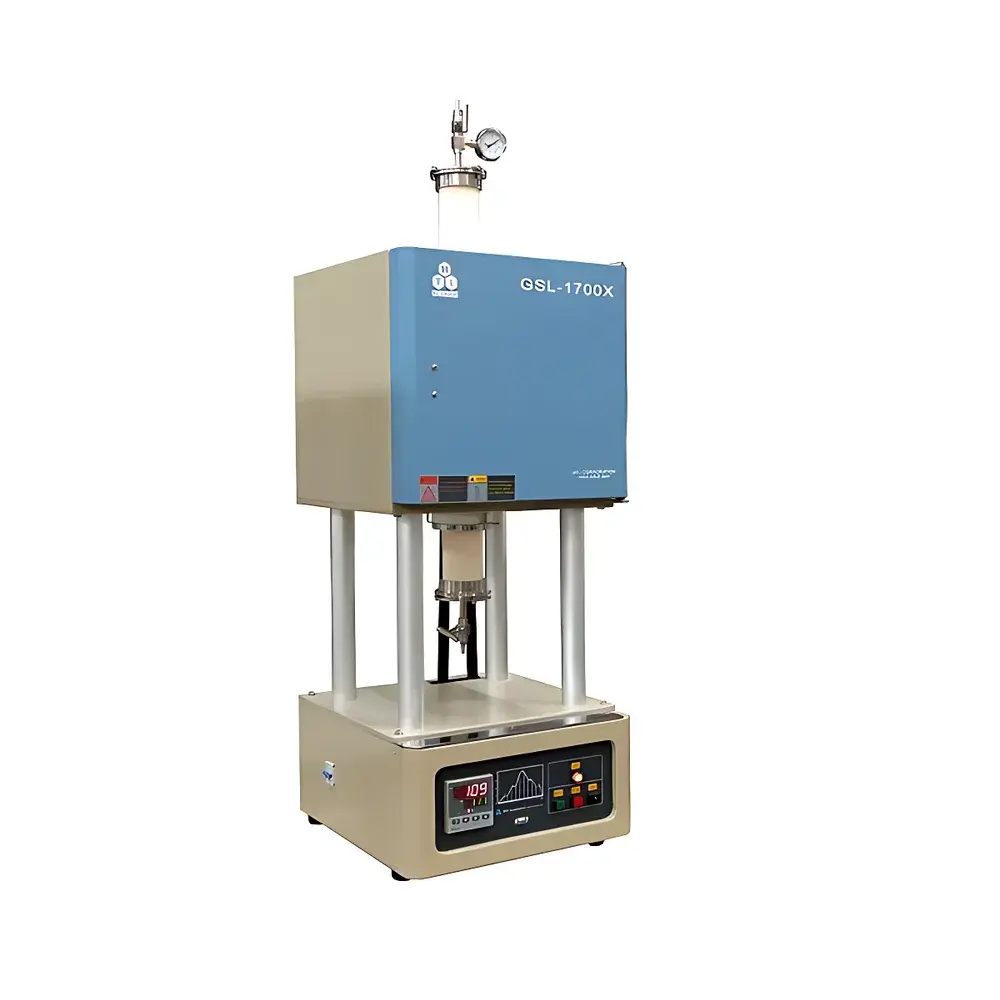
KJ GROUP GSL-1700X-80VT Vertical High-Temperature Tube Furnace
| Brand | KJ GROUP |
|---|---|
| Origin | Liaoning, China |
| Manufacturer Type | Authorized Distributor |
| Country of Origin | China |
| Model | GSL-1700X-80VT |
| Heating Element | U-shaped MoSi₂ rods |
| Max Temperature | 1700 °C (≤1 h), Continuous Range: 800–1600 °C |
| Control Accuracy | ±1 °C |
| Temperature Program | 30-segment PID |
| Heating Zone Length | 150 mm |
| Uniform Zone Length | 50 mm |
| Tube Dimensions | 80 mm OD × 72 mm ID × 800 mm L (Al₂O₃ ceramic) |
| Power Supply | AC 220 V, 50/60 Hz, 4 kW |
| External Dimensions | 490 × 490 × 1130 mm |
| Weight | 150 kg |
| Safety Certification | CE-compliant |
| Cooling | Dual-layer housing with forced-air circulation |
| Surface Temp | <60 °C |
| Thermocouple Type | B-type (Pt/Rh) |
| Vacuum/Atmosphere Compatibility | Yes (with optional gas fittings) |
Overview
The KJ GROUP GSL-1700X-80VT is a vertically oriented high-temperature tube furnace engineered for precise thermal processing under controlled vacuum or reactive/inert atmosphere conditions. Designed around a robust U-shaped molybdenum disilicide (MoSi₂) heating element architecture, it achieves stable operation up to 1700 °C for short-duration treatments and sustained operation between 800 °C and 1600 °C—making it suitable for advanced materials synthesis, sintering, annealing, and chemical vapor deposition (CVD) precursor decomposition. Its vertical configuration optimizes gravitational uniformity during powder-based heat treatments and facilitates easy sample loading/unloading without horizontal tube translation. The furnace integrates a dual-shell enclosure with active air-cooling, ensuring surface temperatures remain below 60 °C during full-power operation—a critical safety feature for laboratory environments where proximity handling is routine.
Key Features
- Dual-layer stainless steel housing with integrated axial fan-driven cooling system, maintaining external shell temperature <60 °C even at 1700 °C internal setpoint.
- High-purity alumina (Al₂O₃) ceramic tube (80 mm OD / 72 mm ID / 800 mm L) rated for continuous use up to 1600 °C; internally coated with proprietary US-sourced alumina slurry to enhance infrared emissivity and thermal stability.
- PID-based temperature controller supporting up to 30 programmable ramp-hold segments, enabling complex thermal profiles required for crystallization kinetics studies, phase transformation analysis, and multi-step CVD processes.
- B-type thermocouple (platinum-rhodium alloy) embedded in the hot zone for high-accuracy measurement across the full operational range; calibrated traceability supports ISO/IEC 17025-compliant lab documentation.
- CE-certified electrical design compliant with EN 61000-6-3 (EMC) and EN 61000-6-4 (immunity); includes over-temperature cutoff, ground-fault detection, and thermal fuse redundancy.
- Standard flange assembly features SS304 construction with Viton O-rings, rated for static vacuum down to 10⁻² mbar and positive pressure up to 0.1 MPa (gauge).
Sample Compatibility & Compliance
The GSL-1700X-80VT accommodates cylindrical samples, crucibles (graphite, alumina, zirconia), and substrate wafers up to 70 mm in diameter within its 50 mm isothermal zone. It is routinely deployed in academic and industrial labs conducting ASTM C1161-compliant flexural strength testing of refractory ceramics, ISO 11553-1–aligned laser crystal growth pre-annealing, and USP thermal stability assessment of pharmaceutical excipients. When configured with optional KF25 vacuum feedthroughs or double-ferrule gas fittings, the system meets GLP/GMP requirements for audit-ready process documentation—including electronic signature support via optional RS485/Modbus RTU interface integration.
Software & Data Management
While the standard unit operates via front-panel controller with local data logging (USB export), optional PC connectivity enables real-time monitoring and automated report generation using KJ GROUP’s FurnaceControl Suite v3.2. This Windows-based application complies with FDA 21 CFR Part 11 requirements when paired with user-authenticated login, electronic audit trail, and immutable parameter-lock functionality. All temperature profiles, dwell times, and alarm events are timestamped and exportable as CSV or PDF for regulatory submission or inter-lab method transfer.
Applications
- Synthesis and annealing of transition metal oxides (e.g., LiCoO₂, NMC cathodes) under Ar/H₂ atmospheres.
- Vacuum-assisted densification of SiC and AlN powders for power electronics packaging.
- Graphene and h-BN monolayer growth via atmospheric-pressure CVD on Cu/Ni foils.
- Thermal calibration of radiation pyrometers using blackbody cavity reference standards.
- Long-term aging studies of high-temperature superconductors per IEC 61788-11 protocols.
- In situ XRD-compatible sample holders (optional) for synchrotron beamline integration.
FAQ
What vacuum level can this furnace achieve with standard configuration?
With included mechanical pump interface and standard flange seals, base pressure reaches ≤1×10⁻² mbar. For ultra-high vacuum applications (<10⁻⁵ mbar), a turbomolecular pump and all-metal sealing upgrade are recommended.
Is the alumina tube replaceable, and what is its typical service life?
Yes—the tube is a consumable component designed for field replacement. Under continuous operation at 1500 °C in inert atmosphere, expected lifetime exceeds 200 cycles (≥1000 hours); degradation accelerates significantly in reducing or halogen-containing atmospheres.
Can the furnace be integrated into an automated process line?
Yes—via optional analog (4–20 mA) setpoint input and digital I/O signals for start/stop/pause, enabling synchronization with PLC-controlled gas manifolds, robotic sample handlers, or mass flow controllers.
Does the CE marking cover EMC and safety directives separately?
Yes—the certification includes compliance with both the Low Voltage Directive (2014/35/EU) and Electromagnetic Compatibility Directive (2014/30/EU), verified by TÜV Rheinland test reports available upon request.
What maintenance intervals are recommended for optimal thermal uniformity?
Biannual inspection of MoSi₂ rod resistance balance and thermocouple calibration drift is advised; annual re-torquing of flange bolts and O-ring replacement ensures vacuum integrity and thermal repeatability across extended campaigns.



